Industrial Policy, State–Business Relations and Tourism Development in the Maldives, 1972–2025
20 Nov 2026, 17:37 · by IzuCT · 35 min read · Research · EN

Tracing Maldives tourism policy from 1972 to 2025, this article examines how government transformed an emerging tourism sector into a high-value service-export industry. Introducing spatially mediated industrial policy, it highlights state coordination, private entrepreneurship and guesthouse liberalisation, while revealing persistent inequalities in economic opportunities, geographic access and environmental sustainability.
Ibrahim Zuhuree, PhD. (2026)
Abstract
Why did a geographically dispersed small island state become a leading exporter of high-value tourism services, and what does that experience reveal about industrial policy beyond manufacturing? This article examines the evolution of tourism policy in the Maldives from the sector’s emergence in 1972 to 2025. It adapts Evans’s four state roles—custodian, demiurge, midwife and husbandry—and his concept of embedded autonomy to an archipelagic, service-export economy. A documentary process-tracing design combines legislation, successive tourism plans, official tourism and monetary statistics, historical accounts and peer-reviewed case studies. The article develops the concept of spatially mediated industrial policy: governments shape tourism markets not only through incentives and coordination but through the allocation of access to islands, transport gateways and environmentally scarce coastal assets. The evidence supports three propositions. Private entrepreneurs initiated tourism before comprehensive planning; subsequent state actions helped organise and expand a resort-based export industry; and the regulatory opening for guesthouses altered access to tourism opportunities without eliminating inequalities in value creation or geographic connectivity. In 2025, tourist arrivals reached 2,246,516 and guesthouses held 24.5% of registered accommodation beds, but these measures do not establish equitable income distribution. Post-pandemic recovery, airport investment and the Fifth Tourism Master Plan demonstrate continued state coordination alongside unresolved sustainability and inclusion challenges. The analysis contributes a sector-specific account of how developmental state functions can coexist with selective access and contested distribution. The evidence warrants a mechanism-based interpretation, not a causal estimate of policy effects.
Keywords: industrial policy; Maldives; tourism development; embedded autonomy; small island developing states; state–business relations; tourism governance; guesthouses
1. Introduction
The Maldives has transformed tourism from an experimental activity undertaken by a small group of entrepreneurs in 1972 into a principal internationally traded service. The sector’s subsequent scale is striking. Official statistics record 1,125,202 tourist arrivals in 2013 and 2,246,516 in 2025; the latter year generated estimated travel receipts of US$5.57 billion (Maldives Bureau of Statistics [MBS], 2026; Maldives Monetary Authority [MMA], 2026). Yet aggregate growth is an incomplete account of the industry’s development. Tourism has also generated a distinctive land-leasing regime, geographically concentrated international gateways, separate resort-island and inhabited-island accommodation models, and recurring debates over labour, environmental costs and the distribution of returns.
This combination of export success and uneven access raises a question with wider implications for small island developing states (SIDS): how do state interventions construct and reshape an internationally competitive tourism industry when production relies on scarce, ecologically vulnerable and spatially dispersed assets? Research on industrial policy has traditionally emphasised manufacturing, technology and export performance. Newer scholarship recognises a broader repertoire of tools and highlights the significance of political constraints and governance capacity (Juhász, Lane, & Rodrik, 2024; Juhász & Lane, 2024). Tourism presents a useful test because the service is traded through the international movement of consumers, while the core production assets—beaches, islands, reefs, infrastructure and cultural settings—cannot be relocated.
A key empirical foundation is Zuhuree (2017), which combined cross-country and Maldives-specific models of international tourist flows with original survey and accommodation-price data. It found that tourist flows were comparatively more responsive to originating-market income and destination security than to price, and that transport infrastructure, service quality and environmental amenities were important for understanding tourism performance. These findings motivate—but do not substitute for—the present investigation of the public institutions and policy instruments that govern access to such productive assets (Zuhuree, 2017).
This article addresses two principal questions: (1) how was industrial policy for tourism formed and implemented in the Maldives, and (2) what does that process reveal about relationships between government and business interests? A third question connects these themes to the developmental consequences of policy: how have interventions shaped the spatial and distributional boundaries of participation in tourism? The framework builds on Hausmann and Rodrik (2003) and Evans (1995), while differentiating the political-institutional analysis undertaken here from existing empirical research on tourist demand, room pricing and environmental amenities.
Three arguments are advanced. First, the emergence of tourism was entrepreneur-led; state action was more clearly consequential in creating conditions for scaling, standardising and governing the new market than in making the initial discovery. Second, tourism policy operated through what this paper terms spatially mediated industrial policy: the allocation of islands, conditions of accommodation, licensing and gateway infrastructure affected which firms and communities could participate. Third, state–business coordination cannot itself demonstrate the embedded autonomy of the bureaucracy; close relationships may support investment and learning but can also heighten risks of preferential access, weak accountability and environmental externalities. The historical progression from isolated resort development to the formal admission of guesthouses on inhabited islands, and then to post-pandemic sustainability planning, makes these tensions observable.
The contribution is therefore not a claim that the Maldivian state single-handedly produced tourism growth. Rather, it is a framework for identifying the type, timing and distributional consequences of sector-specific state action in a service-export economy. The period ends on 31 December 2025. Later academic publications may be used to interpret evidence, but post-2025 tourism outcomes are excluded.
2. Literature and conceptual foundations
2.1 Industrial policy and discovery in tradable services
Hausmann and Rodrik (2003) identify self-discovery as an entrepreneurial process through which firms learn whether a previously untried activity can be produced competitively. Private pioneers bear experimentation costs, whereas entrants may imitate successful discoveries without bearing the same risks. The original Maldives case is consistent with the possibility of such a market failure: pioneers established the viability of holidaymaking in an archipelago lacking a mature tourism service sector. It does not, however, establish that imitation subsequently suppressed investment or that an entry restriction was optimal. Those propositions require information on entrepreneurial costs, rents, learning spillovers and the counterfactual pattern of entry that is absent from the available historical record.
Industrial policy is defined here as purposive public action intended to alter the composition, capabilities or organisation of productive activity, rather than all public spending or regulation that incidentally affects tourism. This includes selective control of tourism land, visitor accommodation regulations, infrastructure investments designed to support the destination, coordinated marketing and sector-specific training. The distinction matters: the provision of a universally accessible airport can support multiple sectors, while decisions about which islands may be leased or which businesses may accommodate international visitors are more clearly selective interventions. Juhász, Lane and Rodrik (2024) demonstrate that contemporary industrial policy analysis requires attention to the instrument, intended market failure, implementation capacity and credible evaluation design, not simply whether exports rose after the policy was introduced.
Tourism complicates the conventional division between traded and non-traded services. A meal, boat journey or hotel room is produced locally but can earn foreign exchange when purchased by an international visitor. Accordingly, services are exportable without shipping the service itself. The resulting development problem is not just to attract demand but to coordinate accommodation, aviation, maritime transport, environmental management, local supply chains and workforce skills. Such coordination needs coexist with significant risks: high import content, congestion, reef damage, unequal bargaining power and the concentration of commercial opportunities around gateways.
2.2 Evans’s four roles and the problem of embedded autonomy
Evans (1995) distinguishes four state roles. As custodian, the state establishes and enforces rules; as demiurge, it directly supplies or produces key goods and services; through midwifery, it encourages entry and formation of firms; and through husbandry, it sustains the capabilities of firms already operating. These are functional categories, not an evolutionary ladder or mutually exclusive stages. For example, the state may regulate resort construction, finance airport infrastructure and coordinate promotion simultaneously. For analytical clarity, the four roles are assessed through their instruments and predicted mechanisms rather than assigned to whole decades.
The related idea of embedded autonomy concerns the quality of state–society relationships: effective coordination requires bureaucratic capacity and useful links to productive actors without subordination to those actors. The existence of repeated meetings or high tourism receipts is insufficient evidence of autonomy. A demanding test also looks for transparent allocation, predictable rules, professional capacity, consistent enforcement and the ability to discipline firms when public and private interests diverge. Recent political-economy research similarly stresses that policy selection and implementation depend on governance constraints (Juhász & Lane, 2024). Bramwell (2011) adds that tourism governance is contested and spatially differentiated; it must be assessed in relation to multiple actors and long-run sustainability, not only investment growth.
2.3 Island spatiality, distribution and environmental limits
SIDS should not be portrayed only as intrinsically helpless or as uniform cases. Scheyvens and Momsen (2008) argue that island capacities and local agency may be obscured by a vulnerability-only narrative. At the same time, small populations, dispersed infrastructure, thin markets and fragile ecosystems can raise the costs of tourism coordination. In the Maldives, the one-island–one-resort model concentrated production within designated tourist spaces, while the formalisation of guesthouses on inhabited islands introduced a different interface between residents and international visitors. These models are not merely product categories: they structure land access, social contact, transport demand, regulation and opportunities for local businesses.
Maldivian research reveals why growth and inclusion must be separated. Shakeela, Ruhanen and Breakey (2011) identify labour-market and institutional obstacles to Maldivian employment in tourism. Chia and Muiz (2021) examine the operational challenges of guesthouses; Wong and Mohamed (2022) investigate quality assurance in the segment. Kothari and Edensor (2024) foreground the precarious position of migrant workers on a former resort island. More recent studies address access barriers in peripheral atolls (Rishan et al., 2024), pandemic shocks to guesthouse owners (Shareef et al., 2025) and differences between stakeholder views on sustainable domestic tourism (Hussain, Kim, & King, 2025). Together, they contest any assumption that increasing room counts automatically generates broadly shared prosperity.
An especially close contribution is Musthaq’s (2026) comparison of the Maldives and Seychelles, which argues that divergent conservation politics shaped tourism-growth strategies. Its comparative argument establishes an important alternative explanation for continued Maldivian capacity expansion: political coalitions and the institutionalisation of conservation matter, not only technical planning. The present article differs by tracing how four specific state roles and the geography of market access evolved within the Maldives over a longer historical sequence. It does not claim originality simply because the country has received limited scholarly attention.
2.4 Prior empirical evidence: tourist flows, room prices and environmental amenities
Zuhuree (2017) provides directly relevant econometric evidence that this political-economy analysis must take into account. Drawing on an international panel and a Maldives-specific tourism-demand model, the dissertation reports relatively inelastic tourism demand with respect to price, alongside greater sensitivity to tourist-origin income and security conditions. It also identifies positive associations between tourism-related infrastructure, domestic transport and visitor flows. These estimates show why evaluating industrial policy solely by accommodation supply or the number of international arrivals is incomplete: changes in external demand and connectivity may independently affect observed tourism growth. The findings refer to the dissertation’s historical sample and should not be assumed unchanged in 2025.
Its second contribution is a hedonic-pricing analysis combining accommodation information with field research on guesthouses, including a survey of 147 guesthouse managers across 24 islands. Zuhuree (2017) reports associations between room prices and beachfront location, beach cleanliness, waste management and tourism-relevant managerial training. These findings give empirical content to the concept of environmentally scarce, location-specific tourism assets: individual properties can capture some value from amenities whose maintenance requires collective action. They also point to congestion, free-riding and local public-service capacity as possible constraints on inhabited-island tourism. Unlike that dissertation, which primarily estimates tourism-flow and accommodation-price relationships, the present article analyses the political selection, institutional governance and distributional consequences of the policies that allocate access to islands, infrastructure and environmental assets.
2.5 Integrative framework and observable expectations
The framework links three levels: policy instruments (rules, public production, entry support and capability support), intermediary mechanisms (access to sites, connectivity, coordination, learning and enforcement), and outcomes (export scale, participation, resilience and ecological pressure). Spatially mediated industrial policy refers specifically to the use of public authority over scarce territory and transport connections to shape the geography and organisation of a productive sector. This is a proposed analytical construct, not a measured causal coefficient.
Three expectations guide the case analysis. P1 (sequence): early private experimentation should precede comprehensive sector planning, whereas state roles in standardisation and scaling should become more visible after the viability of tourism was demonstrated. P2 (spatial selection): changes in accommodation authorisation and gateway infrastructure should correspond to changes in who can host visitors and where visitor nights can occur; correspondence does not establish individual welfare effects. P3 (conditional embeddedness): sustained state–business cooperation should coexist with unresolved questions about bureaucratic autonomy wherever there is no independent evidence on land-allocation decisions, enforcement and benefit distribution. Table 1 specifies the indicators used.
Table 1. Analytical coding framework for the Maldives case
State role / construct | Observable public instrument | Proposed mechanism | Critical test or competing interpretation |
Custodian | Tourism legislation, permits, land-use conditions, environmental and tax rules | Structures entry, standards, rents and environmental behaviour | A rule’s existence does not prove consistent or impartial enforcement |
Demiurge | Public airports and related connective infrastructure | Reduces an indivisibility or gateway bottleneck | Visitors might also have grown through private investment and overseas demand |
Midwifery | Permission for resorts and, later, guesthouses; access to sites | Makes business entry institutionally possible | The distribution of permissions and financing may favour insiders |
Husbandry | Destination promotion, master planning, skills and resilience programmes | Supports continuing competitiveness and adjustment | Plans and intentions do not establish achieved results |
Embedded autonomy | Coordinated but rule-bound public–private relations | Translates information into public-value decisions | Requires evidence on discretion, procurement, enforcement and accountability |
3. Research design, sources and limitations
3.1 Design and case boundaries
This is a single-country, historical institutional case study using documentary process tracing and descriptive statistics. The goal is to reconstruct the timing of interventions, identify plausible pathways linking policy to sector development, and evaluate rival explanations. The unit of analysis is the tourism policy regime rather than individual tourists, firms or households. The period 1972–2025 allows four analytic windows: entrepreneurial discovery and early coordination (1972–1983); institutionalisation and resort-led expansion (1984–2008); opening to inhabited-island accommodation (2009–2019); and pandemic disruption, recovery and renewed policy coordination (2020–2025). These dates are interpretive boundaries, not claims that institutions changed instantly on 1 January of each boundary year.
The research uses four source families: (1) the author-supplied historical draft and its chart data for the earliest visitor series; (2) official government legislation and regulatory notices, including the Tourism Act, the 2009 guesthouse notice and fiscal changes; (3) published statistics and sector plans from the MBS, MMA, Ministry of Tourism and Ministry of Tourism and Environment; and (4) independently published, peer-reviewed studies and assessments, supplemented by the IMF’s 2024 country analysis. Independent scholarship is prioritised when evaluating labour, governance or distribution, because official sector plans are primarily statements of intent.
The published dissertation by Zuhuree (2017) is treated as prior empirical literature, not as primary data re-analysed for this article. Its original tourism-demand estimates, hedonic-price results and survey findings are cited with their historical coverage and inferential limitations; no fresh regression, interview or survey results from that study are claimed here.
3.2 Evidence handling and analytical procedure
The documentary procedure follows five steps: identify a dated policy event; classify its function under the Evans typology; identify a theoretically expected transmission mechanism; examine subsequent official indicators or independent project-level evidence; and consider alternative explanations. This guards against equating the introduction of a policy with its successful implementation. Policies are therefore labelled as adopted, implemented or reported outcomes as the evidence allows. An instrument may receive more than one code: the 2010 guesthouse regime was simultaneously a custodial rule change and a midwifery intervention.
Quantitative analysis is intentionally descriptive. Counts of international arrivals are flows of visits rather than unique individuals; registered bed capacity is a stock at year-end and is not equivalent to operational capacity, occupied room nights or value added; travel receipts are expenditure estimates rather than gross domestic product or net retained foreign exchange. The 2026 MBS Statistical Pocketbook provides a consistent published comparison of accommodation categories for 2013–2025; MMA (2026) supplies the precise 2025 arrivals figure, year-specific visitor composition and estimated travel receipts. The original manuscript’s early annual arrival series is retained only as historical supporting material and is visibly labelled as such in the accompanying research dataset.
No original interview transcripts, consent records, administrative microdata or repeatable interview protocol accompanied the source draft. The original author’s reference to discussions with experts therefore cannot be represented in this revision as verified field evidence. The study does not invent interviews, respondents, quotations, statistical tests or causal estimates. The original informal observations can inform questions but not stand as independent findings. Nor is the documentary record sufficient to show that tourism would have failed without particular government interventions. Those are explicit evidentiary limits.
3.3 Inference and rival explanations
The strongest admissible inference is mechanism plausibility, supported where a dated public action precedes an observable change and the proposed pathway is institutionally coherent. Even then, changing air connectivity, the expansion of international travel, private entrepreneurship, global hotel brands, foreign capital, exchange-rate conditions, demand from China and Russia, and COVID-19 all potentially explain variation in arrivals and investment. The article uses these alternatives as rival explanations rather than treating aggregate tourism growth as proof of policy efficacy. It does not use the term impact to denote an identified average treatment effect.
3.4 Source appraisal and coding reliability
Evidence is assessed according to source function rather than formal status alone. Statutes, regulations and dated government notices are authoritative for the existence or commencement of particular rules; they are not independent assessments of compliance. Master plans are authoritative for government priorities and proposed instruments, not for completed outputs. Official yearbooks and monetary statistics provide aggregate descriptive series, but their categories and publication vintages must be respected. Peer-reviewed studies contribute independently collected evidence, although their research designs often have limited geographical or sample coverage. Thus, a study based on nine guesthouse interviews should inform interpretations of entrepreneurial constraints; it cannot support a national estimate of business failure rates. The same discipline is applied to surveys of stakeholder perceptions, whose results describe reported views rather than proving the underlying policies beneficial.
A code is assigned to a historical episode only where at least one dated instrument or documentary action can be identified. Attribution is graded as follows: documented intervention when a legal or administrative record establishes an action; consistent mechanism when evidence aligns temporally with the proposed effect and alternatives remain plausible; and unresolved effect when outcome and counterfactual evidence are insufficient. This approach intentionally avoids a simplistic count of how often the four Evans categories appear. All four roles may be simultaneously active. The codebook in Table 1 establishes the observable implication for each, while the period narrative explains ambiguities and rival mechanisms. A full independent intercoder reliability assessment is not claimed: the analysis has not been conducted by a separately trained second coder.
The design also treats the periodisation itself as a hypothesis. The year 2009 is a useful breakpoint because a clear official notice preceded the January 2010 guesthouse regulatory change; it does not imply that no local tourist accommodation or informal tourism enterprise existed earlier. The 2020 shock creates an obvious temporal rupture, but recovery dynamics cannot be attributed to one policy without controlling for source-country border rules and airlines. These distinctions sharpen the strength of claims a historically grounded but nonexperimental design can sustain.
4. The making of the tourism policy regime
4.1 Private discovery and limited early planning, 1972–1983
Tourism began through private experimentation, reportedly involving Maldivian intermediaries, local entrepreneurs and overseas travel organisers. Two resorts operated in 1972, and the historical arrival series in the original draft records approximately 1,000 international visits that year. A plausible self-discovery mechanism is evident: a commercially viable package combining islands, air access and a differentiated tropical environment became more visible to potential investors. However, retrospective narratives are prone to founder selection and do not tell us whether contemporaneous investors faced economically significant imitation externalities. Claims that entry restrictions were required to induce discovery would consequently be premature.
The state’s early role was not absent, but nor should later planning be projected backwards. The World Bank’s historical account identifies an initial period of private initiatives concentrated near the main international airport, followed by a government-commissioned tourism development plan prepared in 1983 (World Bank, 1998). That sequence supports P1: market discovery preceded formal integrated planning. It also helps specify a role for public policy distinct from invention. The ability to authorise construction, maintain aviation access, supply basic institutions and subsequently create tourism-specific standards affected how private discoveries could expand beyond their original settings. The first Tourism Master Plan’s arrival after the initial phase demonstrates a transition from ex post accommodation of experimentation to more deliberate organisation of an export sector.
4.2 Institutionalisation and resort-led expansion, 1984–2008
As the industry expanded, the central policy issue shifted from the feasibility of tourism to its spatial organisation, infrastructure and regulation. The 1999 Tourism Act (Law 2/99), together with subsequent amendments, provides documentary evidence of a sector-specific regulatory architecture (Ministry of Tourism, 2026a). Island leasing, accommodation authorisation and environmental rules established a distinctive institutional boundary around tourist activity. Resorts were often operated on islands spatially distinct from populated settlements. This arrangement facilitated concentrated site-level management and differentiated products, but also created institutional separation between a high-value visitor economy and ordinary residential life.
Three roles interacted. As custodian, the state governed establishments and tourist space. Through midwifery, it made resort investment possible by specifying which sites could be developed and under what terms. As demiurge, the state and its public enterprises invested in airport and connective infrastructure, an especially consequential complement in an archipelago. Expansion nevertheless depended on private capital, airlines, tour operators, technological change and foreign visitor demand. These were complementary inputs, not interchangeable accounts of a single government’s achievement.
The key political-economy observation is that geographic scarcity made the right to operate on a particular island a valuable productive input. Access could be allocated through administrative or leasing decisions in ways that created substantial investment opportunities and economic rents. This does not itself demonstrate capture or corruption; assessing those possibilities requires tender, lease, beneficial ownership and enforcement records. The same institutional design that made a luxury resort product legible to investors could limit nearby communities’ direct ability to enter accommodation markets. This spatial trade-off is central to the paper’s interpretation of industrial policy.
4.3 Regulatory opening and differentiated entry, 2009–2019
The most visible change in market access was the formalisation of guesthouses on inhabited islands. A presidential announcement dated 20 December 2009 stated that the Guesthouse Regulation would take effect on 15 January 2010 (President’s Office, 2009). This is a firmer documentary anchor than the draft’s ambiguous references to an unspecified post-2004 shift. The new operating framework represented a custodial adjustment, by specifying standards, and midwifery, by making a different class of tourism enterprise institutionally viable in inhabited communities. Subsequent amendments refined the regulatory regime (Ministry of Tourism, 2026b).
The shift mattered for the geography of opportunity. Some households and local entrepreneurs could now engage in accommodation and complementary services without acquiring an entire resort island. It also created new service and regulatory problems, including waste management, public amenities, cultural interfaces, transport affordability, service standards and financing. Evidence from Chia and Muiz (2021) and Wong and Mohamed (2022) supports caution: guesthouse entrepreneurship introduced new possibilities but also exposed operators to managerial and quality constraints.
The MBS series records an expansion of guesthouse registered beds from 476 in 2010, to 1,918 in 2013, and 16,824 by the end of 2025 (MBS, 2026). These figures establish a substantial structural change in the accommodation supply available under the regulatory regime. They do not establish how many establishments were locally beneficially owned, how much spending stayed within island economies, or what share accrued to women, workers or local suppliers. More rooms are not equivalent to more equitable development. Indeed, the IMF’s 2024 analysis suggests that guesthouses and resorts may contribute very different amounts of value added per occupied night; its exploratory comparison should not be read as a causal evaluation of guesthouse policy (IMF, 2024).
The opening also complicated the earlier island-as-enclave governance arrangement. Tourism became more directly connected to residents’ streets, services and municipal decision-making. Public authority therefore had to manage relations between tourism businesses and communities as well as between the central state and larger resort operators. In the language of the framework, the balance of husbandry shifted: upgrading the capability of many smaller businesses became a different task from supporting a more concentrated set of large resorts. Such change in who needs public coordination is itself an industrial-policy outcome.
The environmental-governance implications of this shift are supported by earlier microeconomic evidence. In an investigation of inhabited-island accommodation, Zuhuree (2017) identified associations between guesthouse prices and beach quality, waste-management conditions and service capabilities. The study supports the argument that the guesthouse opening created a more collective environmental-management challenge, but it does not establish that the 2010 regulatory change itself caused the observed price differences.
4.4 Pandemic disruption, recovery and renewed coordination, 2020–2025
The pandemic provides a stress test for the industry rather than a controlled policy experiment. Tourist arrivals fell from approximately 1.703 million in 2019 to 555,000 in 2020, as official statistics indicate, before recovering to 2.047 million in 2024 and 2,246,516 in 2025 (MBS, 2026; MMA, 2026). The scale of the shock demonstrates that high foreign-exchange earnings do not remove exposure to external mobility restrictions. Guesthouses faced distinctive constraints; qualitative interviews with operators reported by Shareef et al. (2025) document the vulnerability of small firms during restrictive periods. The pandemic should therefore be analysed in terms of differentiated resilience, not only the rebound in national arrivals.
The Fifth Tourism Master Plan (2023–2027) provides strong evidence of stated state intent and policy coordination. Developed by the Ministry of Tourism with Asian Development Bank support, its 15 goals include extending benefits to atoll communities, strengthening climate resilience, reducing energy vulnerabilities, improving transport, upgrading skills, modernising regulations and developing advanced tourism data systems (Ministry of Tourism, 2023). The plan specifically proposes tracking atoll-level income and greater community participation. These ambitions are relevant to husbandry and custodian functions, but are not evidence that the 15 goals had been achieved by 2025.
Transport policy remained integral. The new terminal at Velana International Airport was inaugurated on 26 July 2025, while the MMA reports that international services had transferred to the terminal by year-end (President’s Office, 2025; MMA, 2026). The investment exemplifies the continuing infrastructural role of the state, although the present evidence does not quantify its incremental effect on arrivals in 2025. Fiscal policy also became more explicit: the tourism goods and services tax (TGST) increased from 16% to 17% on 1 July 2025, while the 2025 Green Tax was set at US$12 per visitor-night for most tourist establishments and US$6 for eligible guesthouses and hotels with no more than 50 rooms on inhabited islands (Maldives Inland Revenue Authority [MIRA], 2024a, 2024b). These rules differentiated establishments and raised public revenues, but the environmental additionality of the Green Tax depends on how proceeds are used, not its name.
Taken together, the 2020–2025 period is better characterised as intensified coordination under vulnerability than as proof of a fully fledged developmental state. The central government continued to shape market conditions, but evidence on implementation, enforcement and distribution remains incomplete. Newly published comparative research points to a plausible political explanation for the expansionary orientation: the relative strength of conservation interests versus tourism-oriented coalitions (Musthaq, 2026). The implication is not that environmental policy was wholly absent, but that the formulation of targets and their binding force must be distinguished.
5. Descriptive evidence through 2025
Table 2. Selected indicators of tourism development, 1972–2025
Indicator | 1972 | 2013 | 2019 | 2020 | 2024 | 2025 |
International tourist arrivals | ~1,000 | 1,125,202 | ~1,703,000 | ~555,000 | ~2,047,000 | 2,246,516 |
Registered tourist resorts, including marinas | 2 | 110 | 164 | 156 | 183 | 186 |
Registered guesthouse beds (year-end) | n.a. | 1,918 | 9,753 | 10,343 | 15,491 | 16,824 |
Total registered accommodation beds (year-end) | n.a. | 29,829 | 51,374 | 52,108 | 65,286 | 68,671 |
Guesthouse share of registered beds | n.a. | 6.4% | 19.0% | 19.8% | 23.7% | 24.5% |
Travel receipts (US$ billion, MMA estimate) | n.a. | n.a. | 3.157 | 1.398 | 4.786 | 5.571 |
Sources and comparability: The 1972 count is taken from the original manuscript’s historical chart and is approximate. The 2013 count is taken from the original time series and is consistent with the rounded MBS series. All later rounded visitor counts, resort counts and bed stocks are from the MBS (2026) Statistical Pocketbook; the precise 2025 visitor count is from MMA (2026). Travel receipts are MMA estimates reported by MBS (2026), not export value added. Guesthouse shares are this article’s calculation using registered guesthouse beds divided by total year-end registered beds. n.a. denotes data not presented, not zero.
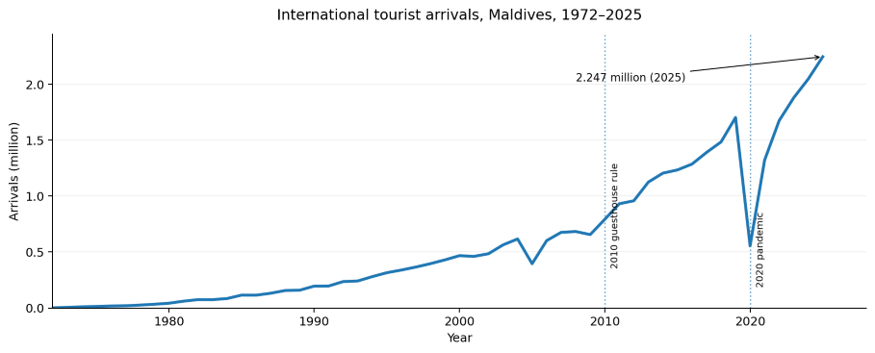
Figure 1. International tourist arrivals in the Maldives, 1972–2025. Historical figures to 2013 come from the original draft; 2014–2024 values are rounded to the nearest thousand in the official MBS pocketbook; the 2025 observation is the exact MMA count. The lines indicate description, not attribution to policies.
Two comparisons capture structural change without imposing unwarranted causality. The 2025 arrivals total was almost twice the 2013 level, while total registered bed capacity increased by approximately 130% over the same interval. Guesthouses accounted for 6.4% of registered beds in 2013 but 24.5% in 2025, an 18.1 percentage-point increase. These movements are consistent with diversification of accommodation supply, though they say less about visitor spending and local retention. The 2025 arrivals figure increased 9.8% on the rounded official 2024 count; travel receipts were estimated at approximately US$5.57 billion (MBS, 2026; MMA, 2026).
The composition of 2025 demand matters. China remained the largest individual source market, while Europe contributed approximately 59% of visits in the aggregate according to MMA (2026). This pattern cautions against describing the industry’s development as a replacement of European markets by China. Greater market diversity may be beneficial, but source-market shares alone cannot establish reduced vulnerability to a globally correlated air-travel shock.
Equally important is the divergence between arrivals, bednights and value. MMA (2026) reports that guesthouse bednights grew by 16% in 2025 while resort bednights declined by 1%, even as arrivals increased. Average length of stay declined from 7.4 days in 2024 to 7.0 days in 2025. Increased visitor counts can therefore coexist with lower average stay duration and shifts between high- and lower-priced accommodation. This is a substantive reason to avoid treating arrivals as a sufficient proxy for welfare or the productivity of tourism policy.
5.1 Why the indicators cannot be collapsed into a single score
A rigorous test of the broader development claims requires separating at least four constructs. Export scale concerns visitor arrivals and receipts; production intensity concerns occupancy, bednights, capacity utilisation and value added; participation concerns who owns businesses, is employed and earns income; and sustainability concerns whether economic activity preserves the ecosystems and social infrastructure on which it depends. These dimensions may move in different directions. Registered beds can rise more rapidly than occupied nights, reducing utilisation even while international arrivals increase. Likewise, a fall in average length of stay may cause tourist visits to increase faster than total nights, and a shift to lower-priced accommodation may alter average receipts per night. None of those patterns by itself establishes improved or deteriorating welfare.
Table 3. Alternative explanations and the additional evidence needed to discriminate among them
Observed development | State-policy mechanism compatible with the observation | Rival mechanism | Evidence that would discriminate |
Resort expansion after early planning | Standards and site permission reduce investor uncertainty | Worldwide demand, airline capacity and chain investment expand independently | Dated lease awards, rejected applications and investor assessments |
Guesthouse bed share rises after 2010 | Entry regulation opens inhabited-island accommodation | Digital booking platforms and changing tourist preferences generate demand | Operator cohorts, licensing dates, ownership and demand by island |
2025 arrivals and receipts reach highs | Public gateways, promotion and sector coordination support recovery | Reopening, airline route restoration and source-market income growth | Flight capacity, origin-specific demand and credible comparison cases |
Benefits remain uneven between atolls | Tourism site allocation and transport access influence participation | Geography and pre-existing agglomeration drive clustering | Island-level prices, transport costs, wages and firm entry data |
Sustainability plans become more ambitious | Environmental custodianship and accountability strengthen | Targets respond rhetorically to tourism pressures without enforcement | Budgeted implementation, inspections and independent reef and waste monitoring |
The alternatives are not necessarily exclusive. A government action may make private investment feasible while external demand determines its profitability. Conversely, a policy might be well designed yet show weak aggregate performance during a pandemic. A credible future causal evaluation would exploit more finely observed policy variation—for example, differences in timing or eligibility of inhabited-island licensing, or changes in transport service across otherwise comparable islands. National annual series alone are too highly confounded to carry that burden. The revised article consequently confines quantitative statements to transparent comparisons and explicitly reports when outcome measures are unavailable.
6. Discussion: What kind of state–business relationship developed?
6.1 From discovery to the construction of an export market
The early Maldives record challenges a simplistic state-centred success narrative. International tourism was initially explored by private actors, and the first integrated tourism plan followed more than a decade later. This sequencing makes self-discovery useful as a description of entry into a novel export service, but it does not by itself demonstrate a role for protection. The stronger interpretation is complementary: private initiative established a model that the state subsequently helped standardise, spatially organise and connect to international markets. The distinction is generalisable to service industries in which an initial private discovery needs complementary public infrastructure and a legal framework before large-scale export expansion becomes feasible.
Demand-side evidence provides an additional check against over-attribution. Zuhuree (2017) found that tourists’ originating-country income and perceptions of destination security were important correlates of arrivals, while price effects were comparatively modest in the historical sample. Consequently, the post-1972 expansion cannot be interpreted as a pure response to tourism-specific policy: policies can shape the supply of an attractive destination, but external economic and security conditions also determine the realised market.
6.2 Spatial selection as an industrial-policy instrument
The central theoretical extension is that an archipelagic state can exercise developmental influence through territorial and connective selection. In classic industrial-policy accounts, sector support may consist of tariffs, directed finance or subsidies. In Maldives tourism, the relevant scarce inputs include rights over islands, reef-adjacent spaces and access to aviation or marine gateways. Entry is selective even without a conventional tariff. Resort licensing and the later opening of inhabited-island guesthouses changed the set of firms and places eligible to participate in accommodation provision. This is the key sense in which tourism industrial policy was spatially mediated.
This argument is conditional. The paper has not assembled complete island-by-island lease awards, financial terms, tender histories or beneficial ownership registers. It therefore cannot quantify political connections, rents or the share of concessions granted competitively. Nor can it determine how much the guesthouse opening changed household welfare relative to a counterfactual without guesthouses. The spatial mechanism can be identified institutionally; its distributive magnitude remains unmeasured.
6.3 Coordination does not prove embedded autonomy
Evans’s vocabulary is analytically productive precisely when it is not used as a label of approval. Industry consultation, ministerial planning and public infrastructure investment show that the state has been engaged with tourism firms. They do not establish a professional bureaucracy insulated from particularistic pressures. Assessing embedded autonomy would require evidence on how lease and tax decisions were made, how rules applied to favoured and non-favoured firms, and whether public authorities enforced ecological or labour standards where doing so imposed costs on powerful investors. Recent research makes the political constraint unavoidable: firm interests, government capacity and conservation coalitions influence policy priorities and implementation (Juhász & Lane, 2024; Musthaq, 2026).
The 2010 accommodation opening complicates a binary interpretation of state capture versus state autonomy. A state can provide investment security to established resort operators while also widening entry opportunities for smaller businesses. Yet the latter may remain disadvantaged by finance, transportation costs, skills and resort–supplier market segmentation. The empirical question is not simply whether the state is embedded in business, but which businesses and communities are embedded in the policy process, on what terms, and with what accountability.
6.4 Export success, inequality and ecological constraints
Aggregate export performance is the strongest demonstrated outcome, but it is not the same as broad-based development. Employment quality, women’s participation, migrant-worker conditions, net foreign-exchange retention, household earnings and island-level distribution require distinct measurements. Research on Maldivian tourism employment, small enterprises and migrant workers confirms that these dimensions cannot be assumed to follow aggregate growth (Shakeela et al., 2011; Chia & Muiz, 2021; Kothari & Edensor, 2024). The IMF’s 2024 sectoral analysis similarly warns that lower-priced guesthouse nights and resort nights differ substantially in estimated value added; this is a reason to study distribution and productivity together, not to rank one segment as intrinsically preferable.
Environmental sustainability further complicates the success metric. The natural assets that attract tourists—reefs, beaches and habitable coasts—are productive capital subject to climate risks, construction pressure, waste and energy demands. The Fifth Tourism Master Plan recognises these tensions and proposes island-level and sector-wide standards (Ministry of Tourism, 2023). But a public commitment to sustainable growth is not equivalent to independent evidence of reef health or improved environmental outcomes. This article consequently rejects an unqualified claim that the tourism sector’s expansion was environmentally sustainable.
Zuhuree’s (2017) guesthouse hedonic-price analysis gives a concrete illustration of the economic stakes. In its observed sample, beachfront accommodation commanded a positive price premium; cleaner beaches and stronger waste-management practices were associated with higher room prices, while tourism-relevant managerial training was associated with a further premium. These are conditional observational associations, not estimates of what a particular public investment or environmental regulation would cause. They nevertheless reinforce the case for combining island-level environmental enforcement with service upgrading and stronger local-government coordination.
6.5 Transferability and its limits
The Maldives case suggests a mechanism that could be explored in other island or geographically fragmented service economies: state power over location-specific assets and transport access may be as important as tax incentives or credit in organising export activity. The relevant variables include the concentration of entry rights, gateway connectivity, ownership and social inclusion, the strength of local government, and environmental enforcement. Such a framework may apply differently in Fiji, Cabo Verde, Seychelles or archipelagic states with different tenure systems. The contribution is a set of propositions for comparison, not an assertion that the Maldives model should be replicated unchanged.
7. Policy implications and further research
The case supports four evidence-sensitive policy priorities. First, tourism governance should publish an accessible, time-stamped record of island and land leases, procurement methods, beneficial ownership where legally disclosable, concession terms, renewal decisions and environmental compliance. This would improve the ability to assess both investment credibility and regulatory autonomy. Second, the state should evaluate place-level returns, not just the national arrival target: tourist spending retained locally, SME procurement, wage quality, women’s employment, commuter and freight connectivity, and costs to island infrastructure should be reported by atoll and accommodation segment.
Third, differentiated policies for resorts, guesthouses, hotels and safari vessels should acknowledge differences in fiscal contribution, infrastructure demand and local benefit, while applying transparent minimum safeguards. For example, a guesthouse support programme might combine business training, waste services, financing access and independent quality inspection rather than simply subsidising beds. Fourth, tourism planning should connect growth objectives to measurable ecological constraints: reef condition, coastal modification, water and energy use, waste management and carbon intensity. Public reporting should clearly distinguish a proposed target from verified implementation or an independently evaluated result.
More specifically, Zuhuree (2017) provides a historical empirical rationale for two complementary interventions: practical hospitality training for small accommodation providers and collective management of beaches and waste systems on guesthouse islands. The evidence supports testing such interventions using measured room-price, employment and environmental outcomes; it does not establish that particular subsidies, taxes or training programmes would deliver specified returns.
The most valuable next empirical investigation would assemble an island-year panel linking lease awards and regulation to openings, capacity, wages, business ownership, procurement and environmental outcomes. A second stream would use interviews with officials, resort owners, guesthouse operators, island councils, employees and civil society, supported by documented recruitment and consent procedures. Comparative research across atolls, or with Seychelles and another SIDS, could test whether differences in political coalitions, connectivity and state capacity explain not only tourism scale but also distributional and ecological performance.
8. Conclusion
Tourism in the Maldives was neither the unaided product of private enterprise nor the mechanical achievement of a comprehensive developmental state. Pioneering entrepreneurs established a new export activity; successive governments then shaped the sector through regulation, physical infrastructure, access to tourism sites and ongoing coordination. The introduction of inhabited-island guesthouses in 2010 materially changed the formal geography of market entry, and the post-pandemic period saw renewed investment and an ambitious policy agenda. By 2025 the country had reached 2.25 million annual visitor arrivals and guesthouses represented almost one-quarter of registered accommodation beds.
The article’s distinctive contribution is to specify how spatially mediated industrial policy operates in an archipelagic tourism economy: public decisions over land, island use and connectivity can structure the geography of private opportunity. Evans’s four roles help identify the functions of the state, but his requirement of embedded autonomy sets a more demanding empirical standard. Tourism growth establishes commercial competitiveness; it cannot establish, without additional evidence, fair access, bureaucratic independence, environmental sustainability or attributable policy impacts. The Maldives thus offers a historically rich and analytically revealing case of the possibilities and limits of state-led coordination in internationally traded services.
Notes:
This is documentary analysis based on publicly available records and an author-supplied content.
The accompanying data-audit CSV records the selected published annual visitor counts and year-end accommodation indicators, their sources and their precision.
Use of generative AI. AI assistance was used to edit this working revision. However, original contesnt and substance is from the author.
References
Bramwell, B. (2011). Governance, the state and sustainable tourism: A political economy approach. Journal of Sustainable Tourism, 19(4–5), 459–477. https://doi.org/10.1080/09669582.2011.576765
Butler, R. W. (1980). The concept of a tourist area cycle of evolution: Implications for management of resources. The Canadian Geographer, 24(1), 5–12. https://doi.org/10.1111/j.1541-0064.1980.tb00970.x
Chia, K. W., & Muiz, A. (2021). The nature and challenges of guest house business in the Maldives: An exploratory study. Tourism and Hospitality Research, 21(1), 3–14. https://doi.org/10.1177/1467358420926688
Evans, P. (1995). Embedded autonomy: States and industrial transformation. Princeton University Press.
Hausmann, R., & Rodrik, D. (2003). Economic development as self-discovery. Journal of Development Economics, 72(2), 603–633. https://doi.org/10.1016/S0304-3878(03)00124-X
Hussain, Z., Kim, S. S., & King, B. (2025). Are we in the same boat? Multi-stakeholder perceptions of the impacts of domestic resort tourism and sustainability in a small island developing state. Tourism Recreation Research. Advance online publication. https://doi.org/10.1080/02508281.2025.2585809
International Monetary Fund. (2024). Maldives: 2024 Article IV consultation—Staff report and associated documents (IMF Country Report No. 24/106). https://www.elibrary.imf.org/abstract/journals/002/2024/106/article-A001-en.xml
Juhász, R., & Lane, N. (2024). The political economy of industrial policy. Journal of Economic Perspectives, 38(4), 27–54. https://doi.org/10.1257/jep.38.4.27
Juhász, R., Lane, N., & Rodrik, D. (2024). The new economics of industrial policy. Annual Review of Economics, 16, 213–242. https://doi.org/10.1146/annurev-economics-081023-024638
Kothari, U., & Edensor, T. (2024). Custodians of a resort island: Standing by between oblivion and restoration. Social & Cultural Geography, 25(7), 985–1005. https://doi.org/10.1080/14649365.2023.2268606
Maldives Bureau of Statistics. (2026). Statistical pocketbook of Maldives 2026. https://statisticsmaldives.gov.mv/mbs/wp-content/uploads/2026/10/Pocketbook-2026.pdf
Maldives Inland Revenue Authority. (2024a, November 5). The President ratifies new amendments to three taxation acts. https://www.mira.gov.mv/ContentItems/View/the-president-ratifies-amendments-to-3-tax-acts
Maldives Inland Revenue Authority. (2024b, December 5). A circular has been issued regarding changes to Green Tax rates, effective from 1 January 2025. https://mira.gov.mv/ContentItems/View/circular-re-changes-to-grt-rates-on-20250101-news
Maldives Monetary Authority. (2026). Annual report 2025. https://www.mma.gov.mv/documents/Annual%20Report/2025/Annual%20Report%202025.pdf
Ministry of Tourism. (2023). Maldives fifth tourism master plan 2023–2027: Goals and strategies. Government of Maldives, with the Asian Development Bank. https://resources.tourism.gov.mv/wp-content/uploads/2024/09/Maldives-Fifth-Tourism-Master-Plan-2023-2027-2.pdf
Ministry of Tourism. (2026a). Maldives Tourism Act and amendments (historical legal collection; initial act 1999). https://tourism.gov.mv/en/legislation/tourism_act
Ministry of Tourism. (2026b). Tourism regulations: Guesthouse rules and amendments (online legal collection). https://tourism.gov.mv/en/legislation/regulations
Musthaq, F. (2026). Restricting tourism via conservation: The Maldives and the Seychelles in comparative perspective. The Political Quarterly. Advance online publication. https://doi.org/10.1111/1467-923x.70078
President’s Office, Republic of Maldives. (2009, December 20). Maldives Guesthouse Regulation to come into effect on 15 January 2010. https://presidency.gov.mv/Press/Article/798
President’s Office, Republic of Maldives. (2025, July 26). President inaugurates new terminal at Velana International Airport. https://presidency.gov.mv/Press/Article/34426
Rishan, M., Heiets, I., Wiedemann, M., & Gerasymchuk, Y. (2024). Evaluating air transport barriers to tourism development in island states—A case study of an air service subsidy scheme in the Maldives. Journal of Air Transport Research Society. https://doi.org/10.1016/j.jatrs.2024.100054
Scheyvens, R., & Momsen, J. (2008). Tourism in small island states: From vulnerability to strengths. Journal of Sustainable Tourism, 16(5), 491–510. https://doi.org/10.1080/09669580802159586
Shakeela, A., Ruhanen, L., & Breakey, N. (2011). The role of employment in the sustainable development paradigm—The local tourism labor market in small island developing states. Journal of Human Resources in Hospitality & Tourism, 10(4), 331–353. https://doi.org/10.1080/15332845.2011.588493
Shareef, F. I., Habeeb, Z., Balasubramanian, K., Kumar, J., Konar, R., & Shahril, A. M. (2025). The effects of COVID-19 on the development and well-being of the Maldives guest house community. Pertanika Journal of Social Sciences & Humanities, 33(S1), 129–148. https://doi.org/10.47836/pjssh.33.S1.08
Wong, P. P. W., & Mohamed, U. (2022). Developing a star rating system for guesthouses to promote budget tourism in the Maldives: An exploratory study. Journal of Tourism, Culinary, and Entrepreneurship, 2(1), 69–91. https://doi.org/10.37715/jtce.v2i1.2218
World Bank. (1998). Tourism and the environment: A case study of the Maldives (World Bank study). https://documents.worldbank.org/curated/en/373861468774707910/pdf/multi-page.pdf
Zuhuree, I. (2017). An empirical analysis on international tourist flow and hotel room prices: The case of Maldives [Doctoral dissertation, National Graduate Institute for Policy Studies]. https://grips.repo.nii.ac.jp/record/1599/files/k166_fulltext_phd14403.pdf