Behind Paradise Collection: The Maldives Where Tourism Was Considered Impossible
11 Nov 2026, 10:56 · by IzuCT · 7 min read · Travel · EN
A chance meeting in Colombo, an Italian searching for a new holiday destination, and a handful of determined Maldivians. This is the story of how an unlikely idea began transforming an entire nation.
Before Paradise Had a Price
In 1971, there was no established international resort industry in the Maldives. No network of luxury hotels, no sophisticated tourism marketing, and no regular international air services delivering holidaymakers to the islands.
There was, however, something that no amount of investment could manufacture: thousands of years of natural history had produced a remarkable archipelago of coral reefs, sheltered lagoons, white beaches and tropical islands.
The beauty was there. The tourism industry was not.
The Maldives had become independent in 1965. Its economy depended heavily on fishing, maritime trade and other established activities. There were limited financial resources for developing an entirely new industry, particularly one requiring international transport, accommodation, skilled workers and reliable supplies.
Even the most basic question remained unanswered.
Why would someone travel thousands of kilometres to holiday in a country that had almost no facilities for tourists?
Today, knowing what happened next, the answer seems obvious. But history is full of ideas that appear inevitable only after they succeed.
In the early 1970s, tourism in the Maldives was still an experiment waiting to happen.
The Country That Was Considered Unsuitable
One of the most enduring stories about the birth of Maldivian tourism concerns the doubts expressed by development advisers.
Mohamed Umar Maniku, one of the industry's pioneers, later recalled that experts associated with the United Nations Development Programme (UNDP) considered tourism unlikely to succeed because the country lacked essential infrastructure.
The underlying obstacles were real.
Hulhulé had a small airstrip, but international air connectivity was extremely limited. Communications with Colombo depended on facilities such as radio. Accommodation suitable for organized foreign holidaymakers was practically nonexistent.
There was also a problem of sequence.
Tourists would not come without accommodation. Investors would hesitate to construct accommodation without tourists. Airlines would have little incentive to establish services without sufficient passenger demand.
Each missing component appeared to depend on another.
This is a familiar problem in development economics: several complementary investments may be necessary before an entirely new industry becomes commercially viable.
For the Maldives, the question was how to break that circle.
The answer began, unexpectedly, in Colombo.
An Italian Searching for Somewhere Different
George Corbin was an Italian travel organizer interested in discovering new destinations for his clients.
In 1971, his search led him to the Maldives' diplomatic mission in Colombo, Sri Lanka, where he encountered Ahmed Naseem, a young Maldivian diplomat.
The meeting would become one of the defining encounters in the history of Maldives tourism.
Corbin was searching for islands where visitors could experience swimming, fishing, diving and a natural environment relatively untouched by organized tourism.
Naseem understood something equally important: the Maldives possessed precisely those attractions, even if it lacked the facilities normally expected of an international holiday destination.
The two men had complementary knowledge.
Corbin understood potential customers and the international travel market. Naseem understood the country, its geography and the people who might help make such a journey possible.
They were connecting two sides of a market that had barely existed.
Corbin and Naseem subsequently travelled to the Maldives by cargo ship in 1971. Accounts of the visit describe their exploration of islands around Malé and their interest in the possibilities of developing accommodation for foreign visitors.
But recognizing the appeal of an island was very different from establishing a business there.
They needed local partners.
The Maldivians Who Turned an Idea into a Possibility
Two young Maldivians became central to the effort.
Mohamed Umar Maniku was working as an agriculture officer. Hussain Afeef, who had studied in Sri Lanka, brought enthusiasm and a willingness to become involved in a completely unfamiliar business.
Together with Naseem and Corbin, they began examining how visitors might actually be accommodated.
Their challenge was not simply to persuade people that the Maldives was beautiful.
They had to solve practical problems.
Where would visitors sleep? How would they travel from the airstrip? Who would prepare their meals? How could supplies be obtained? Who would organize excursions and look after guests?
There was no established hospitality workforce from which to recruit experienced hotel managers.
But there was local knowledge of boats, islands, food, construction and the sea.
The entrepreneurs began assembling those existing capabilities into something new.
What made the opportunity unusual was that the pioneers were not copying a mature Maldivian tourism business. There was no such business to copy.
They were attempting to create the market while learning how to serve it.
The First Test
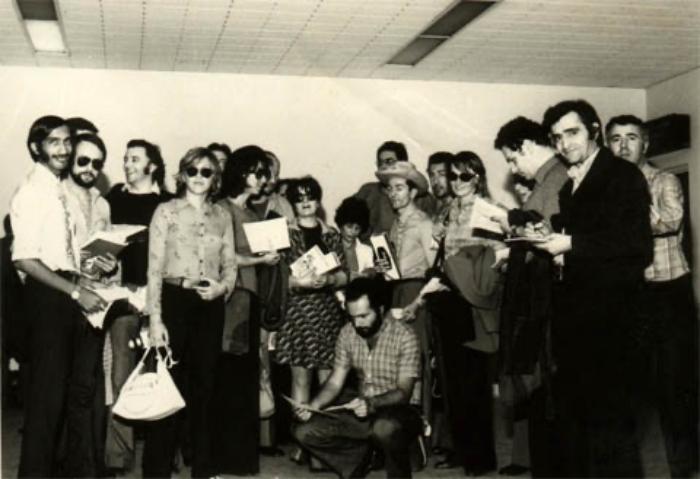
On 16 February 1972, an organized group of 22 tourists arrived on an Air Ceylon charter flight from Colombo.
The group included journalists and photographers, an important detail in an era when printed travel accounts and personal recommendations helped introduce unfamiliar destinations to international audiences.
There was no purpose-built resort ready to receive them.
Instead, the visitors stayed in three houses in Malé, with arrangements made by the young Maldivian hosts.
The trip was both a holiday and a commercial test.
Would visitors enjoy the islands despite the limited facilities? Could their hosts provide a satisfactory experience? Would Corbin be willing to bring additional groups?
The pioneers' later accounts describe the visitors responding enthusiastically to the beaches, lagoons, swimming and fishing.
Corbin was prepared to bring more travellers, provided proper accommodation could be established.
That conditional commitment was significant.
It gave the Maldivian entrepreneurs a reason to invest because there was now evidence of international interest and a potential channel through which customers could be brought to the country.
The experiment had not yet demonstrated long-term profitability, but it had moved beyond speculation.
Someone had tested the idea.
And the first organized visitors had come.
From an Empty Island to a Tourism Business
Attention turned to Vihamanaafushi, an uninhabited coconut-growing island near Malé and Hulhulé.
Its proximity to the airstrip made it an attractive location. The founders could avoid the much greater difficulty and cost of transporting visitors and supplies to distant atolls.
Construction began using materials and skills available locally.
The first accommodation consisted of simple buildings made with coral stone, coconut timber and palm thatch. There were 30 rooms, providing 60 beds. Facilities were basic by modern standards.
On 3 October 1972, Kurumba Village officially opened.
The date is now commemorated as the Maldives' National Tourism Day.
By the end of 1972, two resort islands were operating, with a combined registered capacity of 280 beds.
The Maldives had entered international tourism.
But what had actually changed?
The coral reefs had always existed. The islands had not moved. The beaches were no whiter than before.
What changed was the capacity to connect those natural attractions with international customers through transport, accommodation, local enterprise and organized services.
A natural environment had become the foundation of a new export industry.
From the Observatory: The Starting Point
Maldives tourism in 1972
Indicator | Recorded value |
|---|---|
International tourist arrivals | 1,097 |
Resorts operating by year-end | 2 |
Registered resort bed capacity by year-end | 280 |
First resort opening | 3 October 1972 |
Source: Maldives Tourism Yearbook 2007 and historical tourism statistics. Figures for resort capacity represent the position at year-end, not the capacity available throughout 1972.
The numbers are modest. Yet they establish the starting point of a transformation that would eventually affect employment, infrastructure, public revenue, investment and the geography of development across the Maldives.
The Real Lesson of 1972
It would be tempting to conclude that the success of the Maldives was simply the inevitable consequence of its beautiful environment.
But that explanation overlooks the most interesting part of the story.
There are many beautiful places in the world that have not developed internationally competitive tourism industries.
Natural attractions provide opportunities. They do not automatically produce airlines, hotels, trained workers, investors or customers.
The Maldives required individuals willing to accept uncertainty, connect with unfamiliar markets and learn through experience.
It also required coordination between foreign visitors and local entrepreneurs. The early experience demonstrated that demand and supply could develop together rather than waiting for every facility to be completed in advance.
That lesson remains relevant.
As the Maldives considers new tourism zones, local-island development, investment in transport and the future of its tourism model, infrastructure and market access remain closely connected.
Yet the larger history also raises questions that the celebration of entrepreneurial achievement alone cannot answer: who obtained access to the new opportunities, how were benefits distributed, and what environmental and social consequences followed?
Those questions would become increasingly important as tourism expanded.
In 1972, however, the immediate challenge was much simpler.
Could a group of foreign visitors be persuaded to come to the Maldives, and would they want to return?
The founders now had their first answer.
But the 22 travellers who arrived in February were more than a group of adventurous holidaymakers. Among them were people with the ability to introduce the Maldives to readers far beyond the Indian Ocean.
Their journey deserves a story of its own.
Next in Behind Paradise : The 22 Visitors Who Changed the Maldives.
Before the first resort opened, a small group of travellers arrived in a country that had almost no tourist accommodation. Who were they, what did they discover, and how did their visit help introduce the Maldives to the international holiday market?