Beyond Recovery: What 13.67 Million Bed-Nights Reveal About the Next Phase of Maldives Tourism
31 May 2026, 13:17 · by i.zuhuree · 7 min read · Tourism · EN

The 2025 bed-night data shows the Maldives has entered a new phase: record demand, slower annual growth, and a more balanced seasonal structure. Bed-nights reached 13.67 million in 2025, only 2.0% above 2024 but 27.9% above 2019. Growth is no longer mainly about recovery; it is about squeezing more value from capacity, improving shoulder-season performance, and managing demand quality. The strongest opportunity is not more volume alone, but better yield, product design, and seasonally targeted s
Free tourism insights
Get Free Tourism Insights
Receive selected MTO insights, tourism data alerts, and new resource updates by email.
Get Free Tourism InsightsWhen I look at the 2025 tourist bed-night data, the strongest story is not simply that the Maldives reached another record. The more important story is that the country appears to be moving from a recovery-growth phase into a capacity-and-value-management phase. Tourist bed-nights reached 13.67 million in 2025, the highest point in the series. But annual growth was only 2.0% over 2024, compared with 3.8% in 2024, 5.3% in 2023, and the much sharper post-pandemic rebound of 21.7% in 2022. That slowing growth does not mean the industry is weak. It means the strategic question has changed.
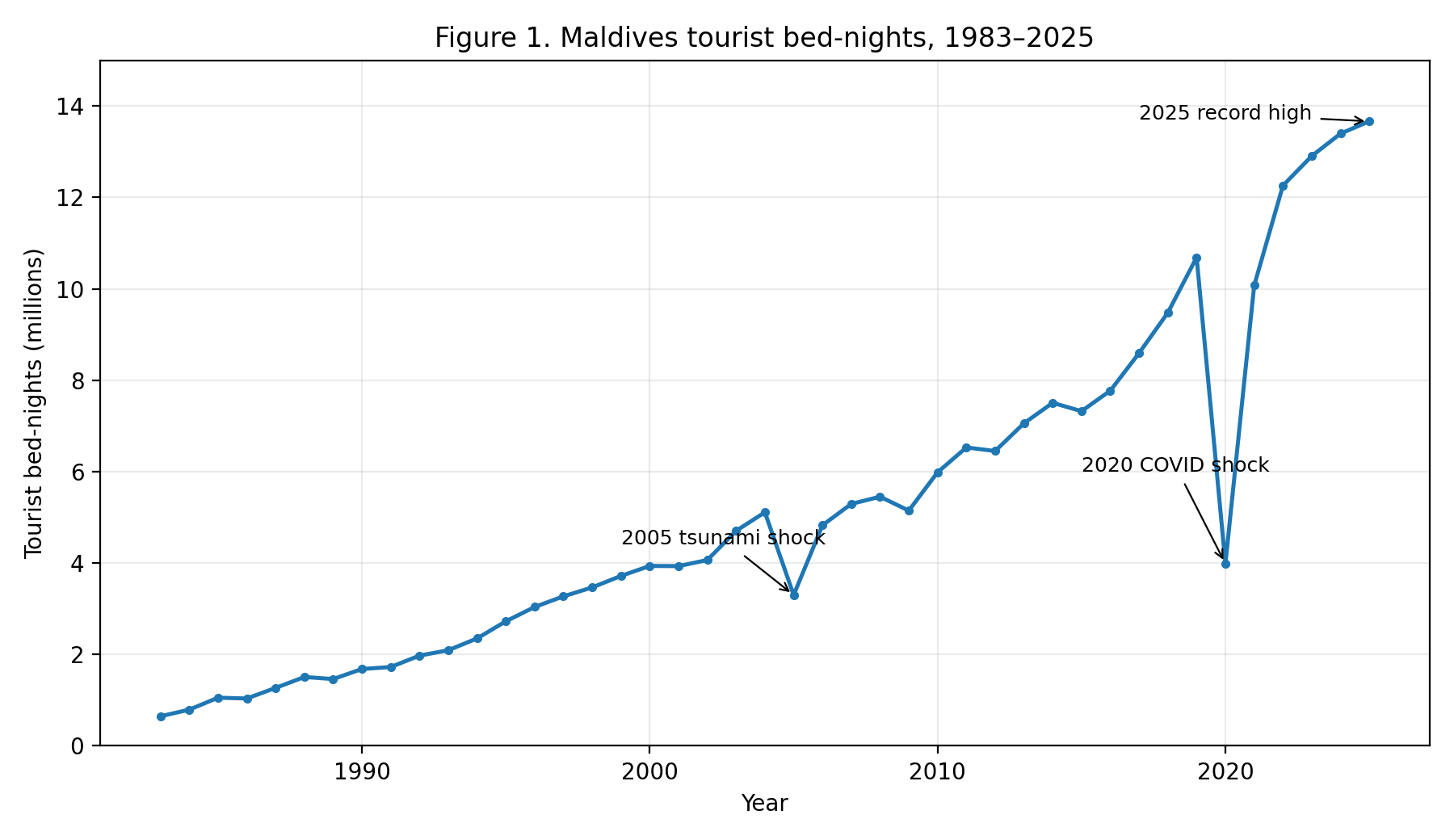
Bed-nights are useful because they measure actual demand pressure on accommodation, not just arrivals. A visitor who stays six nights and a visitor who stays three nights do not have the same operational or economic effect. Bed-nights therefore speak directly to room utilisation, labour planning, transfers, food supply, waste, energy, taxation, and yield. From that perspective, the 2025 figure is a signal that the Maldives has achieved scale, recovered from crisis, and must now focus harder on how demand is distributed across the year and how much value is captured from each occupied night.
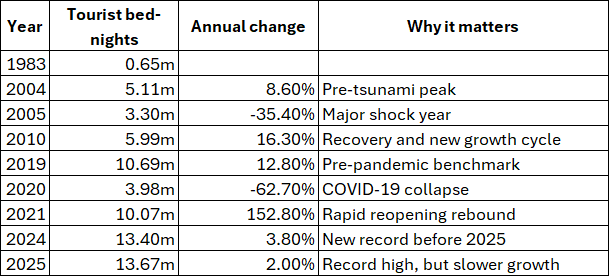
The long-run expansion is remarkable. Bed-nights grew from 647,288 in 1983 to 13.67 million in 2025, a more than twentyfold increase. The full-period compound annual growth rate is about 7.5%. But the growth path is not uniform. Between 1983 and 1990, bed-nights grew at about 14.6% per year. Between 1990 and 2000, the rate moderated to 8.9%. Between 2000 and 2010, it slowed further to 4.3%. The 2010s then brought renewed expansion, with bed-nights rising from 5.99 million in 2010 to 10.69 million in 2019, a compound annual growth rate of 6.7%.
The post-pandemic period is even more revealing. In 2020, bed-nights fell by 62.7%, from 10.69 million to 3.98 million. By 2021, the series had already recovered to 10.07 million, and by 2025 it had reached 13.67 million, or 27.9% above 2019. This is not a normal recovery pattern. It suggests that the Maldives did not merely restore its previous demand base; it expanded beyond it. For policymakers and operators, that should shift attention from crisis recovery to the quality, resilience, and profitability of the current demand structure.
Seasonality
The most valuable insight lies in seasonality. In the early period, demand was much more concentrated in the traditional high season. From 1983–1999, January alone accounted for 10.7% of period bed-nights, while June accounted for only 4.7%. The peak-to-trough monthly ratio was 2.25. By 2010–2019, the ratio had fallen to 1.59. That means the seasonal curve became flatter over time. The industry became better at filling the calendar, not just filling the winter months.
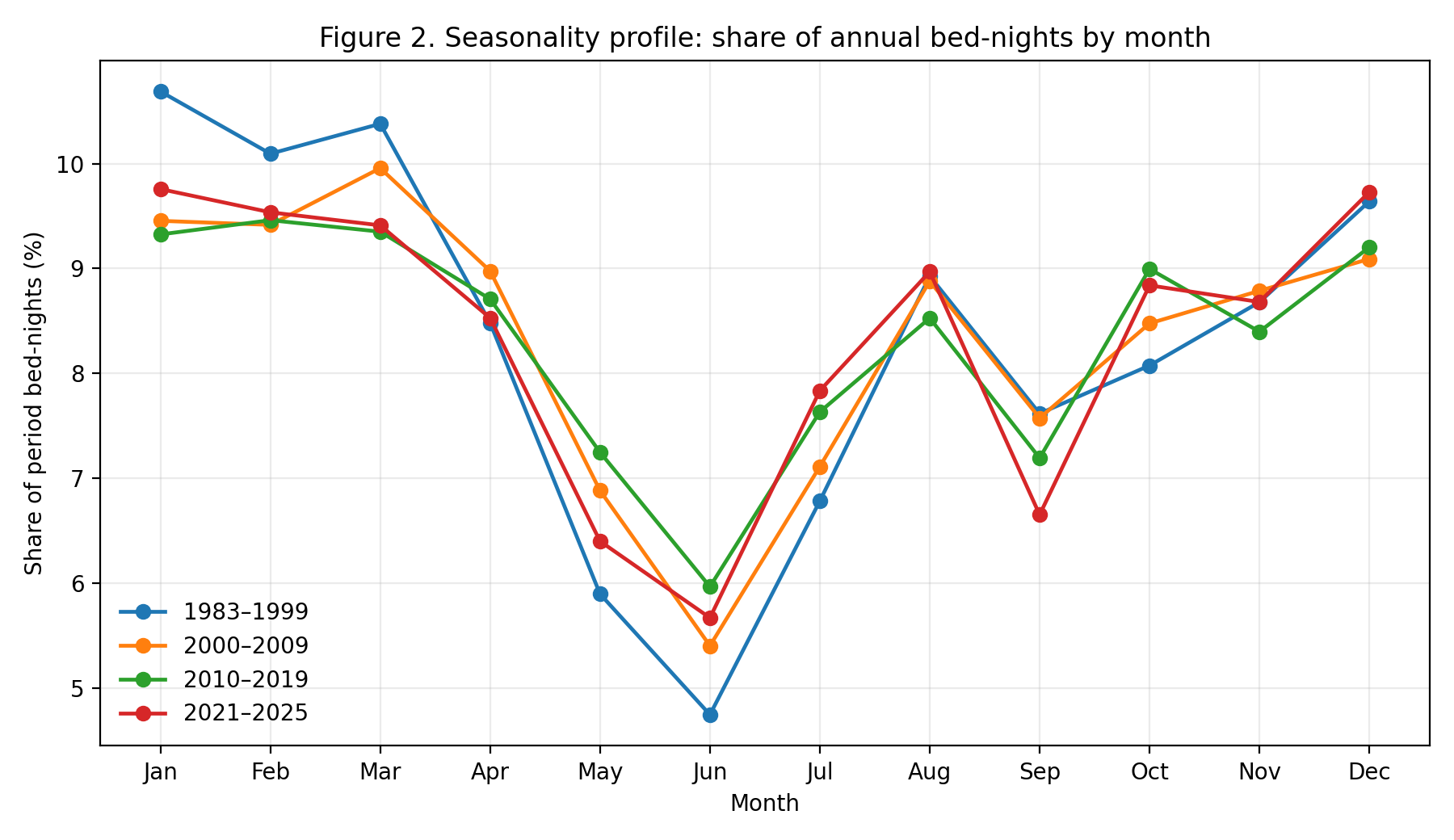
seasonality profile matters because a less seasonal tourism economy is easier to manage. Staff can be retained more consistently. Domestic transport systems can be used more efficiently. Suppliers face less extreme peaks and troughs. Resorts, guesthouses, safari vessels, and local service providers can smooth cash flow. Government also benefits because tourism-linked tax receipts become less concentrated. The data does not say that seasonality has disappeared; June remains the weakest month in the latest period. But it does show that the Maldives has structurally improved its ability to generate demand outside the narrow winter peak.
The 2025 monthly data adds a second layer. Growth over 2024 was not driven by the classic first-quarter peak. February fell by 6.6%, March by 6.9%, and April by 4.2% compared with 2024. The annual gain came mainly from the second half of the year: July rose 7.5%, August 5.7%, September 11.5%, October 4.5%, and November 12.0%. In absolute terms, November added about 119,750 bed-nights over 2024, September added about 94,469, July added about 80,216, and August added about 66,978.
Monthly Data as Market Signal
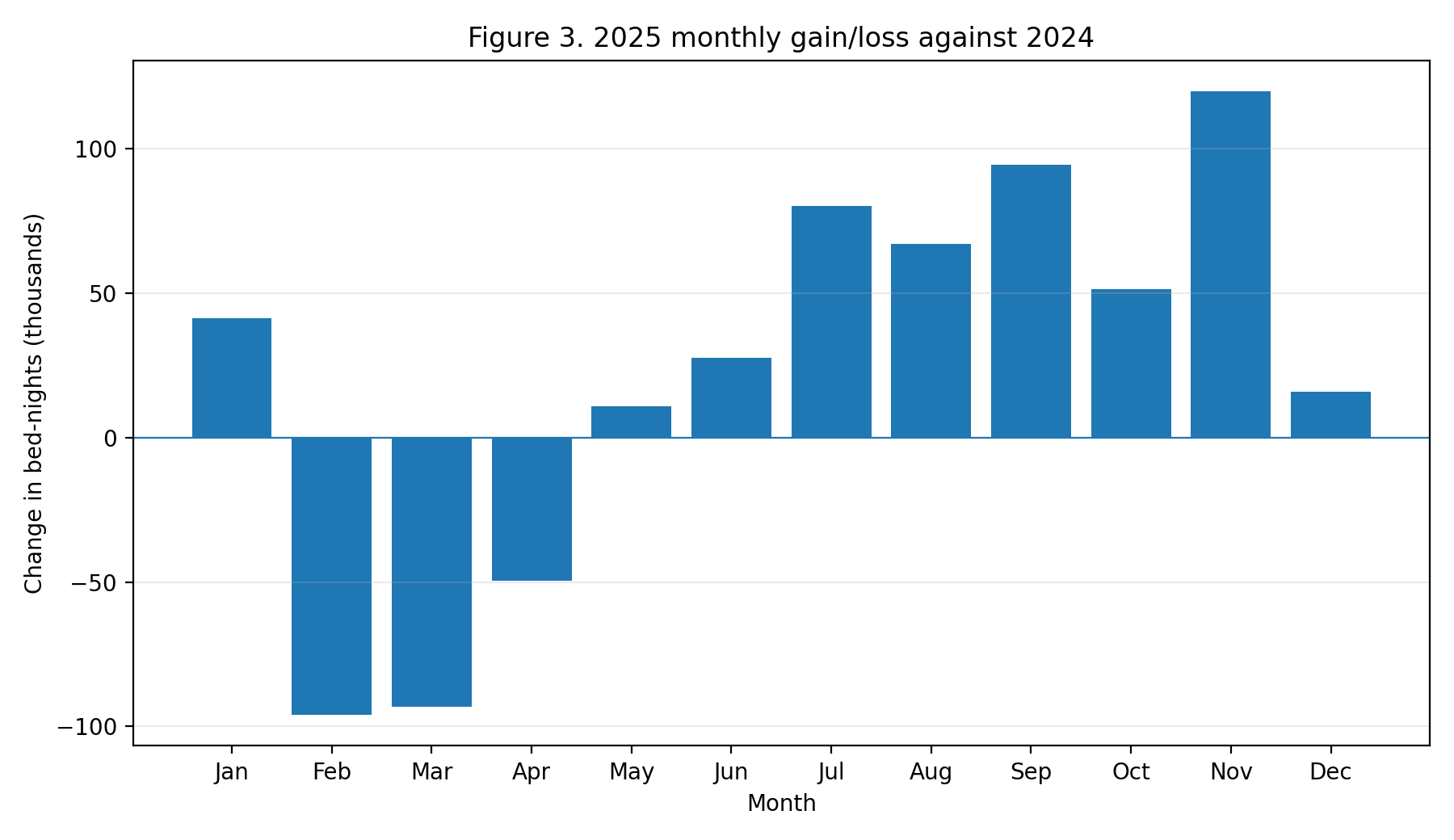
I read montly data as an important market signal. The Maldives is no longer only defending its winter premium. It is increasingly winning demand in months that used to be commercially weaker. That is valuable because shoulder-season and off-peak growth can improve annual utilisation without requiring the same intensity of peak-season pressure. However, it also raises a policy question: is the additional demand generating proportional value, or is it being won through discounting, lower-yield segments, shorter stays, or heavier pressure on local infrastructure? The bed-night dataset cannot answer price and yield questions by itself, but it clearly identifies where the next analytical work should focus.
For destination marketers, the message is direct. The second half of the year deserves more strategic attention. If September and November can grow by double digits while the annual total grows by only 2.0%, then the calendar is changing beneath the headline. Marketing campaigns should not treat the year as one market. They should distinguish winter premium, summer family and regional demand, shoulder-season value seekers, dive and surf segments, long-stay remote workers, and event-based travel. The operational question is not only “how do we increase arrivals?” but “which months still have profitable headroom?”
For hotel operators, the data points towards revenue-management discipline. The country added only 269,525 bed-nights in 2025 over 2024, and that gain was unevenly distributed. Operators should therefore avoid reading the record annual total as a guarantee of pricing power in every month. February, March, and April were weaker than 2024, despite the annual record. July to November carried the growth. A resort or guesthouse that prices only according to old seasonality assumptions may miss the new pattern. The better strategy is to build month-specific pricing, market-specific offers, and transfer-inclusive packages that respond to actual bed-night movement.
For policymakers, the finding is equally important. A record bed-night year increases the need to measure not only volume but also value per bed-night. If bed-nights are rising faster than environmental management capacity, then waste, water, reef pressure, energy use, and congestion risks will grow. If bed-nights are rising while average spending per bed-night is weakening, then the country may be expanding physical pressure faster than economic return. The dataset therefore supports a clear policy priority: the Maldives Tourism Observatory should link bed-nights with prices, occupancy, tax receipts, accommodation type, island geography, and environmental indicators.
Investors should also read the data carefully. The long-run story is positive: bed-nights have grown from less than 1 million in the early 1980s to nearly 14 million in 2025. But the short-run story is more selective. The easy post-pandemic rebound is over. Growth after 2023 is positive but slower. Investment decisions should therefore be based less on national demand growth alone and more on micro-location, transfer efficiency, segment fit, environmental quality, and the ability to perform across weaker months. The best investment thesis is not simply “Maldives demand is growing”; it is “certain products can capture value in under-optimised parts of the calendar.”
The practical industry lesson is that bed-nights now need to be treated as a management variable. A national target based only on arrivals can hide important changes in length of stay and utilisation. A monthly bed-night dashboard can show whether marketing is filling the right months, whether new capacity is being absorbed, whether weak-season campaigns are working, and whether growth is coming with manageable environmental pressure. This dataset gives the industry a base layer for that dashboard.
Turning Bed-Nights into Tourism Strategy
The Maldives has moved beyond recovery. The next phase is about value capture, seasonal balance, and sustainability under high utilisation. My main conclusion from the dataset is that the country’s strongest opportunity is not simply to chase more volume. It is to understand where bed-night growth is occurring, which months still have headroom, which segments are filling those months, and whether the additional demand is producing enough value to justify the pressure it places on infrastructure and the environment.
The most useful next dataset would connect these monthly bed-nights to room prices, accommodation type, island location, occupancy, source markets, tax receipts, and environmental indicators. That would allow policymakers and industry leaders to answer the question that now matters most: not whether Maldives tourism can grow, but whether it can convert high demand into higher national value, stronger business performance, and a more sustainable destination model.