Guesthouse Pricing Series: The Guesthouse Pricing Audit
10 Aug 2026, 18:32 · by IzuCT · 6 min read · Tourism · EN

A pricing audit reveals the small leaks that erode profit: weak floors, unrealistic occupancy, outdated supplier rates, stacked promotions, tax errors, full-capacity activity assumptions and poor policies. Monthly reviews turn pricing decisions into measurable learning.
Free tourism insights
Get Free Tourism Insights
Receive selected MTO insights, tourism data alerts, and new resource updates by email.
Get Free Tourism InsightsA guesthouse rarely loses its margin through one spectacular error.
Profit tends to disappear through small openings: an outdated supplier rate, a stacked promotion, an incorrectly treated tax, a boat priced at full capacity, or a package refund decided after the cancellation.
Each leak appears manageable.
Together, they can drain the business.
A pricing audit closes these openings before another month begins.
Figure 1. Twenty mistakes organised into five control gates.
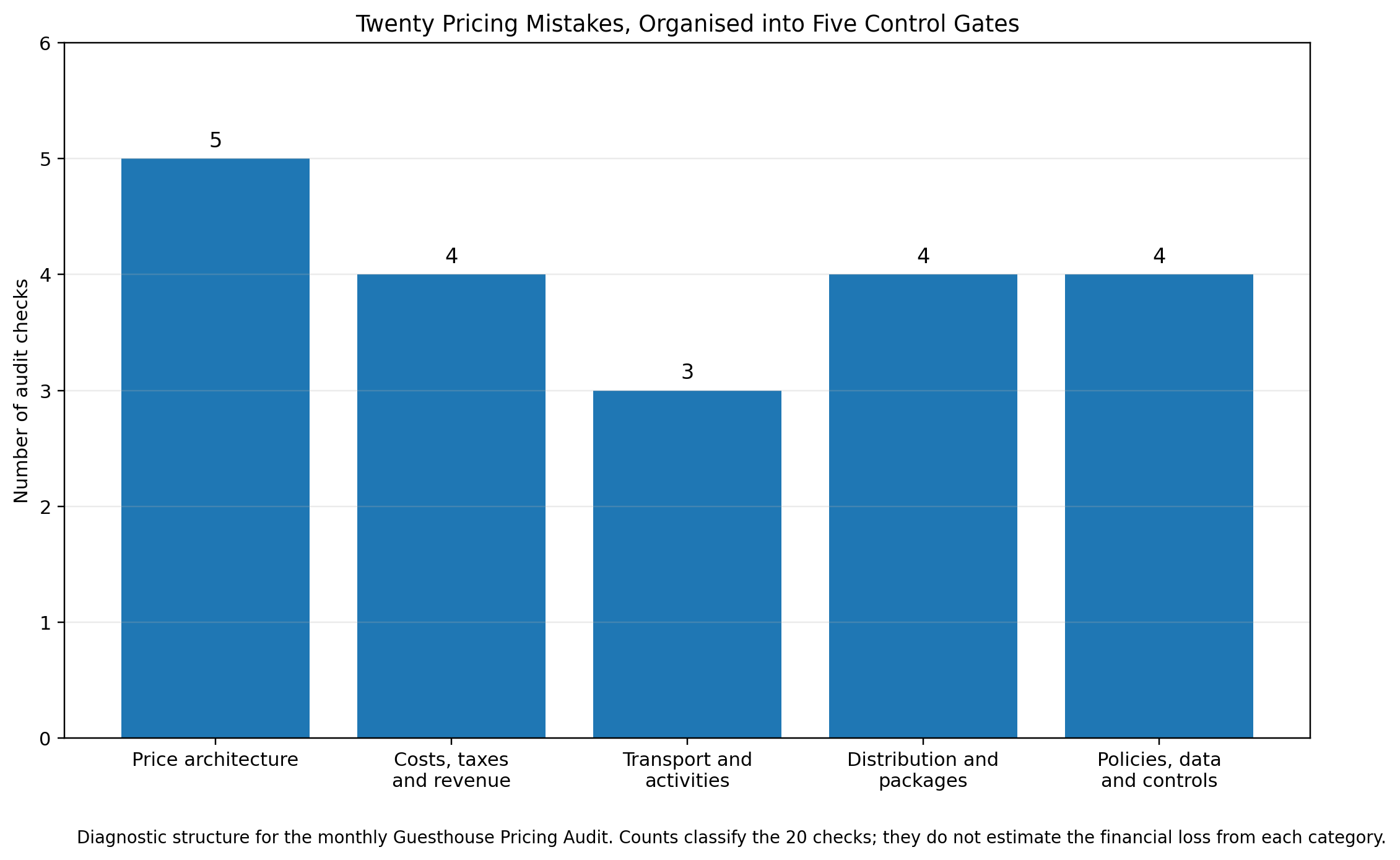
Control Gate 1: Price architecture
1. Underpricing the room
A room rate below its full cost may produce occupancy while destroying cash flow.
The floor should include fixed costs, variable costs, reserves, distribution and target contribution.
High occupancy does not repair a rate that loses money on every occupied night.
2. Overpricing without supporting value
A high rate is not a pricing strategy when photographs, reviews, room quality, transfer access and inclusions do not support it.
Overpricing may reduce conversion early, forcing deep last-minute discounts later.
3. Copying competitors
A competitor may have:
lower debt;
family labour;
different room quality;
excluded taxes;
a weaker cancellation policy;
different distribution cost; or
a temporary need for cash.
Their price is a market signal—not your cost calculation.
4. Using one rate throughout the year
Maldives demand, weather and source-market booking patterns change through the year.
A fixed rate ignores booking pace, lead time and remaining inventory.
5. Operating without a rate ladder
Without planned rate levels, operators tend to make large emotional adjustments.
A controlled ladder allows movement between low, standard, strong, high and peak rates.
Control Gate 2: Costs, taxes and revenue
6. Using 100% occupancy in cost calculations
Fixed cost per occupied room-night should use realistic occupancy.
A ten-room guesthouse is not a 3,650-room-night business unless every room is occupied every night.
7. Ignoring replacement reserves
Air-conditioners, linen, pumps, furniture, paint and equipment deteriorate even when the current month looks profitable.
Profit calculated before replacement cost may be an illusion.
8. Treating tax as income
TGST and Green Tax are collected for the state.
From 1 July 2025, tourism-sector GST is 17%. Green Tax is generally USD 6 per taxable tourist day for inhabited-island guesthouses with 50 or fewer rooms, while different rates apply to other establishment categories.
The collected amounts should not be mistaken for operating revenue.
9. Treating service charge as business income
Tourism businesses are required to levy at least 10% service charge, and the regulatory framework governs its distribution among employees. Current reporting in 2026 continued to describe 99% as distributable after the permitted administrative portion.
Service charge may move through the business bank account, but it should not be used to overstate the margin available to the owner.
Control Gate 3: Transport and activities
10. Pricing private transfers without empty legs
The return or positioning journey burns fuel and crew time even when no guest is aboard.
The entire vessel movement must be costed.
11. Pricing excursions at maximum capacity
A 12-seat boat that normally carries seven guests should not divide its fixed cost by 12.
Use expected paying participants.
12. Omitting weather and disruption reserves
Marine operations face cancellation, rerouting, unused food, crew commitments and refund costs.
A reserve should be based on actual disruption history.
Control Gate 4: Distribution and packages
13. Ignoring channel deductions
A USD 100 booking is not USD 100 of retained room revenue when commission, payment cost and promotion are deducted.
Compare channels using net revenue.
14. Stacking promotions
A property may combine:
seasonal discount;
mobile discount;
loyalty discount;
last-minute offer;
length-of-stay discount; and
OTA commission.
Each percentage may look small. Their combined effect can move the price below the cost floor.
15. Running permanent discounts
When a discount is always available, it becomes the normal price.
The published higher rate loses credibility and provides little useful reference point.
16. Selling unprofitable packages
Rooms, meals, transfers and excursions each need a cost.
A package with a large selling price can still lose money when supplier costs, tax, service charge and commission are ignored.
Control Gate 5: Policies, data and controls
17. Failing to update supplier rates
Transfer, meal, excursion and laundry rates should have an effective date and review date.
A package should not remain on sale after its supplier contract expires.
18. Using weak cancellation policies
A policy may be too flexible for the operator or too restrictive for the guest.
It should reflect:
lead time;
ability to resell;
supplier commitments;
channel rules; and
seasonal demand.
19. Hiding mandatory charges
The displayed price should make the final payable amount understandable.
MIRA generally requires GST-inclusive price display, with defined exceptions where service charge is levied and customers receive sufficient instructions to calculate the total.
Unexpected mandatory charges damage trust even when legally collectable.
20. Failing to record pricing decisions
A rate change without a record teaches the business nothing.
For every important adjustment, record:
date;
arrival period;
previous rate;
new rate;
booking pace;
remaining inventory;
competitor movement;
reason;
result; and
lesson.
Pricing becomes more accurate when decisions create data.
The 20-point pricing checklist
Use the following checklist each month.
No. | Audit question | Yes/No | Action required |
1 | Is every public room rate above the calculated cost floor? | ||
2 | Does the rate reflect the property’s demonstrated value? | ||
3 | Are competitors used as comparables rather than copied? | ||
4 | Are rates differentiated by demand period? | ||
5 | Is an approved rate ladder in use? | ||
6 | Are occupancy assumptions realistic? | ||
7 | Are replacement reserves included? | ||
8 | Are taxes separated from retained revenue? | ||
9 | Is service charge separated and administered correctly? | ||
10 | Do private-transfer prices include empty legs? | ||
11 | Are excursions priced using expected passengers? | ||
12 | Is a disruption reserve included? | ||
13 | Is net revenue calculated by channel? | ||
14 | Have stacked promotions been tested? | ||
15 | Do all promotions have start and end dates? | ||
16 | Is every package profitable by component? | ||
17 | Are supplier rates current? | ||
18 | Do cancellation terms match commercial exposure? | ||
19 | Can guests understand the final payable price? | ||
20 | Are rate decisions and outcomes recorded? |
Monthly pricing review template
A. Performance
Indicator | Current month | Previous month | Same month last year |
Occupancy | |||
Average base room rate | |||
Net revenue per occupied room-night | |||
Direct-booking share | |||
OTA-booking share | |||
Cancellation rate | |||
Average length of stay | |||
Ancillary revenue per occupied room-night |
B. Forward demand
Arrival period | Rooms sold | Forecast | Pace position | Rooms remaining | Current BAR | Action |
Next 7 days | ||||||
8–15 days | ||||||
16–30 days | ||||||
31–60 days | ||||||
61–90 days | ||||||
91–120 days |
C. Supplier and package controls
Item | Current rate | Last verified | Expiry | Cancellation rule | Update needed |
Scheduled transfer | |||||
Private transfer | |||||
Domestic flight | |||||
Excursion | |||||
Meal supplier | |||||
Laundry |
D. Decisions
Decision | Evidence | Expected result | Review date | Actual result |
The end of the series and the beginning of the system
This series began with the cost of one room.
It then followed the money through taxes and commissions, examined the market, introduced booking pace, priced excursions, investigated transport, compared package models, built package calculations and explored value-added offers.
The final lesson is that pricing is not one decision. It is a system of connected decisions. The room affects the package. The package affects the transfer. The transfer affects arrival satisfaction. The excursion affects the margin. The cancellation rule determines who carries the risk.
A monthly audit brings these parts back together. The purpose is not to eliminate every mistake. No pricing system can predict every booking, storm, supplier change or guest decision. The purpose is to make errors visible early—before twenty small leaks become one large loss.