Guesthouse Pricing Series: Discount Less, Add More Value
09 Aug 2026, 14:29 · by IzuCT · 5 min read · Tourism · EN
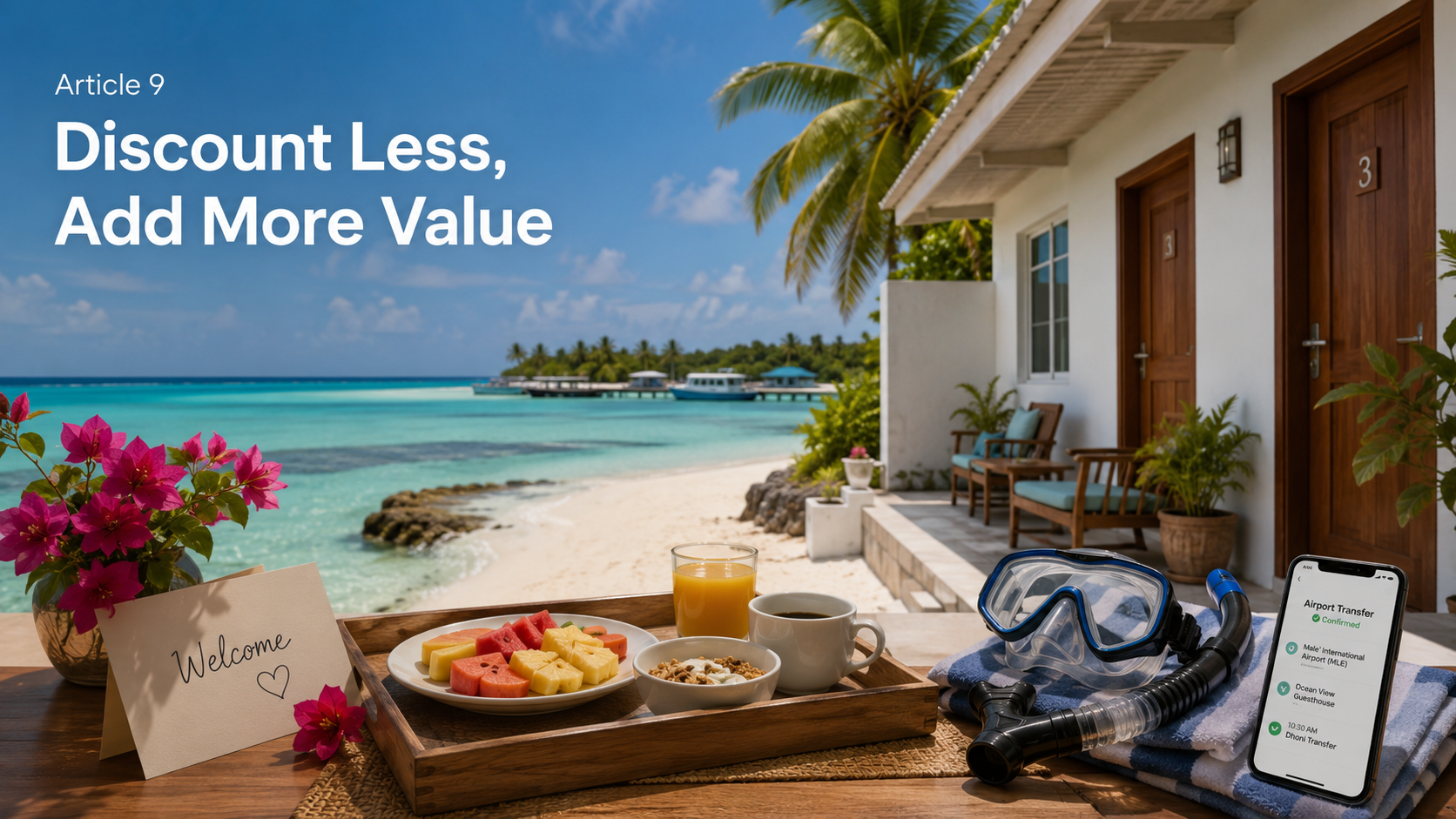
Value-added offers can outperform discounts when perceived benefit exceeds incremental cost. Flexible breakfast, orientation, transfer coordination, digital guides, equipment use, activity credits and celebration touches strengthen conversion while preserving room rates and direct-booking overall profitability.
Free tourism insights
Get Free Tourism Insights
Receive selected MTO insights, tourism data alerts, and new resource updates by email.
Get Free Tourism InsightsA room discount is mathematically simple. Reduce USD 15, and the guest pays USD 15 less.
Value is more interesting. A benefit may cost the operator USD 5 while saving the guest time, uncertainty or effort worth considerably more.
The difference lies in what the guest is buying.
A discount changes the number. A useful benefit changes the experience.
The value-leverage principle
A simple proposed measure is:
Value Leverage Ratio = Perceived guest value ÷ Incremental operator cost
Suppose complimentary snorkelling-equipment use costs the property USD 5 per stay after allowing for cleaning and depreciation.
If guests perceive the benefit to be worth USD 15:
Value Leverage Ratio = USD 15 ÷ USD 5 = 3.0
A USD 15 room discount has:
USD 15 value ÷ USD 15 cost = 1.0
The value-added offer can therefore create the same perceived benefit at one-third of the operator cost.
Perceived value must be tested. It should not be invented by management and presented as research evidence.
Figure 1. A small benefit may create more value than a larger discount.
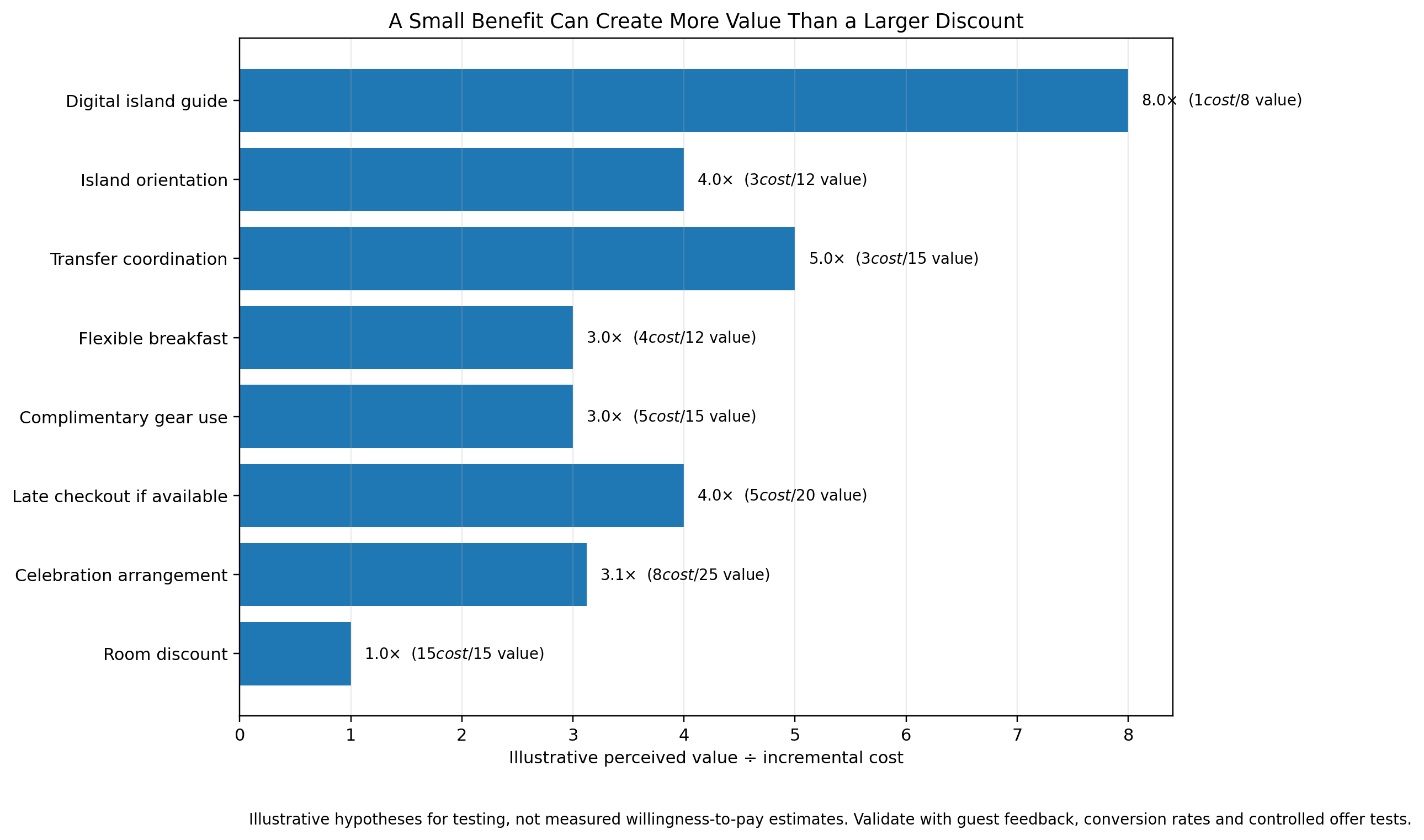
The values are hypotheses for guest testing, not measured willingness-to-pay estimates.
Why discounts become dangerous
A temporary discount may be justified when booking pace is weak and price is the actual barrier.
The problem begins when the discount becomes permanent.
A USD 15 reduction affects:
every discounted night;
OTA commission calculations;
future reference prices;
direct-booking negotiations;
repeat-guest expectations; and
the property’s position against competitors.
When demand returns, restoring the original rate may feel like a price increase.
Cornell research on hotel revenue management during downturns recommended considering service bundles and other value approaches rather than relying exclusively on rate cuts.
Flexible breakfast
A guest leaving at 5:30 a.m. for diving may gain little from a breakfast served at 7:30.
The property could offer:
packed breakfast;
early tea and fruit;
late breakfast after an excursion;
a breakfast credit; or
a simple takeaway meal.
The incremental food cost may be small. The perceived benefit is reliability.
The offer should specify ordering time and included items so flexibility does not become an uncontrolled 24-hour kitchen.
Island orientation
An orientation lasting 15 minutes may explain:
the bikini beach;
appropriate local-island behaviour;
restaurant locations;
prayer-time considerations;
shops and pharmacies;
ferry points;
weather conditions;
waste and reef practices; and
emergency contacts.
The financial cost is mainly staff time. The value comes from reducing uncertainty during the guest’s first hours.
The orientation can also create legitimate opportunities to explain excursions and services without a hard sales pitch.
Transfer coordination
The transfer ticket may be inexpensive. Coordination may be highly valuable.
A direct-booking benefit could include:
flight monitoring;
meeting instructions;
transfer confirmation;
delay communication;
airport contact;
luggage guidance; and
island arrival assistance.
This benefit should not be called a complimentary transfer unless the transport itself is included.
Call it what it is: airport-transfer coordination.
Digital island guides
A digital guide can contain:
an island map;
restaurant opening times;
beach rules;
activity options;
weather links;
emergency information;
cultural notes;
reef guidelines;
check-out procedures; and
direct contact buttons.
Once produced, the cost of providing it to another guest is very low.
Its quality must nevertheless be maintained. Outdated ferry schedules or closed restaurants can destroy the benefit.
Complimentary equipment use
Depending on the island and property, equipment might include:
snorkelling masks;
beach towels;
umbrellas;
bicycles;
beach bags;
reusable water bottles; or
children’s beach items.
“Complimentary” equipment still has a cost:
Cost per use = Purchase cost ÷ Expected usable rentals + cleaning and loss allowance
Equipment should have safety, damage and return rules.
Activity credits
A USD 20 activity credit may cost the guesthouse less than USD 20 when:
the activity has unused capacity;
the guesthouse earns supplier commission;
the activity’s marginal cost is low; or
the credit encourages the purchase of a larger experience.
Credits can be restricted by:
minimum spend;
selected activities;
shared trips;
advance booking;
stay period; and
non-cash redemption.
A credit is generally safer than promising unlimited activities.
Early check-in and late checkout
When the room would otherwise be empty, flexible arrival or departure time may have high value and low cost.
The phrase “subject to availability” is essential.
A benefit that cannot be honoured on a busy day should not be advertised as guaranteed.
The operator should consider housekeeping schedules, electricity use, staffing and displacement of paid late-checkout demand.
Celebration arrangements
A honeymoon or birthday arrangement might include:
simple bed decoration;
handwritten note;
local flowers where appropriate;
small cake;
photograph;
beach setup; or
reserved dinner table.
The benefit should be designed around a fixed cost ceiling.
A “complimentary honeymoon arrangement” without defined contents can produce escalating guest expectations.
Direct-booking benefits
Direct booking may save OTA commission, but the full saving should not automatically be returned as a room discount.
Part can finance benefits such as:
flexible cancellation;
transfer coordination;
room preference;
activity credit;
flexible breakfast;
welcome arrangement;
digital guide; or
priority communication.
This creates a direct-booking distinction without publicly weakening the room rate.
Service quality can support price
Historical Maldives guesthouse research found positive associations between room prices and service-quality indicators, including staff language capability, manager experience and relevant training. These findings came from 2016–2017 data and should not be treated as current causal estimates. They nevertheless support the proposition that better service can be reflected in price rather than given away through perpetual discounting.
Test value rather than assuming it
For each offer, record:
Indicator | Question |
Incremental cost | What does one additional redemption cost? |
Take-up rate | How many eligible guests use it? |
Conversion | Does the offer increase bookings? |
Satisfaction | Do guests mention it positively? |
Ancillary spend | Does it create other purchases? |
Operational burden | Does it disrupt staff or capacity? |
Repeatability | Can it be delivered consistently? |
Compare two offers over similar dates:
Offer A: USD 15 room discount.
Offer B: USD 5 benefit.
Measure conversion, retained revenue and guest feedback.
The purpose is not to prove that value always beats price. It is to discover which benefits create more demand than their cost.
Add what the guest notices
The best benefit is rarely the longest list of complimentary items.
It is the small intervention that removes a real difficulty:
breakfast when the guest needs it;
transfer information before anxiety begins;
equipment at the moment of use;
island knowledge on the first day;
flexibility when capacity allows; or
recognition during an important occasion.
Discounting says the room was worth less.
Value creation says the stay can be worth more.