Guesthouse Pricing Series: How to Price Transfers Without Hiding the Real Cost
01 Aug 2026, 12:27 · by IzuCT · 7 min read · Tourism · EN
Transfer pricing must capture the entire journey, including supplier fares, empty positioning legs, waiting, luggage, coordination and disruption risk. Clear rules for scheduled boats, private charters, domestic connections and package inclusions protect margins and confidence.
Free tourism insights
Get Free Tourism Insights
Receive selected MTO insights, tourism data alerts, and new resource updates by email.
Get Free Tourism InsightsIn the Maldives, the airport is rarely the end of the journey. It is a change of vehicle.
The guest may continue by scheduled speedboat, private launch, public ferry, domestic flight, or some combination of these. Each connection introduces another clock, another supplier and another possibility of disruption.
For a guesthouse, transfer pricing is therefore not a minor administrative task. It is the economics of geography.
One transfer can contain several journeys
A transfer price should account for the entire movement required to deliver the guest—not only the occupied leg.
Consider a private launch travelling from the airport to an island. The guest sees one journey. The operator may see four:
positioning the vessel before arrival;
waiting for the international flight;
carrying the guest to the island; and
returning empty or travelling to the next assignment.
The empty leg consumes fuel, engine hours and crew time. Its lack of passengers does not make it free.
A useful starting calculation is:
Required transfer price = Total transport cost ÷ (1 − selling cost − target margin)
Total transport cost should include the loaded journey, positioning or empty return legs, waiting, luggage handling, coordination and a disruption reserve.
Figure 1. Transfer cost exposure by geography and mode (Illustrative).
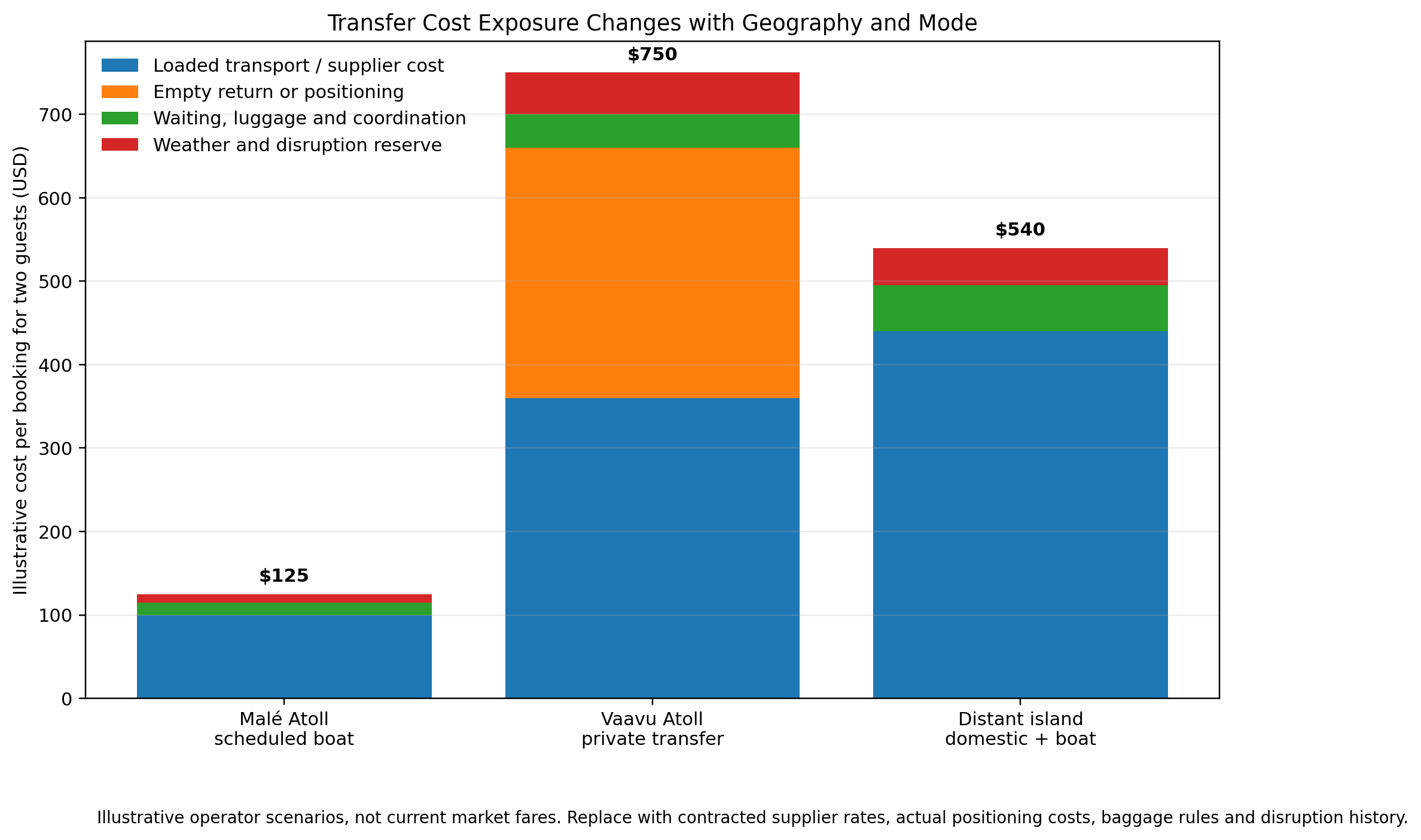
The scenarios are illustrative and should be replaced with each operator’s contracted rates and operating history.
Scheduled speedboats: price the seat and the service
For many islands in Malé Atoll, scheduled speedboats provide the most commercially manageable option. The guesthouse purchases or arranges individual seats rather than financing the entire vessel.
Suppose a return supplier ticket costs USD 50 per guest. For two guests:
Component | Cost |
|---|---|
Two return tickets | USD 100 |
Booking and airport coordination | USD 15 |
Disruption reserve | USD 10 |
Total cost | USD 125 |
With 3% payment cost and a 15% target margin:
Required selling price = USD 125 ÷ (1 − 0.03 − 0.15)
= USD 152.44 per booking
The price is not simply two tickets with a small markup. The guesthouse is also selling certainty: confirming the departure, monitoring the flight, identifying the guest, communicating delays and resolving missed connections.
An earlier official visitor survey found that 47% of respondents used speedboat transfers. It also found that most visitors valued hotel-transfer service highly. These are historical 2015 results rather than current market shares, but they demonstrate how central transfers have long been to the Maldives visitor experience.
Private transfers: the empty return must be visible
A private transfer can be appropriate when:
guests arrive outside scheduled service times;
the group is large;
the island lacks a convenient scheduled connection;
privacy has substantial value;
the booking is time-sensitive; or
the guest accepts the additional cost.
Consider an illustrative Vaavu Atoll transfer:
Component | Cost |
Loaded airport-to-island leg | USD 360 |
Empty return or positioning leg | USD 300 |
Waiting, luggage and coordination | USD 40 |
Weather and disruption reserve | USD 50 |
Total operating exposure | USD 750 |
With a 20% target margin and 3% selling cost:
Required charter price = USD 750 ÷ 0.77
= USD 974.03 before mandatory charges and taxes
If six guests travel together, the underlying transfer cost is approximately USD 162 per guest. If two guests travel, it is approximately USD 487 per guest.
The vessel has not become more expensive. The cost is being divided among fewer passengers.
This is why private transfer prices should be quoted per vessel, with a clear maximum passenger and luggage allowance, rather than disguised as a low per-person rate that assumes full capacity.
Domestic flight and boat combinations
For distant islands, the transport chain may include:
airport reception;
movement to the domestic terminal;
domestic check-in;
baggage handling;
flight waiting time;
domestic flight;
arrival coordination;
local speedboat or vehicle transfer; and
contingency for missed connections.
Maldivian stated in 2026 that its network could connect international passengers to 17 destinations beyond Malé. Velana International Airport also directs passengers transferring domestically to a separate domestic terminal.
A distant-island package for two guests might contain:
Component | Illustrative cost |
Return domestic flights | USD 340 |
Airport and island boat transfers | USD 100 |
Baggage, waiting and coordination | USD 55 |
Disruption reserve | USD 45 |
Total cost | USD 540 |
This transfer should not be sold as a single non-refundable block unless the operator understands each supplier’s cancellation rules. A delayed international arrival may affect the flight but not the local boat. A cancelled domestic sector may require accommodation in Malé. Excess luggage may be charged separately.
Every link in the chain needs a named party responsible for solving the problem.
Public ferries: low price does not remove coordination cost
Public and scheduled ferry networks can expand affordable access to local islands. Raajje Transport Link provides routes, schedules, seat booking and electronic tickets through its platform.
A guesthouse using public transport should nevertheless check:
operating days;
embarkation point;
luggage rules;
schedule changes;
weather cancellations;
the distance between the airport and ferry terminal;
whether the guest can realistically make the connection; and
the cost of an overnight stay when the connection is missed.
A USD 5 ferry ticket can be part of a USD 60 coordination problem if the international flight arrives after the last departure.
Public ferry access should therefore be presented as a transport option, not an unconditional airport-transfer guarantee.
Night transfers require a different price
A late-night private transfer may require:
overtime or additional crew;
harbour lighting and assistance;
higher navigation risk;
fewer replacement vessels;
longer staff waiting;
late check-in support; and
compensation for a disrupted crew schedule.
The night-transfer premium should arise from these additional costs and risks—not from an arbitrary percentage.
A practical rule is:
Night premium = Additional night operating cost + additional risk reserve
The guest should be told why the rate differs and what conditions may prevent the journey from operating.
Supplier resale and commission are not the same
There are two common commercial structures.
Resale model
The guesthouse buys the transfer at a net rate and resells it.
If the supplier net cost is USD 100 and the guesthouse charges USD 125, the gross spread is USD 25. From this amount, the guesthouse must still cover payment fees, coordination, refund risk and tax obligations.
Commission model
The supplier charges the guest and pays the guesthouse an agreed commission.
If the public transfer price is USD 100 and commission is 12%, the guesthouse earns USD 12. It should not record the full USD 100 as its own transfer revenue.
Maldives tax rules distinguish agency relationships from principal transactions, and travel-agency services are treated as tourism goods and services. Operators should document whether they are acting as principal, reseller or agent.
Transfer-inclusive packages can hide large liabilities
“Free transfer” is not free to the operator.
A transfer-inclusive package becomes risky when:
the international flight arrives outside scheduled hours;
the supplier increases its rate;
a child becomes chargeable under the supplier’s policy;
excess baggage is excluded;
the trip requires an overnight connection;
weather changes the transport mode; or
the guest changes flights after booking.
The package should specify:
included route and mode;
eligible arrival and departure times;
standard baggage allowance;
waiting-time limits;
child and infant treatment;
missed-connection responsibility;
weather alternatives; and
the amount refundable when the transfer is cancelled.
Price the whole chain
For Malé Atoll, the main problem may be seat confirmation and airport coordination.
For Vaavu Atoll, it may be the relationship between scheduled services and private alternatives.
For distant islands, it is the chain of air and sea connections.
The operator should ask five questions:
What does the supplier charge?
What work does the guesthouse perform?
What happens to the empty or positioning leg?
Who pays when the connection fails?
What margin remains after all costs?
The Maldives is a nation in which a straight line on a map may cross open ocean. Transfer pricing must therefore describe more than distance. It must describe the journey required to turn an international arrival into a guest standing safely at the guesthouse reception.
Next in the series
Room Only, Half-Board or All-Inclusive? Choosing the Right Package
The next article will Explain the main accommodation and meal-plan models.