Guesthouse Pricing Series: What Should Your Guesthouse Room Really Cost?
17 Jul 2026, 06:52 · by IzuCT · 10 min read · Tourism · EN

Guesthouse pricing should begin with real costs, realistic occupancy, commissions, replacement reserves and profit—not competitor rates. Calculate the required base rate, distinguish margin from markup, add taxes correctly, and treat break-even as a boundary.
Free tourism insights
Get Free Tourism Insights
Receive selected MTO insights, tourism data alerts, and new resource updates by email.
Get Free Tourism InsightsEvery guesthouse owner eventually faces the same question: How much should I charge?
The answer is rarely visible on OTAs. It cannot be found by copying the cheapest property on the island, adding a small amount to last year’s rate or asking a neighbouring operator what they charge. A room price sits at the meeting point of several forces: operating cost, occupancy, taxes, commissions, seasonality, competition and the value guests attach to the room and island.
This article begins a nine-part practical pricing series for Maldives guesthouses. Each article will address one operator problem through a plain-language framework, a worked example and an action checklist.
The series will examine: calculating the real cost of a guesthouse room; understanding what remains after taxes, commissions and payment fees; comparing competitors without blindly copying their prices; using seasonal and dynamic pricing; pricing excursions and water sports; pricing airport transfers and domestic transport; choosing among room-only, meal-plan and inclusive packages; constructing profitable bundled packages; and adding value, controlling discounts and auditing the complete pricing system.
This first article begins beneath everything else, with cost. And visit our digitaltools page to test the ideas discussed here.
A room-night disappears at sunrise
A guesthouse room is an unusual product. A shop can keep an unsold shirt and offer it tomorrow. A warehouse can store a spare part. An empty guesthouse room cannot be preserved.
When the sun rises over the island, last night’s unsold room disappears from the inventory forever. This is why hospitality is described as a business with fixed capacity, perishable inventory and demand that changes over time. A guesthouse cannot quickly add five rooms when demand rises, nor can it store tonight’s empty rooms for the high season.
Yet the empty room was not free.
The building still had to be financed. Salaries remained payable. Internet, maintenance, licences and software continued. Air-conditioners aged. Mattresses moved one night closer to replacement.
The first principle of sustainable pricing is therefore: An occupied room must help pay for the nights when other rooms are empty.
Why the competitor’s price is not your cost
Suppose a nearby guesthouse advertises a room for USD 65. That tells you something about the market. It tells you almost nothing about whether USD 65 will work for your business.
The competing property may: own its building while you pay rent; employ family members without recording their full labour cost; have older furniture and little debt; receive most bookings directly; exclude breakfast or taxes; operate with a lower maintenance standard; be discounting temporarily to collect reviews; or be losing money.
Competitor prices will be examined later in this series. First, the operator needs a private number that no booking platform can provide:
What does one occupied room-night really cost this business?
Let's follow the steps
1. Separate fixed costs from variable costs
Fixed costs
Fixed costs generally continue whether zero rooms or every room is occupied.
Examples include: permanent salaries; rent or lease payments; loan interest and other financing costs; licences and insurance; internet and software subscriptions; accounting and administration; security; routine maintenance contracts; management costs; and depreciation or replacement reserves.
These costs are not perfectly fixed forever. Electricity, staffing and maintenance can change as the business grows. The distinction is still useful for short-term pricing.
Variable costs
Variable costs arise mainly because a guest occupies a room.
Examples include: breakfast; drinking water; toiletries; laundry; housekeeping materials; additional electricity and water; guest amenities; booking payment fees; an room-turnover costs.
The difference matters. Fixed costs are spread across the rooms the guesthouse expects to sell. Variable costs are added to every occupied room-night.
2. Do not forget depreciation
A television may last several years. A mattress may survive hundreds of nights. An air-conditioner can operate long after its purchase invoice has disappeared from the monthly accounts. None of these assets lasts forever. When replacement is ignored, the room can appear profitable until several items fail at once.
A simple replacement reserve can be calculated as:
Annual replacement reserve = Replacement value ÷ Expected useful life
Suppose room furniture and equipment would cost USD 3,000 to replace and are expected to last five years.
The annual reserve is:
USD 3,000 ÷ 5 = USD 600
The monthly reserve is USD 50 per room.
For ten rooms, this becomes USD 500 per month. It is not necessarily money that must be spent immediately. It is recognition that some current revenue belongs to the future room.
3. Use realistic occupancy, not hope
Imagine a ten-room guesthouse operating for 30 days. Its monthly capacity is:
10 rooms × 30 nights = 300 available room-nights
The fixed cost must not be divided by 300 unless the property genuinely expects 100% occupancy. At 55% occupancy, expected occupied room-nights are:
300 × 55% = 165 occupied room-nights
If monthly fixed costs are USD 8,000:
Fixed cost per occupied room-night = USD 8,000 ÷ 165 = USD 48.48
If variable cost is USD 18:
Full cost per occupied room-night = USD 48.48 + USD 18 = USD 66.48
This is the economic floor before commissions and profit. The occupancy assumption has enormous influence. At 35% occupancy, the same fixed costs are carried by only 105 sold room-nights. At 75%, they are spread across 225.
Figure 1. Occupancy and the required room rate.
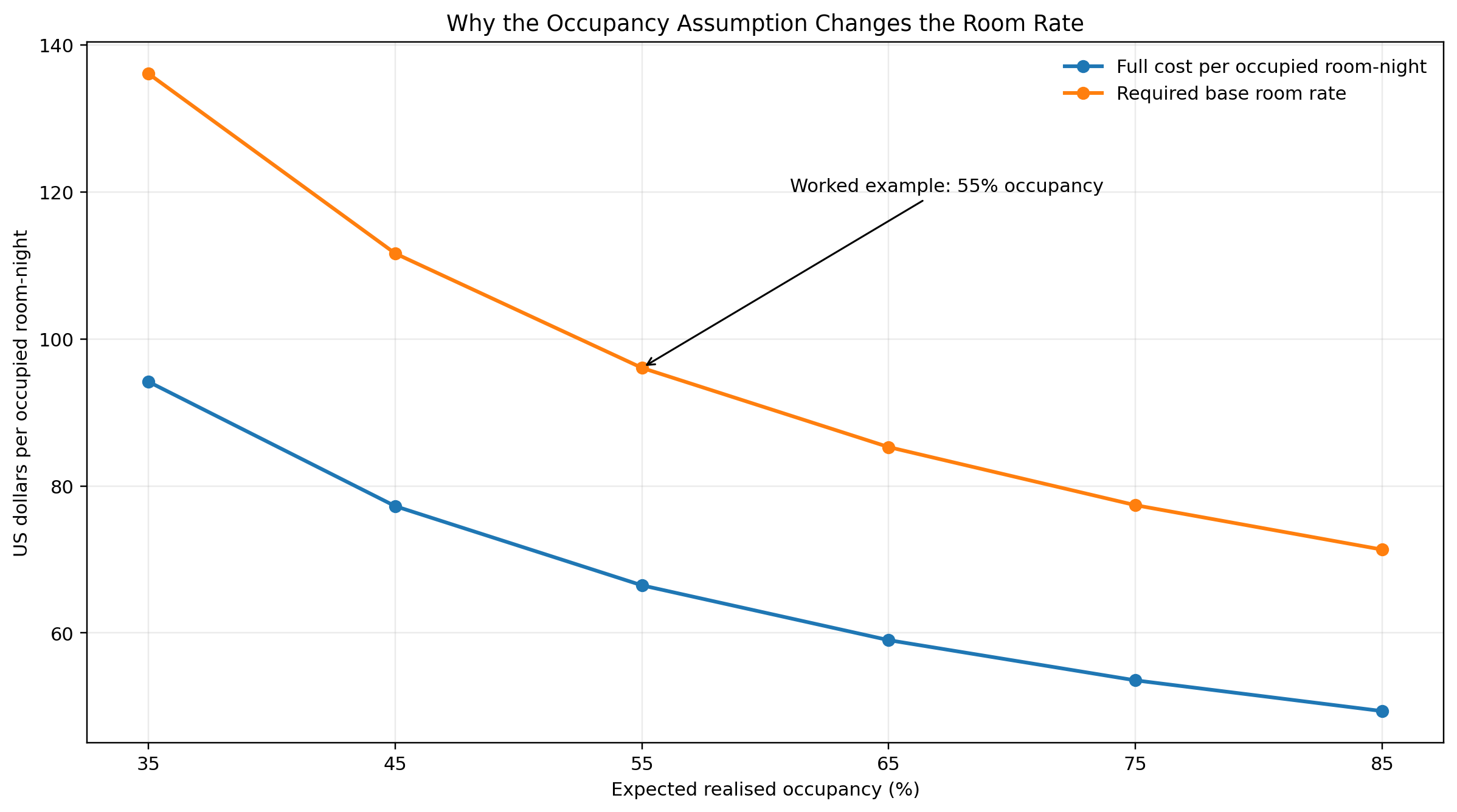
Illustrative ten-room guesthouse with monthly fixed costs of USD 8,000, variable cost of USD 18, weighted distribution cost of 10.8% and a 20% target margin.
The graph reveals an important asymmetry. Moving from 35% to 55% occupancy sharply reduces the required rate because fixed costs are spread over many more nights. Moving from 75% to 85% produces a smaller improvement.
This does not mean the solution is to cut prices until occupancy rises. A lower price may increase occupancy while reducing total profit. The useful question is whether the additional rooms sold generate enough contribution to compensate for the lower rate.
4. Add distribution costs
A USD 100 booking does not produce USD 100 of business revenue when it arrives through a commission-charging platform. Suppose:
65% of bookings arrive through an OTA charging 15%; and
35% arrive directly with a 3% payment cost.
The weighted distribution cost is:
(65% × 15%) + (35% × 3%) = 10.8%
This weighted percentage is more useful than applying the OTA commission to every booking.
Use the actual commission and payment terms in your agreements. General industry estimates are not a substitute for the property’s invoices and contracts.
5. Decide on a target profit margin
Profit is not whatever remains accidentally at the end of the year.
A sustainable business needs a return for: the capital invested; the owner’s risk; unexpected repairs; weak seasons; future improvements; and the possibility that actual occupancy falls below forecast.
Suppose the guesthouse targets a 20% operating margin.
The central formula is:
Required base room rate
Required base room rate = Full cost per occupied room-night ÷ (1 − distribution cost − target margin)
Using the example:
Full cost: USD 66.48
Distribution cost: 10.8%
Target margin: 20%
Required base room rate = 66.48 ÷ (1 − 0.108 − 0.20)
Required base room rate = approximately USD 96
The mathematics is less important than the logic:
Start with the cost of delivering the room. Allow for the cost of selling it. Then create space for profit.
A practical digital version of this calculation can be linked to the Maldives Guesthouse Go/No-Go Navigator, which tests room rates against occupancy, costs, ancillary revenue, debt and low-season risk.
6. Margin is not the same as markup
These terms are often used as though they mean the same thing.
They do not.
Suppose a room costs USD 80.
A 20% markup produces:
USD 80 × 1.20 = USD 96
The profit is USD 16, which is only 16.7% of the selling price.
A 20% profit margin requires:
USD 80 ÷ 0.80 = USD 100
The profit is USD 20, which is 20% of sales.
When operators intend to earn a margin but use a markup calculation, they systematically underprice.
7. Find the break-even room rate
The break-even rate is the price at which the operation covers its estimated costs but earns no target profit.
Using the example:
Break-even base rate = Full cost ÷ (1 − distribution cost)
USD 66.48 ÷ (1 − 0.108) = approximately USD 74.53
This number is useful, although it should not become the normal public rate.
A business that continuously sells at break-even has no financial protection against: lower occupancy; major repairs; inflation; supplier increases; cancellations; bad debts; or reinvestment needs.
The break-even rate is an emergency boundary—not a destination.
8. Convert the base rate into the guest’s final price
The base room rate is not necessarily the amount the guest pays.
From 1 July 2025, the Maldives tourism-sector GST rate is 17%. Tourist establishments covered by the service-charge rules must levy at least 10% service charge, and the service charge is subject to GST at the same rate as the underlying service.
For an inhabited-island tourist guesthouse with 50 or fewer registered rooms, Green Tax is USD 6 per taxable tourist per day of stay. Green Tax must not itself be subjected to GST.
For a base room rate of USD 96 and two taxable adult guests:
Component | Amount |
|---|---|
Base room rate | USD 96.00 |
10% service charge | USD 9.60 |
17% TGST on room and service charge | USD 17.95 |
Green Tax: USD 6 × 2 guests | USD 12.00 |
Final guest price | USD 135.55 |
Figure 2. Building the final guest price.
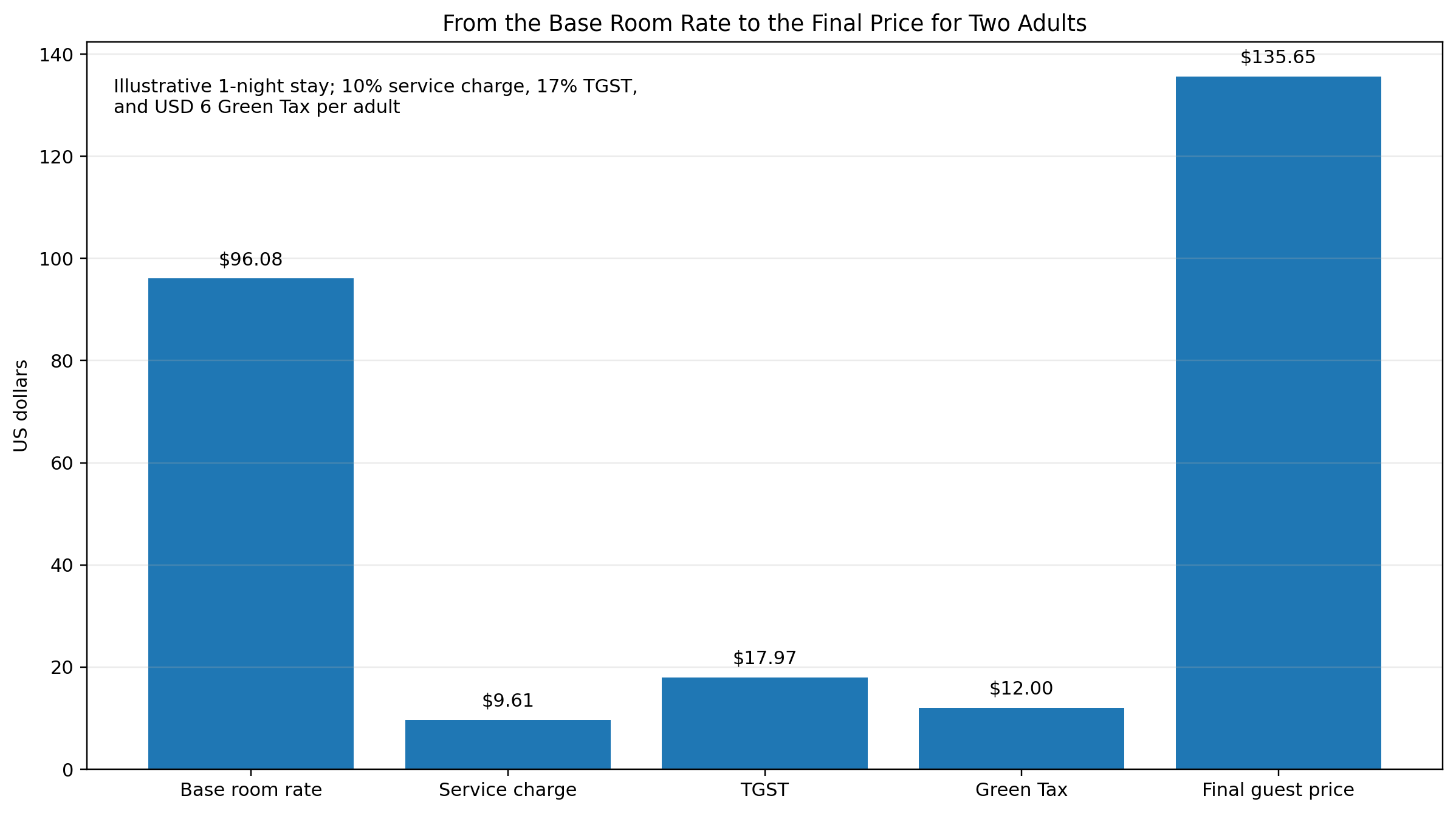
The final amount is much higher than the base rate, yet the difference is not additional ordinary revenue for the operator.
This is why comparing your base price with a competitor’s tax-inclusive final price can lead to a serious error.
9. Cost is the floor, not the complete pricing strategy
The calculation tells us what the business needs. It does not automatically tell us what the market will pay. Historical research using Maldives accommodation data from 2016 found substantial variation in guesthouse prices, including monthly seasonality. It also found that prices were associated with characteristics such as beachfront location, environmental quality, staff language ability and management training. These historical estimates should not be used as current premiums, yet they show that a room is more than its walls: guests also value service, location and the island environment.
This creates three possible situations:
The market price is above the required rate
The guesthouse may have room to earn a stronger return, reinvest or offer carefully designed benefits.
The market price is close to the required rate
The operator needs tight control over costs, commissions and discounts.
The market price is below the required rate
The problem cannot be solved permanently by selling more rooms at a loss. The operator must reconsider costs, debt, channel mix, product quality, target segment or the business model itself.
Action checklist: calculate your room cost this week
List every monthly fixed cost.
Include a fair salary for working owners and family members.
Add depreciation or an equipment replacement reserve.
Calculate the variable cost of one occupied room-night.
Count total available room-nights.
Use realised occupancy after cancellations and no-shows.
Calculate fixed cost per expected occupied room-night.
Add variable cost.
Calculate the weighted cost of OTAs and direct payments.
Select a target profit margin.
Calculate the required base room rate.
Calculate the break-even rate separately.
Add service charge, TGST and applicable Green Tax correctly.
Compare the final price with genuinely similar properties.
Review the calculation whenever costs or occupancy change.
Visit our digitaltools page to test the ideas discussed here.
The next article
A guest may pay USD 135 for a room while the guesthouse retains far less after taxes, service charge, OTA commission and payment fees. The next article in this series will follow that money through the system: The Price the Guest Pays Is Not the Revenue You Keep. Because before an operator can manage a price, she must see where it goes.