In a Country Made of 99% Water, Does a Private Pool Still Matter?
28 May 2026, 15:20 · by IzuCT · 12 min read · Tourism · EN
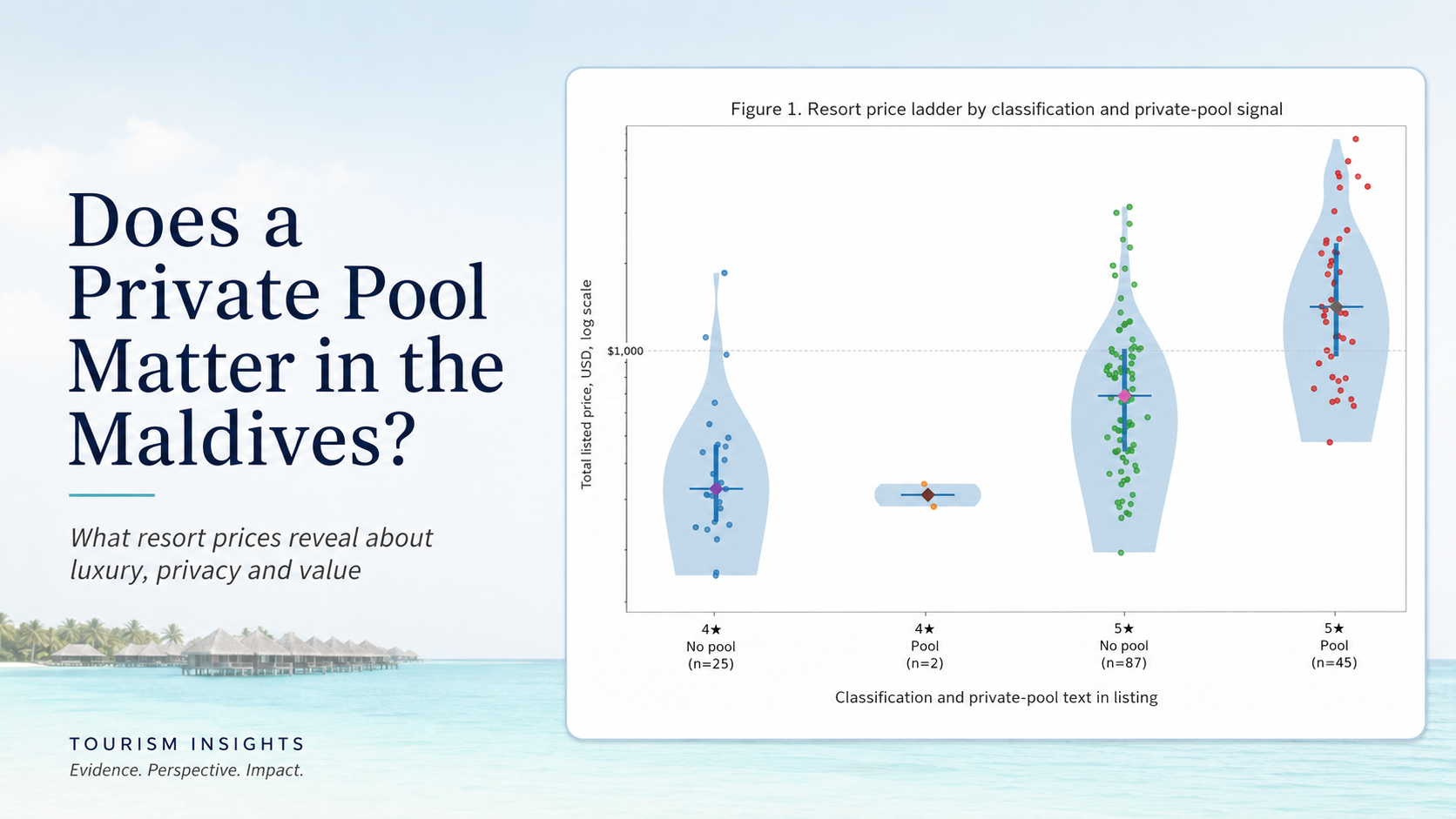
Here I test a simple but important tourism question: do private pools really add value in the Maldives, where every resort island is already surrounded by beautiful sea? Using 164 resort listings for the first week of June 2026, I compare prices by classification, room type, private-pool signal, distance and reputation.
Free tourism insights
Get Free Tourism Insights
Receive selected MTO insights, tourism data alerts, and new resource updates by email.
Get Free Tourism InsightsThe question that started this analysis
About two years ago, in New York, an entrepreneur entering the tourism industry kept telling me that private pools are essential in the Maldives. I understood the argument, but I was not fully convinced. The Maldives is already surrounded by water. Every island is framed by lagoon, reef, beach and sea. If a guest can walk directly into the Lagoon, why should a private pool matter so much?
That question stayed with me because it touches something larger than pool. It is really a question about how luxury is created in the Maldives. Is the value of a resort room mainly the island itself? Is it the distance from the airport? Is it the star classification? Is it the room type? Or is the modern Maldives resort product increasingly about controlled privacy?
So, I decided to test the question using price data. I wanted to see whether private pools appear as a real price signal in the market, or whether they are just a fashionable design feature. In simple terms, I asked: when resorts list rooms, do rooms and resorts associated with private pools command a measurable premium?
The answer is yes. But the result is more interesting than “private pools are expensive.” The data suggests that private pools are part of a wider luxury architecture. They work alongside five-star classification, room format, review reputation, meal plans and brand positioning to convert a beautiful island setting into a higher-priced tourism product.
Source and method
The analysis uses 164 Maldives resort listings from Booking.com for the first week of June. The search basis is one bedroom, one night and two adults. I use total listed price in US dollars as the main price variable because tourists respond to the full amount they are asked to pay, not only the base room rate.
The dataset includes resort classification, room class, meal plan, review score, review count, private-pool text, sustainability certification, transfer-offer text and distance from Velana International Airport. These fields are useful because they allow the analysis to move beyond simple price comparisons. Instead of only asking which resort is expensive, we can ask which visible attributes are associated with higher prices.
I estimate a hedonic price model using the natural logarithm of total price as the dependent variable. This method is appropriate because resort prices are highly uneven, with a small number of ultra-luxury properties pulling the average upward. The model controls for five-star classification, private-pool text, room class, meal plan, distance from Velana International Airport, review score, review count, sustainability certification, transfer-offer text, sponsored-ad text and featured-listing text.
I should warn that the model should be read carefully. It is not a causal experiment. A private pool is not randomly added to one resort and removed from another. Resorts with private pools may also have stronger brands, better service, larger villas or more exclusive island settings. Still, the model is useful because it shows whether the private-pool signal remains strongly associated with price after several other visible factors are controlled.
Hypothesis 1: private pools should not matter much because the Maldives already has beautiful sea
My first hypothesis was sceptical. I expected private pools to matter, but I did not expect them to be among the strongest price signals. In the Maldives, the beach and lagoon are not distant amenities. They are usually part of the immediate resort environment. This makes the private-pool question analytically interesting. If the sea is already available, then the pool must be selling something else.
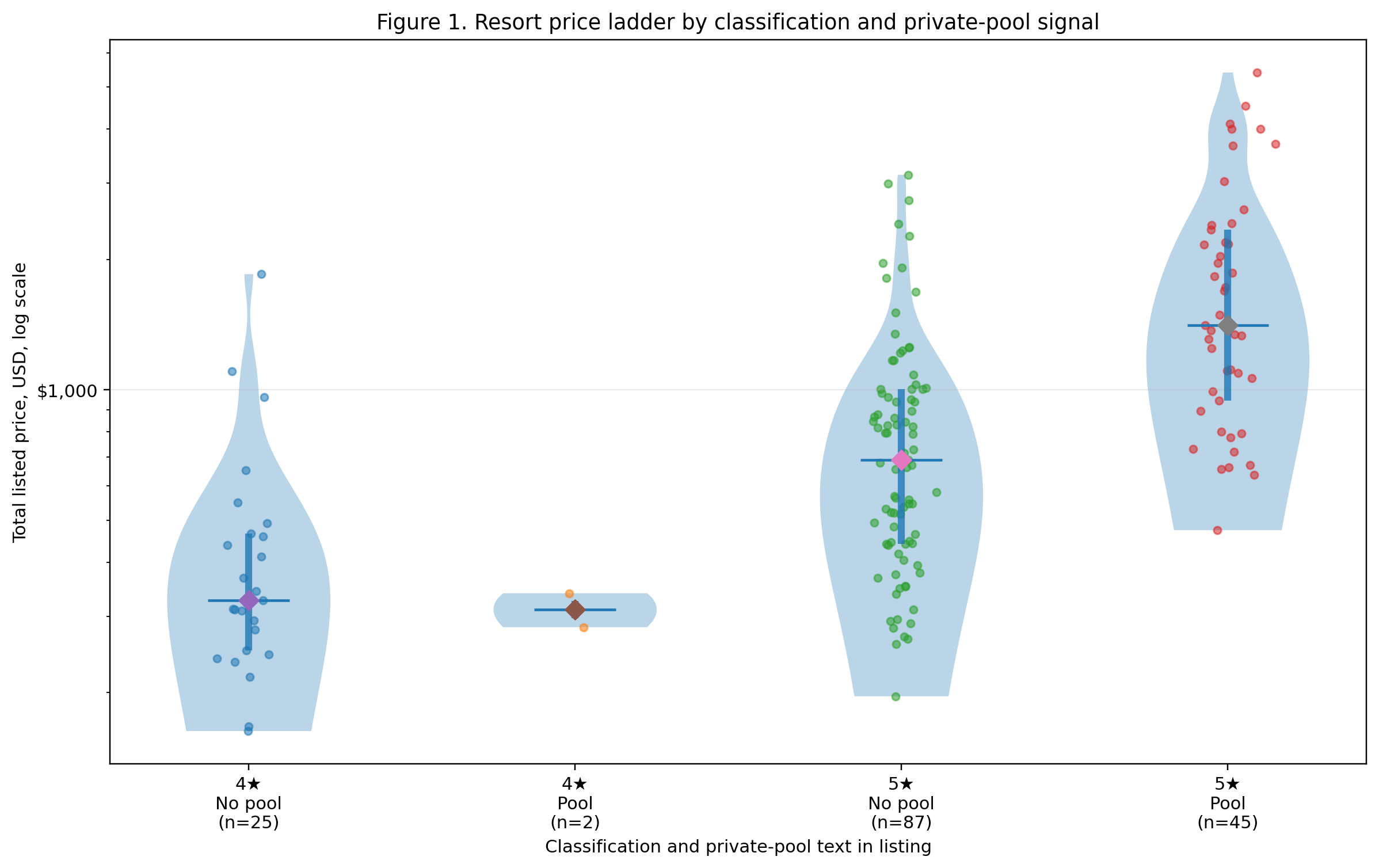
The raw data gives the first answer. Resorts with private-pool text have a median total listed price of USD 1,357. Resorts without private-pool text have a median total listed price of USD 545. This means the private-pool group has a median price about 149% higher than the non-private-pool group. The difference is too large to ignore. It suggests that private pools are not merely decorative. They are a market signal. They appear to mark a higher tier of privacy, space and personal control.
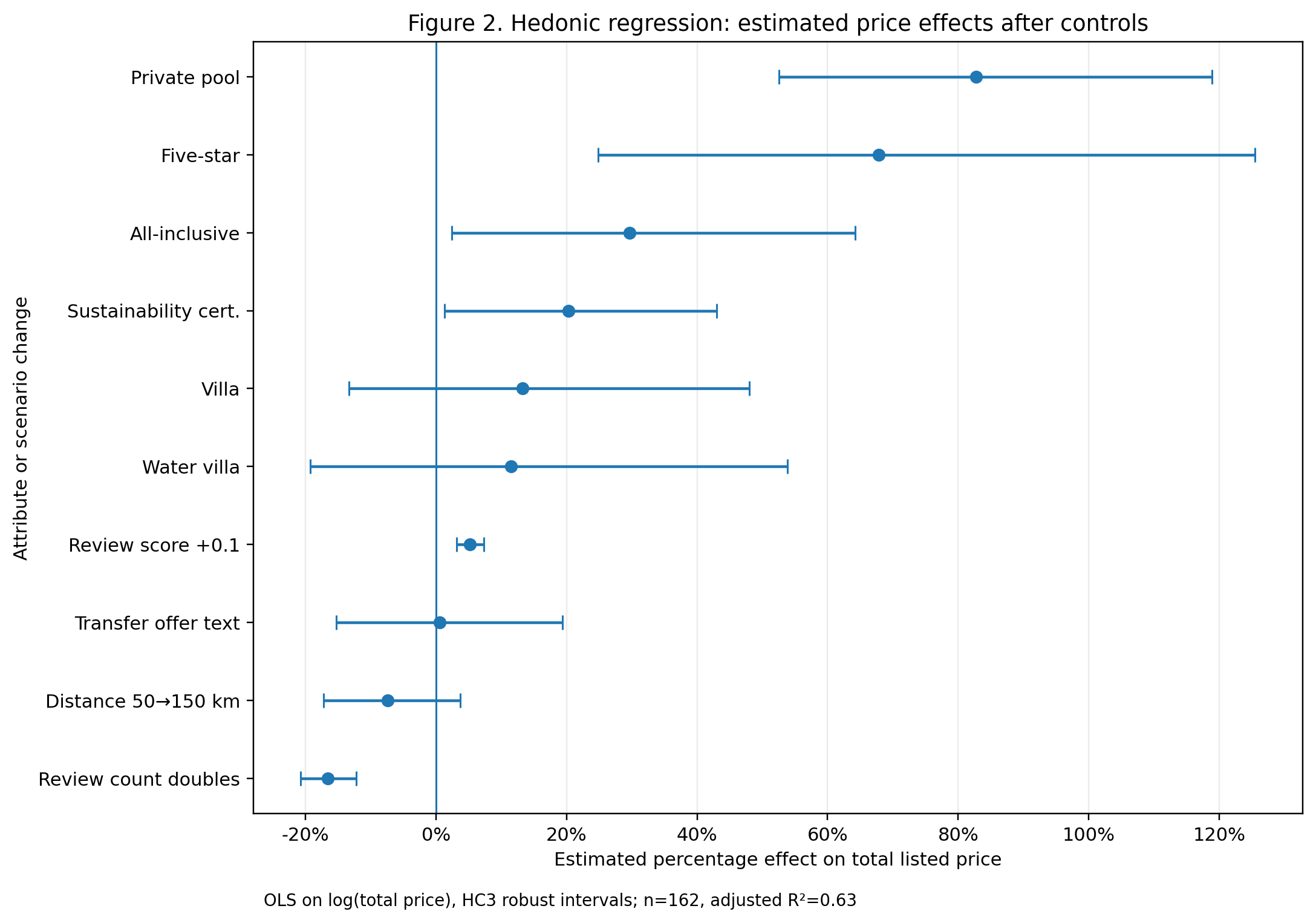
The regression result strengthens this point. After controlling for classification, room class, meal plan, distance, review score, review count and other listing features, private-pool text is associated with an estimated 83% higher total listed price. This does not mean the pool alone creates an 83% premium. It means the private-pool signal remains one of the strongest visible markers of higher pricing in the resort dataset. The interpretation is straightforward. In the Maldives, the private pool is not competing with the ocean. It is adding another layer to the experience. The sea offers nature, openness and beauty. The private pool offers privacy, control, convenience and social separation. For high-paying guests, that distinction appears to matter.
Hypothesis 2: classification still separates the market
My second hypothesis was that star classification would matter strongly. This was expected because classification signals service level, facilities, design standards and the overall promise of the resort.
The data confirms this. Five-star resorts have a median total listed price of USD 864. Four-star resorts have a median total listed price of USD 326. The five-star median is therefore about 165% higher than the four-star median. This is not a small classification difference. It is a major price boundary.
The regression also confirms the classification premium. After controlling for other visible attributes, five-star listings are associated with an estimated 68% higher total price. This shows that classification continues to matter even after room type, review score, private-pool text and distance are included.
This finding is important for investors and policymakers because it shows that the Maldives resort market is tiered. A resort is not priced only by location. It is priced by the promise attached to the property. Classification helps turn that promise into a price.
Hypothesis 3: distance from the airport should reduce price
My third hypothesis was that distance from Velana International Airport would reduce price. This is a reasonable assumption. Longer distance usually means more travel time, higher transfer cost and more logistical friction. In many destinations, distance from the main arrival point would be treated as a disadvantage.
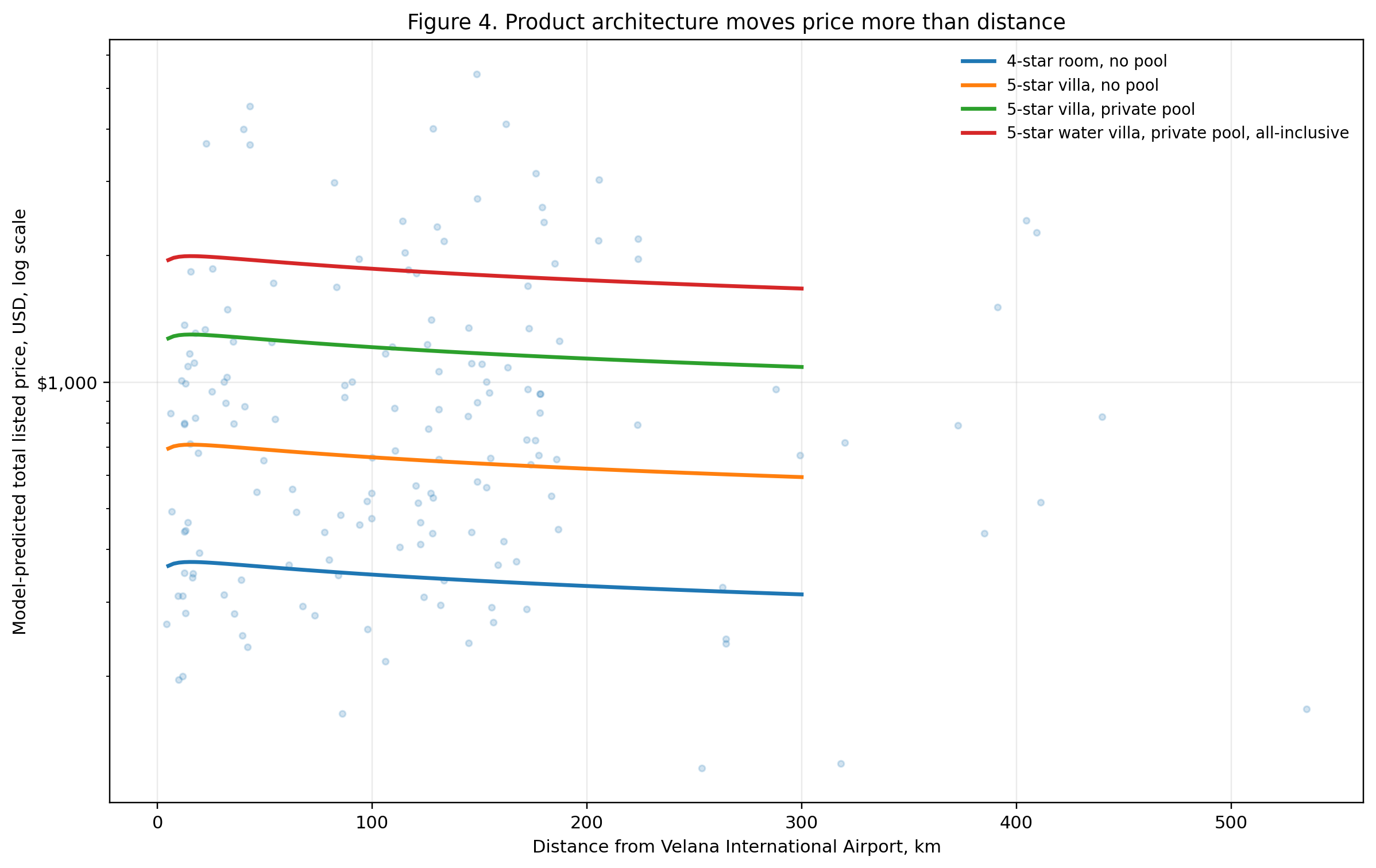
The Maldives does not follow that simple pattern. The controlled model suggests that moving from 50 km to 150 km from the airport is associated with an estimated 7% lower price, but the confidence interval crosses zero. In plain language, distance is not a strong independent price driver after product features are controlled.
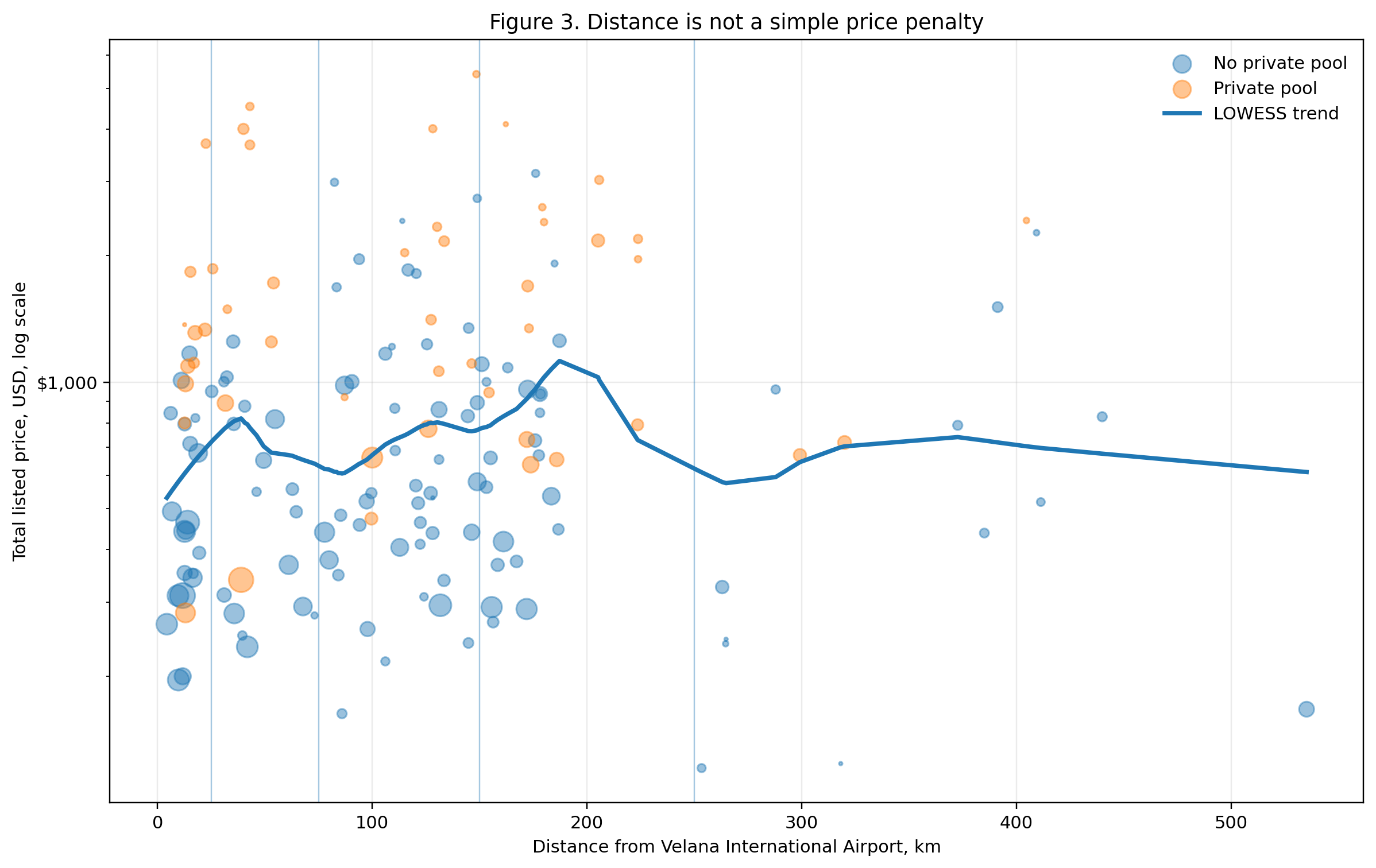
The chart tells the same story. Some expensive resorts are close to the airport. Some expensive resorts are remote. Some remote resorts are relatively affordable. This means distance does not operate as a simple penalty. It becomes valuable only when it is converted into exclusivity, privacy or a stronger destination experience.
This finding suggests changes how we should think about tourism infrastructure. Reducing travel time is useful, but it does not automatically create higher resort prices. A remote island can become premium if the journey feels like part of the escape. The same remoteness can become a weakness if the product does not justify the transfer. Indeed, the Front Office Manager, who previously worked as a guest butler, confirmed to me that distance is not really the issue. In his view, what truly matters is the overall guest experience; in the Maldives, travel distance is not always the obvious differentiating factor.
Hypothesis 4: reputation should carry a price premium
My fourth hypothesis was that review scores would be associated with higher prices. This matters because online reputation is now part of the tourism product. Guests do not only buy what the resort says about itself. They also buy what previous guests appear to confirm.
The model finds that a 0.1-point increase in review score is associated with about a 5% higher total listed price, holding other visible factors constant. This is a meaningful result because resort review scores are already high and compressed. In a market where many properties score well, small differences in perceived quality can still carry commercial value.
Review count has a negative association after controlling for review score. A doubling of review count is associated with about a 17% lower price. This should not be read as “more reviews reduce value.” A better interpretation is that high review counts may identify older, larger or more mass-market resorts, while smaller review bases may include newer, more exclusive or more tightly positioned properties.
Neverthless, resort managers should know its not the numbers of reviews that matters. This result reminds us that price is partly about scarcity. A resort can be highly reviewed and still operate in a wider market segment. Another resort may have fewer reviews but stronger exclusivity, stronger brand power or a more premium positioning.
What the model says about the variables of Maldives resort product
The model explains about 63% of the variation in log total price after adjustment for predictors. For a cross-sectional price snapshot, that is a strong result. It means the visible features in the dataset explain much of the resort price ladder.
The strongest lesson is that Maldives resort pricing is not random. It is structured around a set of signals. Private pools signal privacy. Five-star classification signals service depth. Review scores signal trust. All-inclusive meal plans signal a broader consumption bundle. Sustainability certification appears to sit within the same premium language, although the model cannot prove that certification itself causes higher prices.
All-inclusive meal plans are associated with about 30% higher total price. This is expected because total listed price includes more than the room. It also shows why total price is a better analytical variable than base price. Tourists experience the package, not the stripped-down rate.
Sustainability certification is associated with about 20% higher total price. This does not prove that tourists are directly paying 20% more for certification. Higher-end resorts may simply be more likely to have certification. Still, the result is worth tracking because sustainability may increasingly become part of premium positioning
The clearest story: luxury is controlled access to nature
The modelled scenarios show the main story clearly. A four-star room without a private pool sits in one price band. A five-star villa sits higher. A five-star villa with a private pool moves higher again. A five-star private-pool water villa with an all-inclusive plan moves into an even higher tier. These differences are larger than the price movement associated with distance alone. That means the Maldives resort price ladder is not mainly a map of kilometres. It is a map of controlled luxury.
This is where the private-pool result becomes more meaningful. The Maldives already has beautiful water, but the private pool changes the nature of access. It makes water private, immediate, predictable and personal. It allows the guest to enjoy the symbolism of water without sharing space, timing or visibility with others.
That is why the private pool matters. It is not replacing the lagoon. It is packaging the lagoon lifestyle into a more controlled form of luxury.
Outliers show what the dataset still cannot see
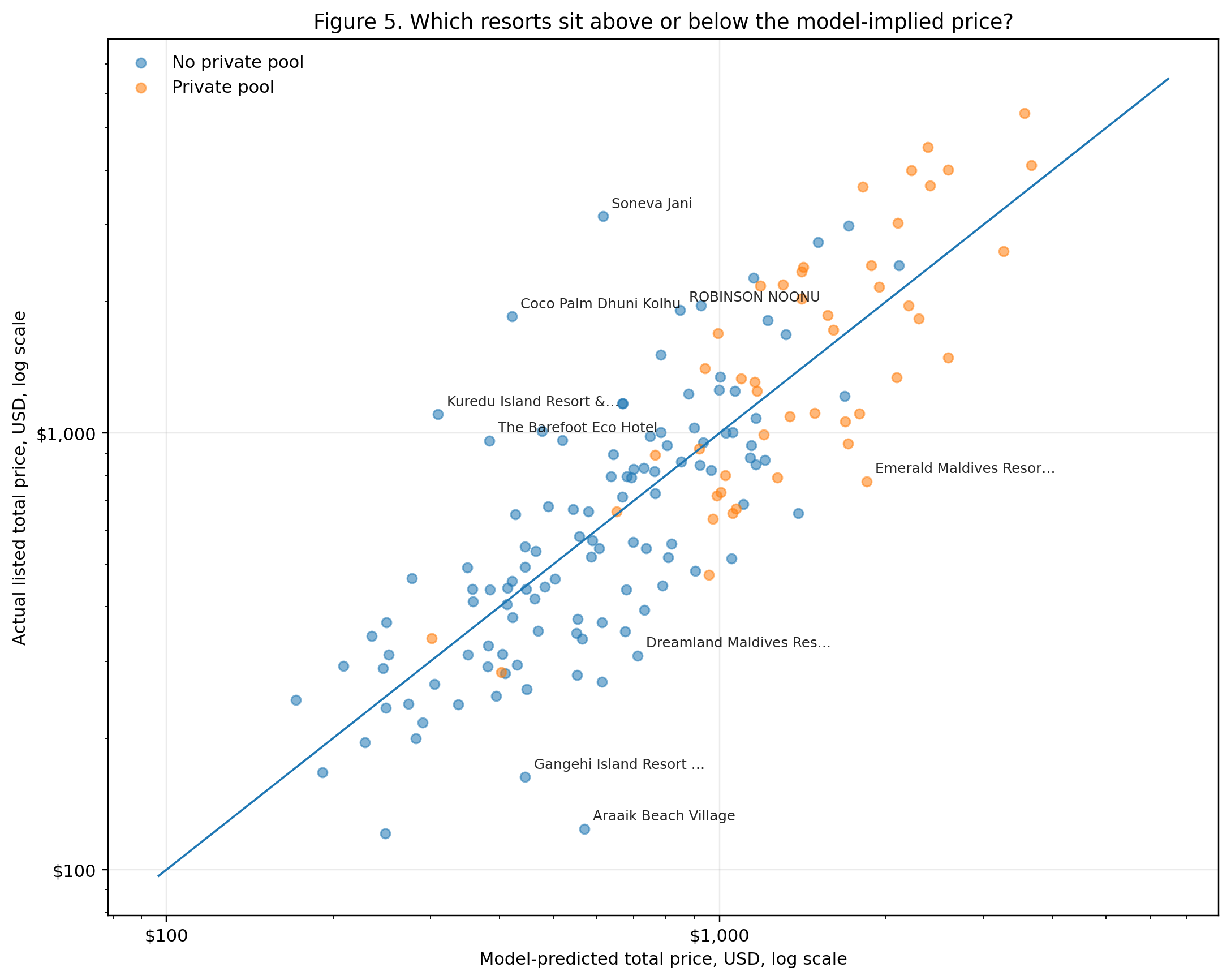
The actual-versus-predicted chart shows which resorts are priced above or below the model’s expectation. Properties above the predicted line may have unmeasured strengths such as global brand power, exceptional island quality, larger villas, stronger design, better food and beverage reputation, or a more complete service ecosystem. Properties below the predicted line may be discounting, repositioning, or targeting more value-sensitive demand.
This outlier analysis is important because it reminds us that visible Booking.com variables do not capture everything. Luxury is partly measurable, but not fully measurable. Staff-to-guest ratio, privacy norms, architectural quality, reef health, transfer experience and brand trust may all affect price.
This means online price data should be treated as a foundation rather than a complete explanation. The next stage should combine price data with environmental indicators, resort-level service features, transfer cost, island size, room size, occupancy and repeated observations across seasons.
Practical implications for tourism strategy
For investors, the result is direct. A private pool is not just a construction feature. It is a pricing signal linked to a higher-value segment. The investment question is not whether a pool looks attractive in a brochure. The question is whether the full product can support a privacy-led premium. For resort operators, the result shows that pricing power comes from a bundle of signals. Private pools, five-star positioning, strong reviews and package design work together. A resort that adds a private pool without strengthening service quality, maintenance and positioning may not capture the same premium. For policymakers, the analysis shows why tourism price data matters. Arrival numbers measure volume, but price data measures value. A country can receive more tourists while capturing less value per visitor. If the Maldives wants a high-value tourism strategy, it needs to monitor prices, not only arrivals.
For destination marketers, the findings show that the Maldives is not one resort market. There are several markets within the resort sector: near-airport convenience luxury, remote exclusivity, all-inclusive leisure, ultra-luxury private-island experiences and more affordable resort products. Each segment needs a different message.
For sustainability policy, the certification result should be treated as an invitation for deeper research. If sustainability is becoming part of premium positioning, then reef quality, waste management, energy systems and beach protection should be studied as value-generating assets, not only as compliance issues.
What I learned from testing the private-pool question
I began with a simple doubt. In a country surrounded by some of the most beautiful water in the world, I wondered whether a private pool really mattered. The data suggests that it does. But the real lesson is not about pools alone. The private pool is a symbol of a larger shift in resort value. Maldives luxury is not only about access to nature. It is about controlled access to nature. The guest pays not only for the sea, but for privacy, certainty, service and separation.
This matters for the future of tourism strategy. If the Maldives wants to protect its high-value position, it must understand which features actually generate price premiums. It must also understand whether those premiums come from genuine quality, scarcity, service, environmental excellence or simply branding.
A single June price snapshot cannot answer every question. It cannot prove causality, and it cannot measure full tourist willingness to pay. But it gives a strong market signal. Private pools, classification and reputation are not minor details in the resort price ladder. They are part of how the Maldives converts island geography into economic value.
The next step is to repeat this analysis across seasons, booking windows and years. With repeated data, we can test whether the private-pool premium is stable, whether sustainability premiums are growing, whether remote resorts are gaining or losing pricing power, and whether the Maldives is strengthening value per visitor.
Another important next step is to repeat a similar analysis for the guesthouse segment, where the target audience, value expectations and price drivers may be very different. Unlike luxury resorts, guesthouses may compete less on controlled exclusivity and more on affordability, local experience, accessibility, room quality, excursions, service reliability and proximity to beaches or transport links.
This would help show whether the same features that generate premiums in the resort segment also matter in the guesthouse market, or whether a different set of factors shapes value for budget-conscious and experience-seeking travellers. Such an analysis would be especially useful for understanding how local island tourism converts community-based hospitality into economic value.
For now, the entrepreneur’s instinct appears to have been right. In the Maldives, the pool matters because the highest-value guest is not only buying water. They are buying water on their own terms.