Maldives Resort Series: The Choice Architecture of Villas
07 Sep 2026, 12:17 · by IzuCT · 4 min read · Tourism · EN
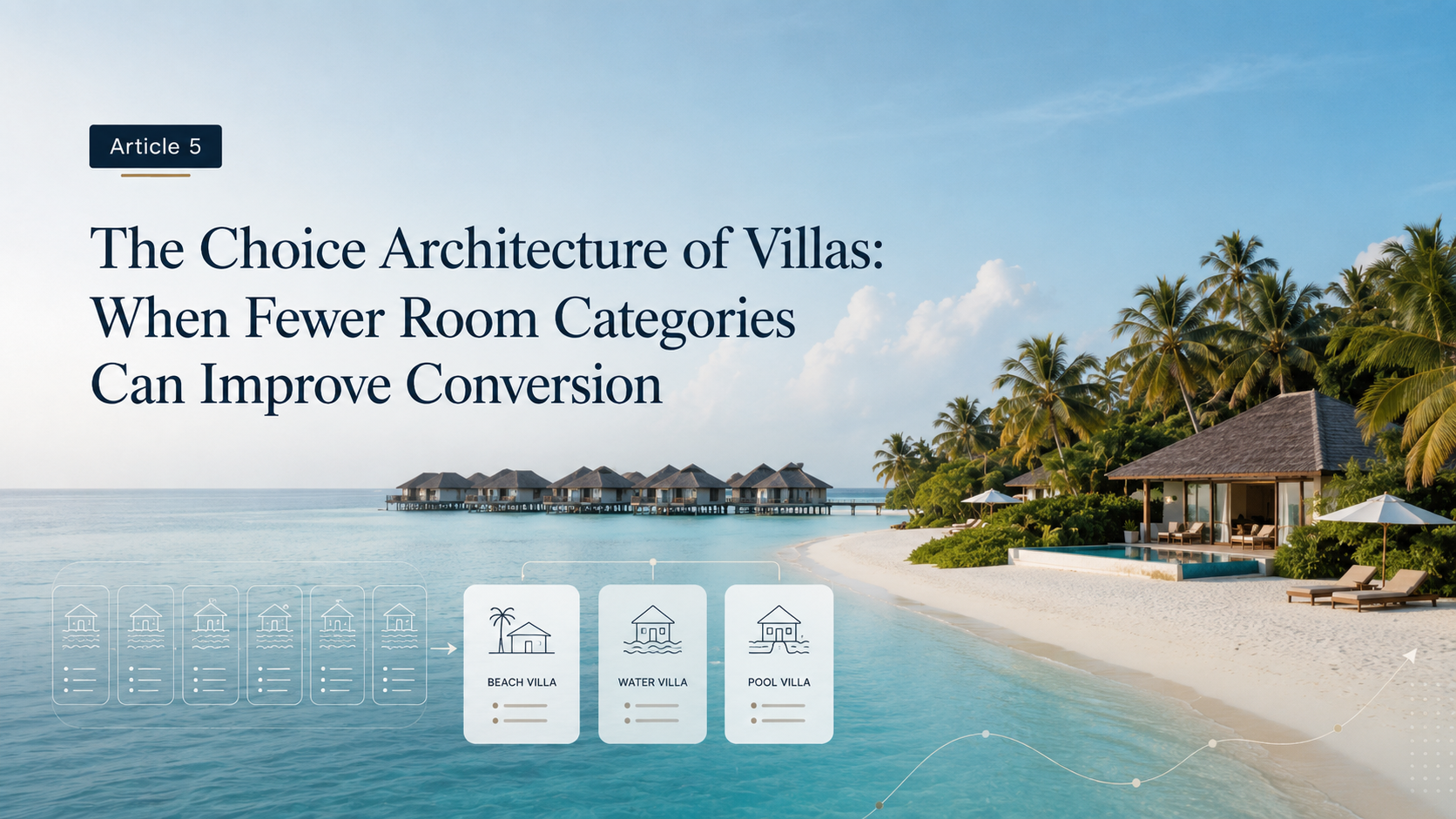
More villa categories improve price discrimination but can also create booking friction and fragmented inventory. In one illustrative resort, a tiny conversion improvement is enough for a simpler room architecture to outperform richer category pricing.
Free tourism insights
Get Free Tourism Insights
Receive selected MTO insights, tourism data alerts, and new resource updates by email.
Get Free Tourism InsightsCentral Question:
When can simplifying a resort's villa categories create more value than preserving every possible upsell distinction?
Hypothesis:
A Maldives resort can profit from fewer room categories when the resulting conversion improvement exceeds the yield lost from eliminating marginal category distinctions.
Article
When Six Beautiful Villas Become a Difficult Decision
Consider a guest who has finally chosen the Maldives.
Then the resort website asks another question.
Beach Villa. Sunset Beach Villa. Beach Pool Villa. Sunrise Water Villa. Sunset Water Villa. Water Pool Villa.
Then meal plans.
Then transfer types.
Then refundable and non-refundable conditions.
Each option may be commercially rational. Together, they can turn a dream into a spreadsheet.
Hospitality businesses often assume that more choice must increase the probability that every customer finds exactly what they want.
Behavioural research suggests the relationship is not that simple.
Experimental hotel-booking research comparing choice sets of 3, 9 and 30 rooms found evidence that larger choice sets can increase choice overload and reduce decision confidence, while filtering mechanisms can mitigate the effect. Other online hotel experiments similarly show that both the amount and presentation of information affect booking difficulty.
The question for a Maldives resort is therefore not “How many villa types can we sell?”
It is: How many distinctions create more pricing value than decision friction?
Why Island Resorts Multiply Choice
The Maldives naturally creates product differentiation.
A villa can be:
on land or over water;
sunrise or sunset;
with or without pool;
reef-facing or lagoon-facing;
near or far from facilities;
bundled with breakfast, half board or all-inclusive;
sold with different cancellation conditions.
Operationally, these characteristics are real.
Commercially, however, every characteristic does not necessarily need to become a separate public category.
The same lesson appears in package architecture: a package is useful when it makes a buying decision easier, not merely when it bundles more components.
The Economic Trade-Off
Fewer categories create one obvious cost.
The resort loses some ability to price-discriminate.
A guest willing to pay $25 more for “Sunset Water Villa” may now receive the view inside a broader “Water Villa” category. That is foregone yield.
But simplification can improve:
search speed;
comparison;
mobile booking;
decision confidence;
inventory flexibility;
room assignment;
maintenance substitution;
upselling after booking.
The correct question is therefore whether conversion gain exceeds lost category yield.
A 180-Key Illustration
Consider an illustrative 180-key branded resort receiving 100,000 direct booking sessions annually.
Current structure:
six major villa categories;
conversion rate: 2.8%;
2,800 bookings;
average stay: 5.5 nights;
ADR: $550;
estimated total contribution per booking, including ancillary contribution: $2,598.
Management considers simplifying six categories into four.
Assume this loses $12 of room yield per occupied night, or approximately $66 per 5.5-night booking.
Contribution per converted booking falls from $2,598 to $2,532.
But suppose conversion rises from 2.8% to 3.0%.
The economics become:
Structure | Conversion | Bookings | Contribution/booking | Annual contribution |
|---|---|---|---|---|
Six categories | 2.80% | 2,800 | $2,598 | $7.274m |
Four categories | 3.00% | 3,000 | $2,532 | $7.596m |
The simpler choice architecture creates approximately $321,600 more contribution.
Evidence classification: Illustrative Analytical Model.
The Surprising Threshold
How much conversion improvement is actually required?
Solve:
new conversion × $2,532 = 2.8% × $2,598.
Break-even conversion is approximately:
2.873%.
In other words, if simplifying the range sacrifices $66 per booking, the resort needs conversion to increase by only about 0.073 percentage points—from 2.800% to 2.873%—to recover the lost yield.
That is a much smaller hurdle than many teams would intuitively expect.
Fewer Categories Does Not Mean Fewer Experiences
This distinction is critical.
The resort can still physically possess sunrise villas, sunset villas, pool villas and superior locations.
It does not have to force guests to evaluate every distinction before purchase.
Some differences can be converted into:
post-booking paid upgrades;
preference requests;
loyalty privileges;
guaranteed-feature supplements;
algorithmic room assignment.
The resort can therefore preserve product richness while reducing decision complexity at the purchase stage.
This relates to a broader pricing lesson in why ADR alone can give the wrong signal. A higher achieved rate is not necessarily better if the structure producing it suppresses enough demand or shifts the mix adversely.
The Operational Side of Choice
There is another Maldives-specific gain.
Every villa category fragments inventory.
A resort island cannot create another room when one category sells out. If five sunset pool villas remain empty while the guest wants a standard water villa that has sold out, category rigidity can turn physical capacity into commercial unavailability.
Simpler room families can increase substitution flexibility across a finite island inventory.
This means choice architecture interacts with revenue management and operations, not just website design.
The Better Question
The correct number of room categories is not four, six or eight.
It is the number at which the marginal pricing benefit of another distinction equals the marginal cost of choice and inventory fragmentation.
That is measurable.
Run controlled website tests. Track conversion. Track achieved ADR. Track upgrade revenue after booking. Track abandonment at the room-selection screen.
A resort may discover that one of its easiest revenue-management improvements involves no new villa, no additional employee and no rate cut.
It simply asks the guest to make one fewer decision.