Maldives Resort Series: The Extra-Night Dividend
05 Sep 2026, 04:30 · by IzuCT · 4 min read · Updates · EN

An extra night can be more valuable than a higher room rate. Where capacity is available, extending roughly one-quarter of stays may generate more contribution while spreading transfer friction across a longer Maldives holiday.
Central Question:
When is persuading some guests to stay one additional night more valuable than increasing ADR across the existing occupied nights?
Hypothesis:
Where spare capacity exists, a modest increase in average stay can outperform a small ADR increase because the additional night adds rooms and ancillary contribution without requiring another guest acquisition or transfer cycle.
One Guest, Two Ways to Grow Revenue
Suppose a resort needs more profit next year.
The instinctive commercial response is familiar: raise the room rate.
But a Maldives resort has another variable that can be just as powerful: time.
A couple staying seven nights has already bought the flight, accepted the seaplane or speedboat, passed through arrival formalities, occupied the villa and entered the island's dining and activity ecosystem.
What happens if they remain for an eighth night?
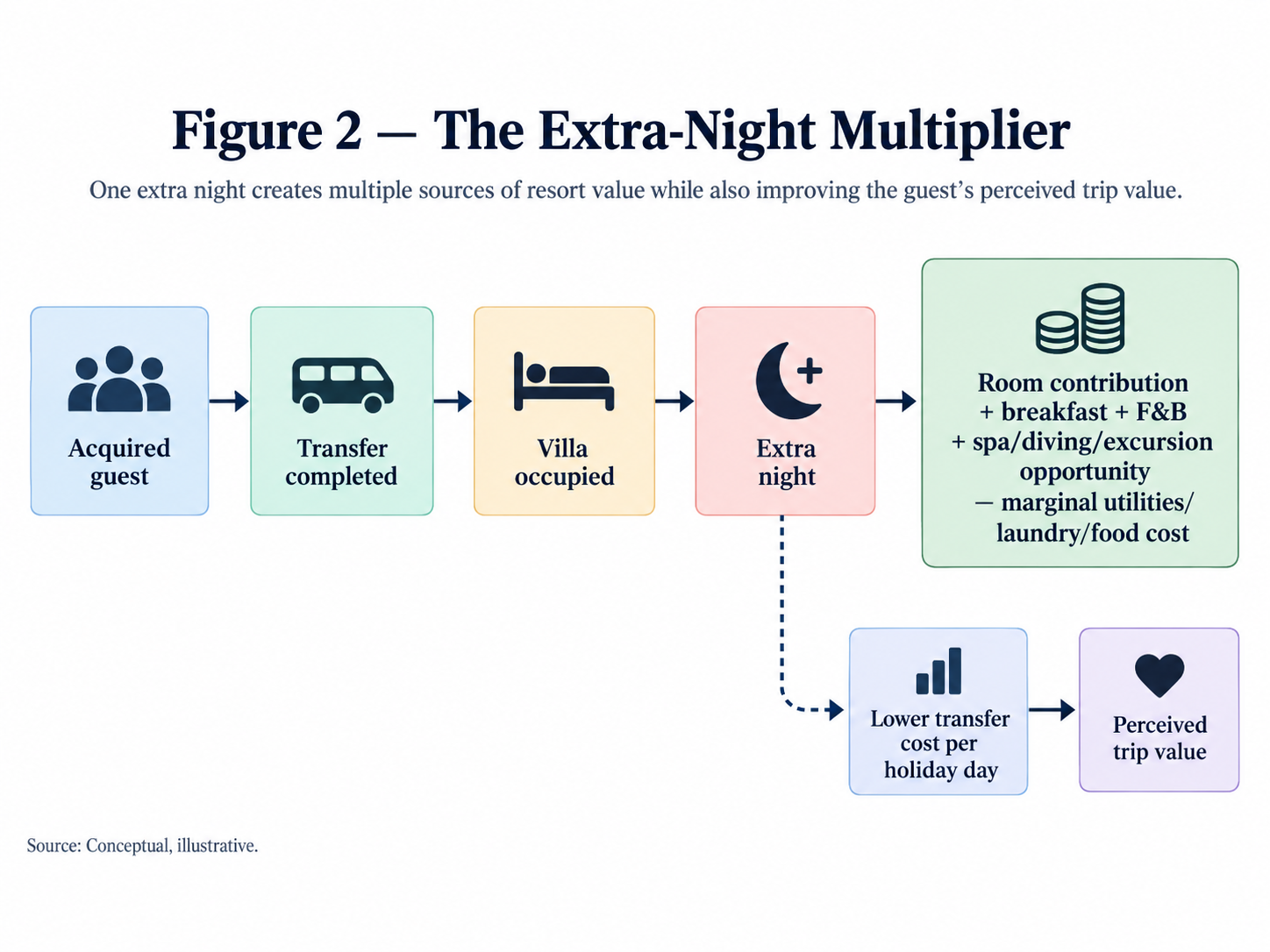
The resort has not acquired another customer. It has not processed another arrival. It has not needed another transfer seat for a new booking. Yet it gains another villa night, meals, drinks, perhaps a spa treatment or dive, and another day over which the original journey cost is psychologically spread.
This makes average length of stay more than a tourism statistic.
It is an economic lever.
The point is especially relevant after the structural changes discussed in the Maldives' seven-night tourism reset, where changing stay patterns were shown to affect the number of bed nights generated by every arrival.
Arrivals Are Not the Final Product
A resort does not earn an ADR from an arrival.
It earns it from an occupied night.
That simple distinction changes the arithmetic. A market producing 10,000 arrivals at seven nights creates 70,000 visitor-nights. The same arrivals at eight nights create 80,000.
This is also why the economic importance of repeat guests can be underestimated. Earlier analysis of the value of repeat visitation showed that repeat visitors can contribute disproportionately to total nights when their stays are longer.
My earlier empirical work also found strong habit persistence in Maldives demand, although the precise coefficient should not be interpreted literally as a repeat-visitor share.
Testing an Extra-Night Strategy
Consider an illustrative 120-villa upper-upscale resort.
Assume:
occupancy: 70%;
occupied villa nights: 30,660 annually;
ADR: $700;
average stay: 7 nights;
approximately 4,380 stays annually.
Management has two strategies.
Strategy A: raise ADR by 3%.
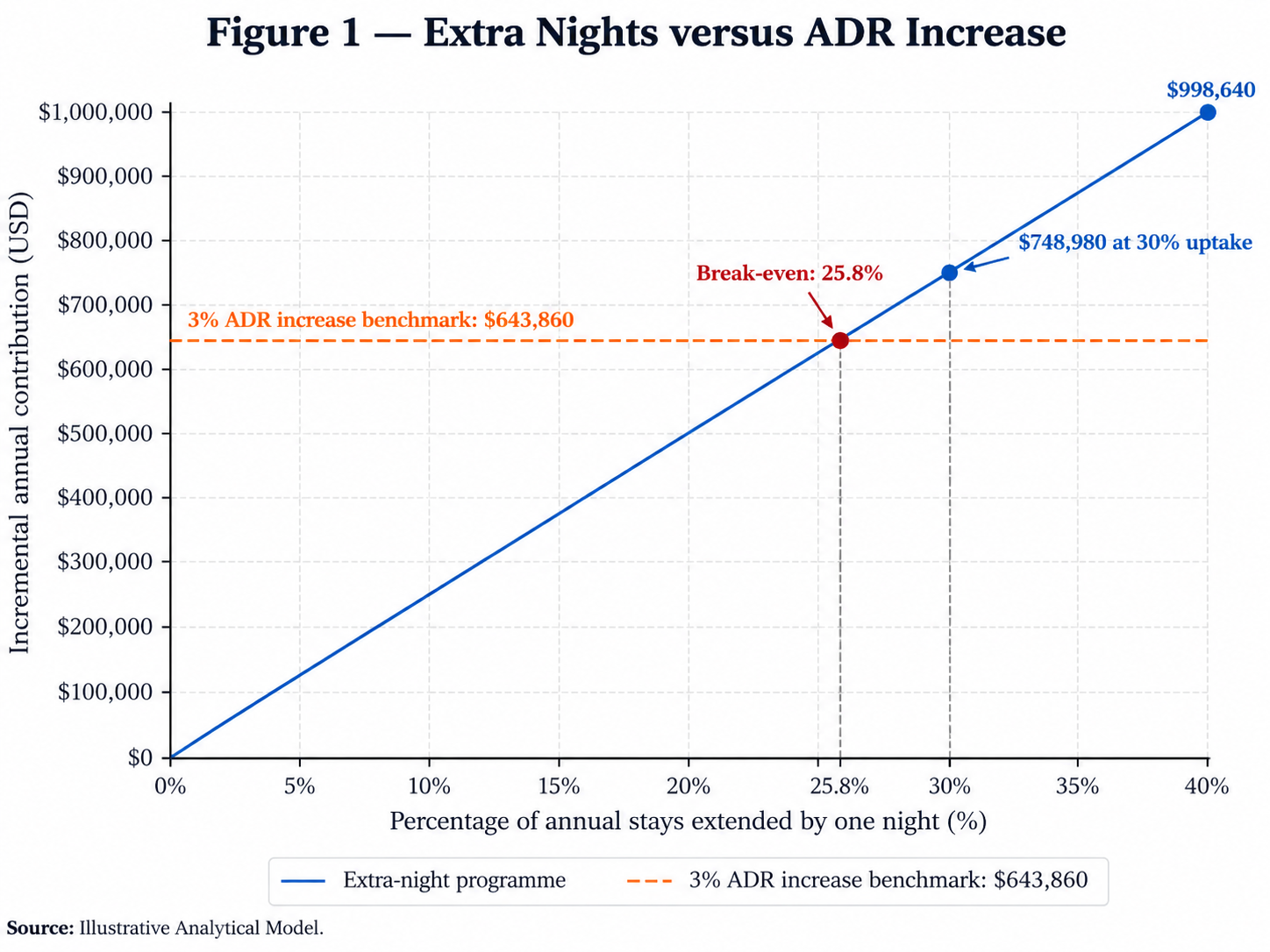
If volume does not change, the $21 increase applied to 30,660 occupied villa nights produces approximately $643,860 of incremental room revenue.
Strategy B: persuade some guests to add one night.
Assume one additional occupied night generates:
$700 room revenue;
75% room contribution = $525;
$120 ancillary contribution;
minus a $75 resort credit used to make the eighth night attractive.
Net contribution from each successfully extended stay = $570.
How many extensions are required to equal the 3% ADR strategy?
$643,860 / $570 ≈ 1,130 additional nights.
That is only 25.8% of the resort's 4,380 annual stays.
If 30% accept the extension, the resort creates approximately 1,314 incremental occupied nights and $749,000 of contribution—about $105,000 more than the frictionless 3% ADR increase.
The Capacity Condition
There is, however, an important constraint.
Those extra nights must physically fit.
The base resort operates at 70% occupancy, so an additional 1,314 occupied nights lifts annual occupancy by about three percentage points. That may be highly feasible in shoulder periods but impossible during Christmas, Easter or other compression dates.
Length-of-stay management must therefore be date-specific.
A guest extending into a Tuesday with empty villas is economically different from a guest blocking a scarce Saturday that could have been sold inside a higher-value booking.
That is why package design should be treated as a capacity decision rather than merely a promotional exercise.
The Hidden Dividend
The eighth night can have another effect that our simple model does not monetize.
For a seven-night stay, a $900 round-trip transfer represents roughly $129 per occupied night. Across eight nights, it falls to about $113 per night.
Nothing about the transfer invoice has changed. But the generalized cost per day of holiday falls.
For long-haul island tourism, that can improve the value proposition of the entire trip.
It may explain why extending stays can sometimes be more commercially elegant than lowering the headline rate.
The Decision Rule
The resort should not universally chase longer stays. It should identify dates where the marginal value of another occupied night exceeds the displacement value of keeping that night available.
During soft periods, the shadow value of the empty villa is low. An extra night is valuable.
During compression, the shadow value can become high. The extension may crowd out a more valuable future booking.
The opportunity is therefore not “longer stays are always better.”
It is: Extend stays where marginal contribution is high and displacement cost is low.
A Different Way to Read Occupancy
The usual question asks how many villas are occupied.
A more powerful question asks how much time each acquired guest contributes to the island economy.
A resort with the same arrivals and slightly longer stays can generate more room nights, more dining occasions and more activity demand without increasing airport arrivals or guest turnover.
Sometimes the next unit of growth is not another guest.
It is tomorrow morning.