Maldives Tourism Brief: Arrivals Are Stabilising, but Is the Industry Becoming Stronger?
05 Nov 2026, 04:28 · by IzuCT · 4 min read · Updates · EN

October brought encouraging news for Maldives tourism. But the most important number may not be the number of tourists who arrived.
The Maldives Tourism Observatory's October 2026 Monthly Review suggests we need to distinguish three ideas often treated as interchangeable: stabilisation, recovery and profitability.
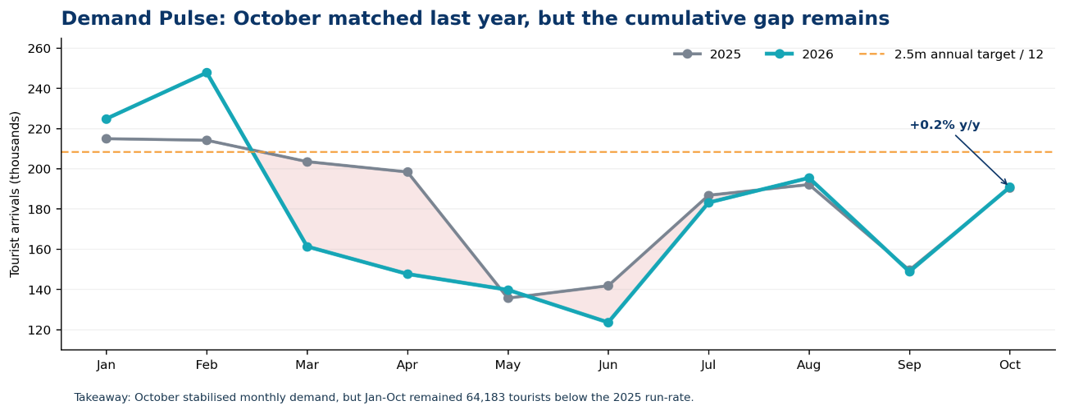
October welcomed 190,774 tourists, 0.2% more than October 2025 and 28.2% more than September. For resorts, guesthouses, transport operators and destination marketers, that rebound matters.
But January–October arrivals reached 1,762,751, still 3.5% below the corresponding period in 2025.
A positive month does not necessarily mean a recovered year.
The tourism target has become two different questions
The original Government target of 2.5 million tourists would require another 737,249 arrivals during November and December—approximately 12,086 tourists daily.
That is almost twice October's actual daily average of 6,154.
The 2027 Budget presents a more realistic full-year projection of approximately 2.17 million tourists. Reaching that level requires around 6,676 daily arrivals over the remaining 61 days.
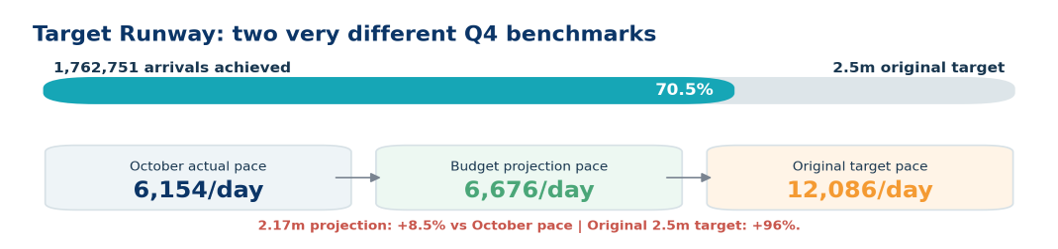
These are different benchmarks. One represents the original ambition; the other provides a revised planning projection.
For investors and operators, this distinction matters. Staffing, airline commitments, procurement and cash-flow decisions should reflect realistic demand scenarios rather than depend on an increasingly difficult catch-up.
The more important warning comes from accommodation
Detailed accommodation statistics lag behind arrival reports. Consequently, October's arrivals cannot yet tell us whether the improvement translated into occupied nights.
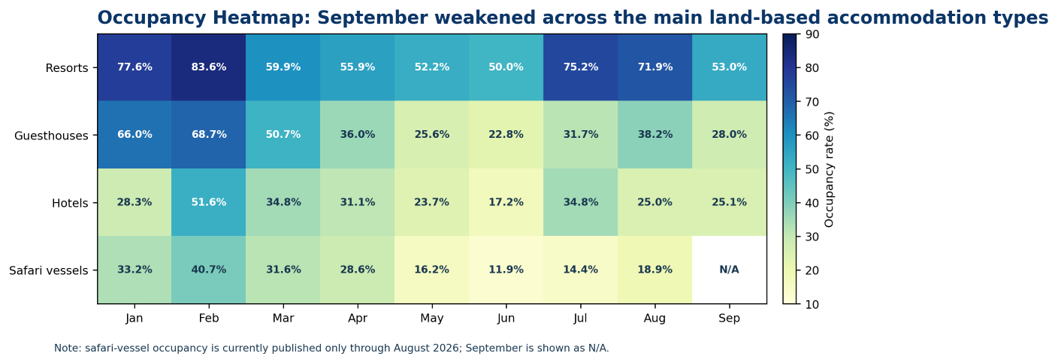
The latest accommodation data, covering September, show:
898,640 tourist bed nights sold
44.1% overall occupancy
53.0% resort occupancy
28.0% guesthouse occupancy
2.27x Capacity Pressure Index
The Capacity Pressure Index compares available bed-night capacity with actual bed nights sold.
At 2.27x, the tourism system offered approximately 2.27 bed nights for every night actually occupied.
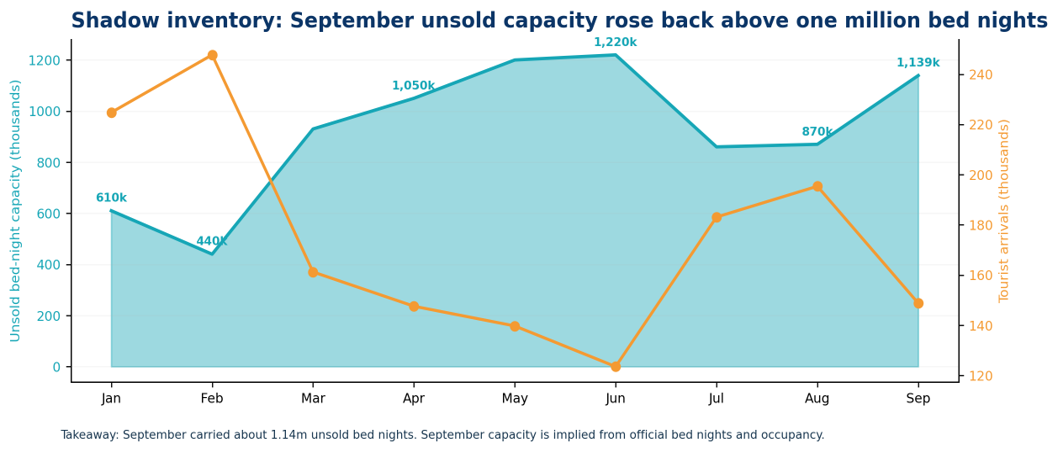
This implies around 1.14 million unsold bed nights during September, using capacity derived from official bed nights and occupancy.
I have previously described this phenomenon as shadow inventory: tourism capacity that has been built, financed, maintained and often staffed, but has not been converted into paying guest nights.
Unlike physical inventory, an unsold accommodation night cannot be stored for future sale. When the date passes, that opportunity disappears.
The commercial implications are examined in The Million Unsold Nights: What Shadow Inventory Reveals.
September's utilisation weakness does not establish October's accommodation performance. But it reminds us why arrivals alone cannot confirm a system-wide recovery.
Our source markets are becoming more concentrated
China supplied 331,817 tourists through October, while Russia contributed 256,822.
Together, these two markets accounted for 33.4% of total arrivals, with both recording year-on-year growth.
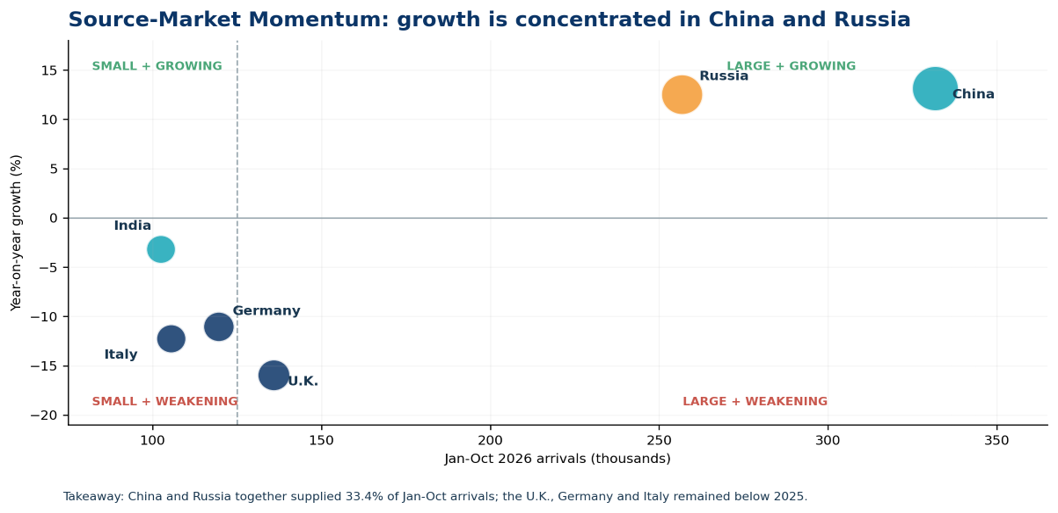
Meanwhile, the United Kingdom, Germany and Italy remained below their 2025 levels.
This matters because source markets differ not only in volume, but also in seasonality, spending patterns, accommodation preferences and air connectivity.
As explored in Different Source-Market Calendars Can Make Tourism Demand More Resilient, diversification works best when markets provide complementary demand across the year.
Protecting China and Russia while rebuilding Western European demand should therefore be central to the industry's high-season strategy.
The next opportunity is better conversion, not simply more arrivals
For November and December, three commercial priorities deserve attention: converting available airline capacity into bookings, increasing occupied nights without sacrificing yield, and protecting the value of existing demand.
Sometimes the most profitable additional tourist night comes from a visitor already in the country.
In The Extra-Night Dividend, I examine why extending an existing stay can sometimes create more contribution than increasing the average daily room rate.
Equally, discounts need discipline. As The Price-Memory Effect explains, repeatedly rewarding late bookings may teach future customers to wait for lower prices.
From tourist arrivals to economic value
Tourism's contribution ultimately extends beyond accommodation.
It affects employment, suppliers, tax collections, foreign-exchange liquidity and public finances.
September's MIRA collections reached MVR 2.69 billion, above forecast but below September 2025. However, prior-period payments and recovery activity mean collections cannot be interpreted as a direct measure of current tourism performance.
The relevant economic chain is:
Arrivals → Bed nights → Occupancy → Spending → Tax revenue and foreign-exchange earnings.
October demonstrates that tourist demand can stabilise.
The next challenge is to translate that stability into stronger utilisation, better yield and sustainable financial performance.
The success of the coming high season should be measured not only by how many tourists arrive, but by how much value the Maldives creates from each visitor and each available bed night.
Read the complete Maldives Tourism Observatory Monthly Review — October 2026 for detailed statistics, charts, source-market analysis and strategic recommendations.
Explore the MTO Tourism Signals dashboard and Capacity Pressure Monitor to follow the indicators shaping Maldives tourism decisions.