Pricing intelligence report: November Lodging Price Trends
06 Nov 2026, 13:04 · by IzuCT · 4 min read · Tourism · EN

In November’s Maldives accommodation snapshot separately listed fees reshape apparent bargains. Island comparisons and room-label differences show why operators need matched competitors, transparent prices, and reliable booking data.
Free tourism insights
Get Free Tourism Insights
Receive selected MTO insights, tourism data alerts, and new resource updates by email.
Get Free Tourism InsightsThis article covers 437 distinct properties quoted for two adults staying for six nights in November 2026. All figures use the listed payable total, including separately disclosed fees. These are forward advertised offers, not realised average daily rates (ADR).
A Maldives guesthouse listed at US$75 a night may not be a US$75 purchase. In the Observatory’s November booking snapshot, most offers display an additional amount for “taxes and fees”. Across 375 terrestrial listings with such separately quoted charges, the median uplift is 36% of the pre-fee rate. That gap matters to both pricing strategy and travellers’ comparisons: the lowest headline tariff is not necessarily the cheapest accommodation.
The November pricing landscape
The central price ladder is striking. The 422 provisionally classified guesthouse listings have a median payable rate of US$101 per night (interquartile range US$76–130). The mean for terrestrial listings is US$114, above the median, because a few entire-home and premium accommodation products stretch the upper tail. A manager benchmarking against the mean would overestimate the price of the typical visible competitor.
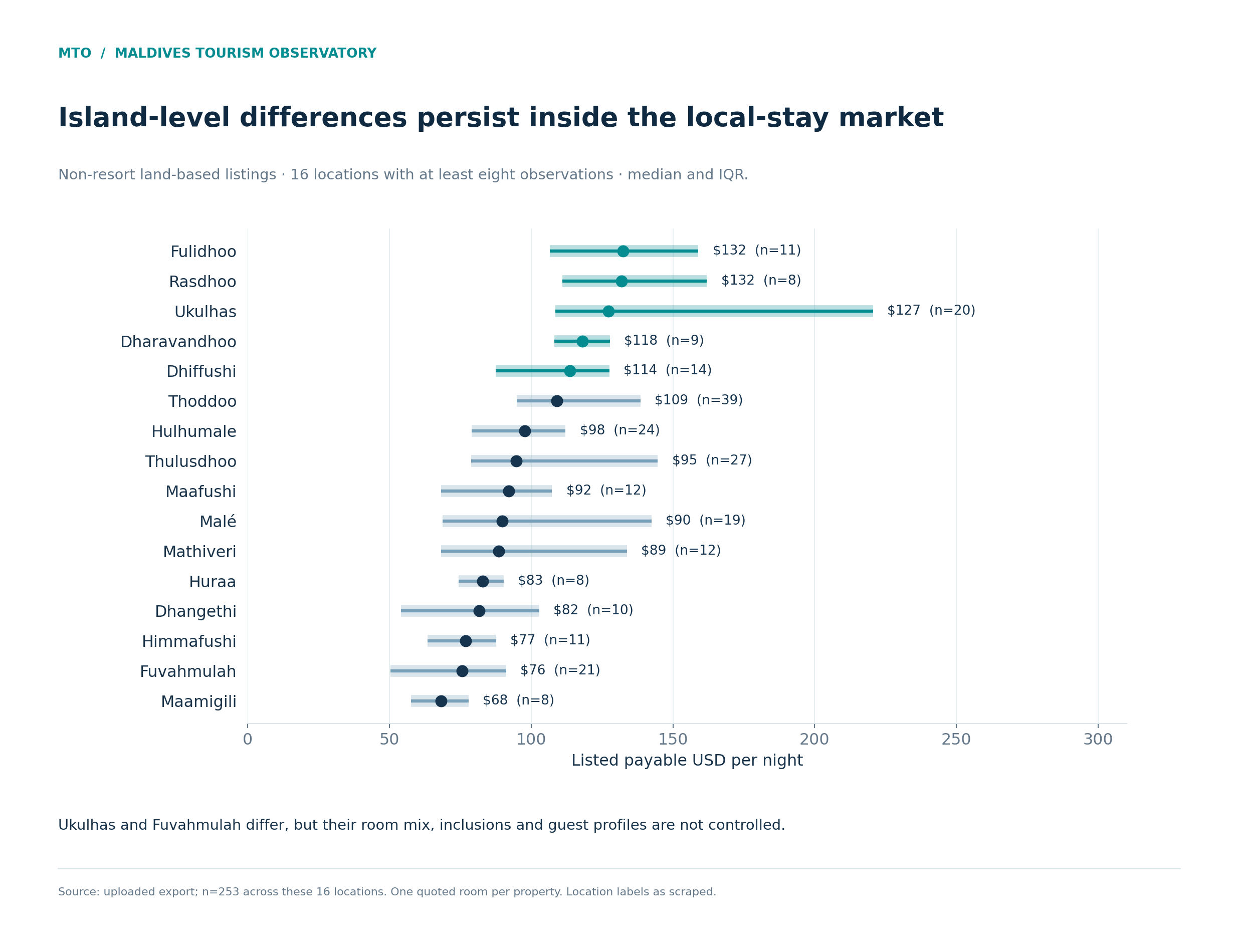
Prices differ considerably inside the lower-priced market: the 16 locations with at least eight offers range from US$68 in Maamigili to US$132 in Fulidhoo. Among locations with at least 20 offers, Ukulhas records a median of US$127, Thoddoo US$109, Maafushi US$92 and Fuvahmulah US$76. Ukulhas is about 68% above Fuvahmulah in this cross-section, but room size, beach access, service standard and booking conditions are uncontrolled. The observation signals where to investigate—not where to raise tariffs mechanically.
Prices differ considerably inside the lower-priced market: the 16 locations with at least eight offers range from US$68 in Maamigili to US$132 in Fulidhoo. Among locations with at least 20 offers, Ukulhas records a median of US$127, Thoddoo US$109, Maafushi US$92 and Fuvahmulah US$76. Ukulhas is about 68% above Fuvahmulah in this cross-section, but room size, beach access, service standard and booking conditions are uncontrolled. The observation signals where to investigate—not where to raise tariffs mechanically.
Some islands also have wide interquartile ranges, indicating substantial competitive differentiation or offer heterogeneity. A small operator should therefore follow a handful of directly comparable rooms on its island, rather than infer a universal “Maldives guesthouse rate”.
Some islands also have wide interquartile ranges, indicating substantial competitive differentiation or offer heterogeneity. A small operator should therefore follow a handful of directly comparable rooms on its island, rather than infer a universal “Maldives guesthouse rate”.
The economics of the final price
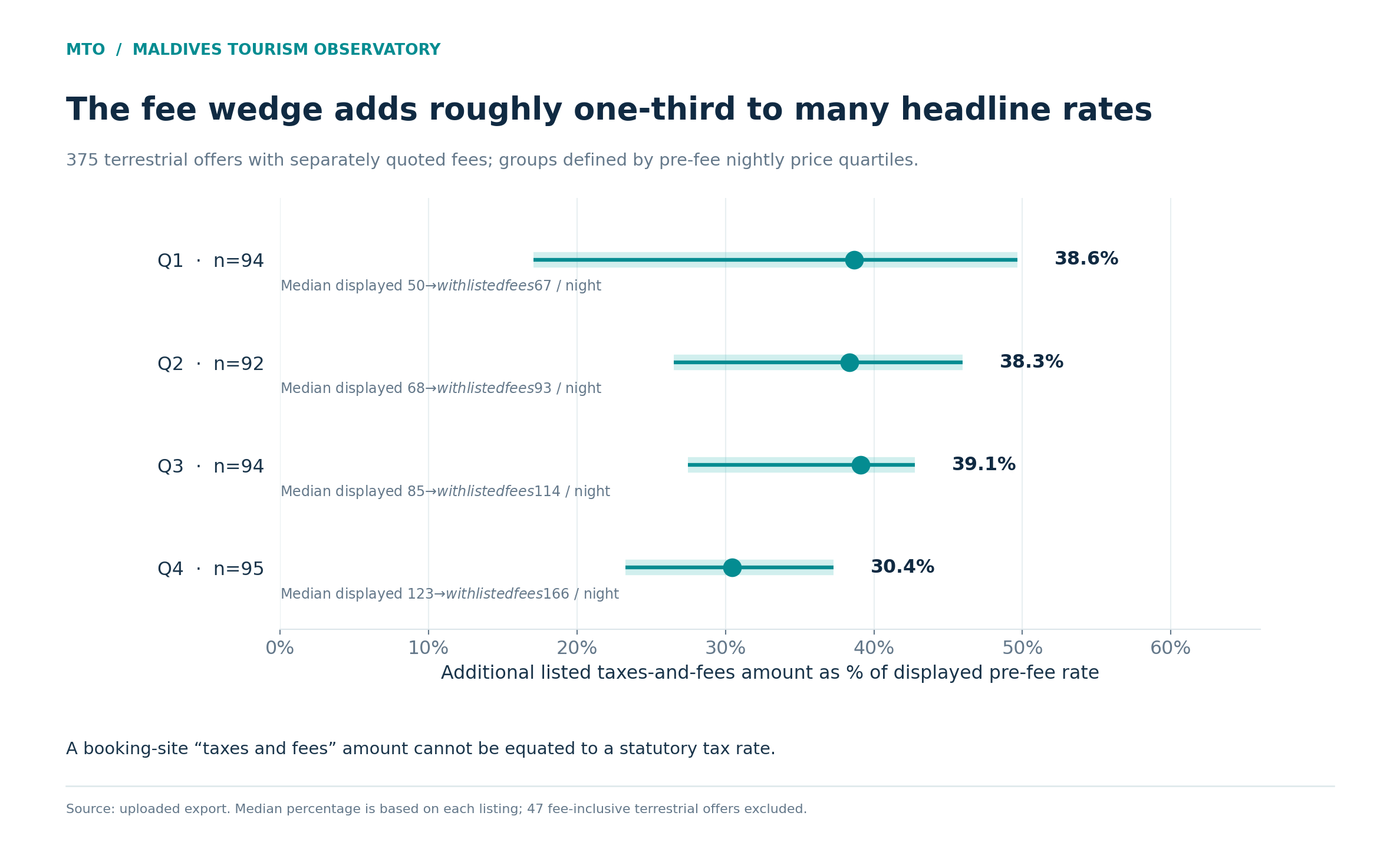
The fee structure changes the competitive picture.The median proportional fee uplift ranges from approximately 30% to 39% across advertised-price quartiles. These percentages describe what the booking interface adds; they are not the Maldivian tax rate. The Maldives tourism GST rate is 17%, but the export does not decompose GST, green tax, service charge and other booking fees.
Revenue managers should compare the same guest-payable basis across channels, while monitoring their own net revenue after commission and costs. A smaller headline amount can fail to convert when the checkout total is unexpectedly higher.
Why room names are not price premiums
Room descriptions are not standardised across operators. Comparing deluxe or superior quotes with basic-room quotes within 14 better-sampled islands yields a positive difference in nine islands, but a negative one in five. For example, the median deluxe-labelled quote in Ukulhas is 59% above basic offers; in Fulidhoo it is 31% lower. These are comparisons across different properties, not prices for two room types in the same hotel.
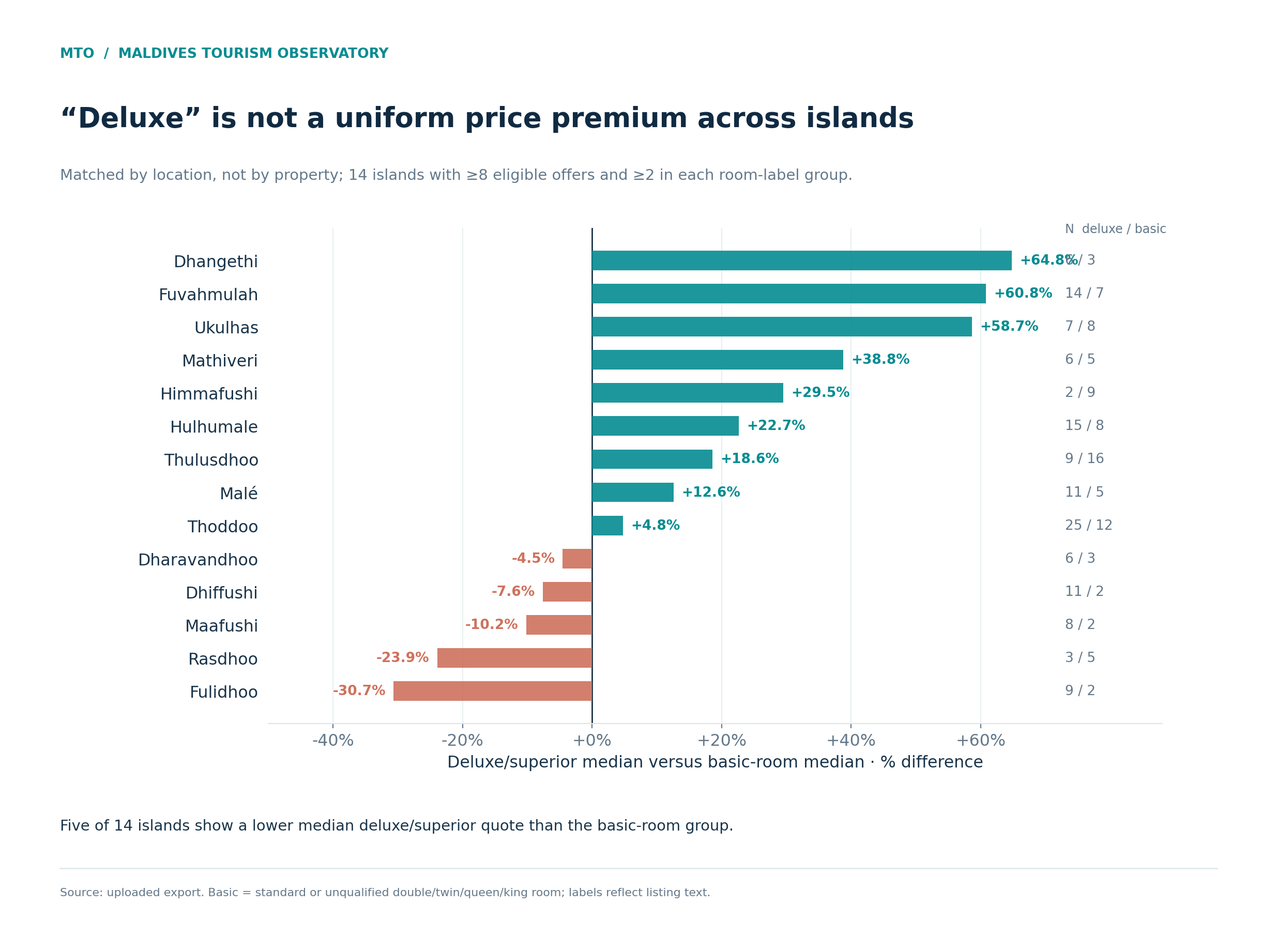
A credible upgrade premium requires matched room types within the same property, with identical dates, occupancy, inclusions and cancellation rules. Without that structure, a “deluxe premium” is mainly a signal of product positioning.
Discounting is widespread, but its meaning is limited
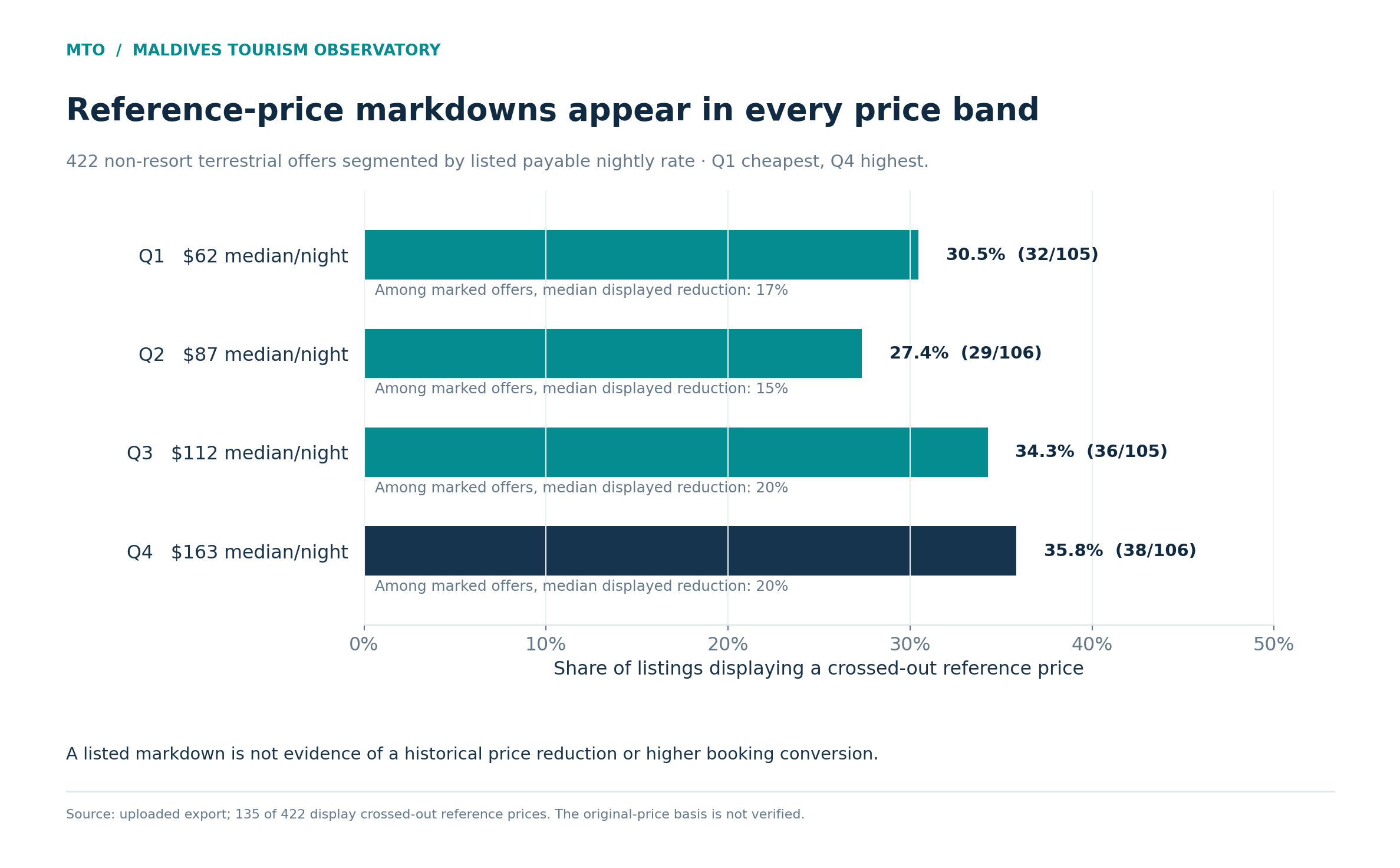
Crossed-out reference prices appear on 135 of the 422 terrestrial offers, or 32%. Their median displayed reduction is 20%, and markdowns appear in every price quartile. Yet a reference price is not verified historical revenue, and the data do not show whether such offers book more successfully. The commercial question is therefore not how large the badge looks, but whether a promotion improves net contribution without weakening future price expectations.
December positioning: prepare, but do not predict
November is a historically important transition toward the northern-winter travel season, and the Maldives recorded exceptionally strong December arrivals in 2025.
For operators, the practical response is to monitor the same room, dates, lead time and booking terms every week. Raise prices when forward occupancy and booking pace exceed the property’s plan at acceptable net yield; discount selectively only when the expected incremental contribution exceeds the cost of unsold inventory, distribution fees and displacement.
The decision rule
First, benchmark all-in guest prices against three to five genuinely comparable properties. Second, maintain separate ladders for base rooms and verified upgrades, testing premium take-up rather than copying room names. Third, record every rate change alongside occupancy forecasts, channel commissions, cancellations and booking lead time. Fourth, explain compulsory fees clearly and protect rate integrity when offering promotions.
November’s most useful pricing signal is not that one island or property charges more. It is that transparent final prices and well-chosen comparisons are prerequisites for turning competitive intelligence into profitable decisions.