The Guesthouse Investment Equation: Hanimaadhoo OR Dhigurah, and the Cost of Choosing the Wrong Island
10 Jun 2026, 20:18 · by i.zuhuree · 5 min read · Tourism · EN

A cost-benefit story comparing Hanimaadhoo and Dhigurah shows why discounted land matters, but demand, access, seasonality, pricing, and excursions determine whether a guesthouse investment becomes bankable in first five years.
Free tourism insights
Get Free Tourism Insights
Receive selected MTO insights, tourism data alerts, and new resource updates by email.
Get Free Tourism InsightsAn entrepreneur recently asked me a deceptively simple question: should he invest in a 10–15 room guesthouse in Hanimaadhoo, where he has access to a discounted 4,000 sq ft site, or should he consider a more established guesthouse island such as Dhigurah in Alif Dhaal Atoll?
At first, the question sounds like a property decision. There is land. There is a discount. There is a possible building. But tourism investments are rarely just property decisions. They are systems decisions. A guesthouse does not survive because concrete has been poured. It survives because demand, access, pricing, seasonality, service, excursions, reviews, and cash flow line up in the right sequence.
So I approached the question as a cost-benefit problem. Not “which island do we like?” but “where does a small guesthouse have the better probability of generating stable cash flow within the first five years?”
That distinction matters. Discounted land can make a project attractive. But a low entry cost cannot, by itself, create demand.
The Two Islands Tell Two Different Stories
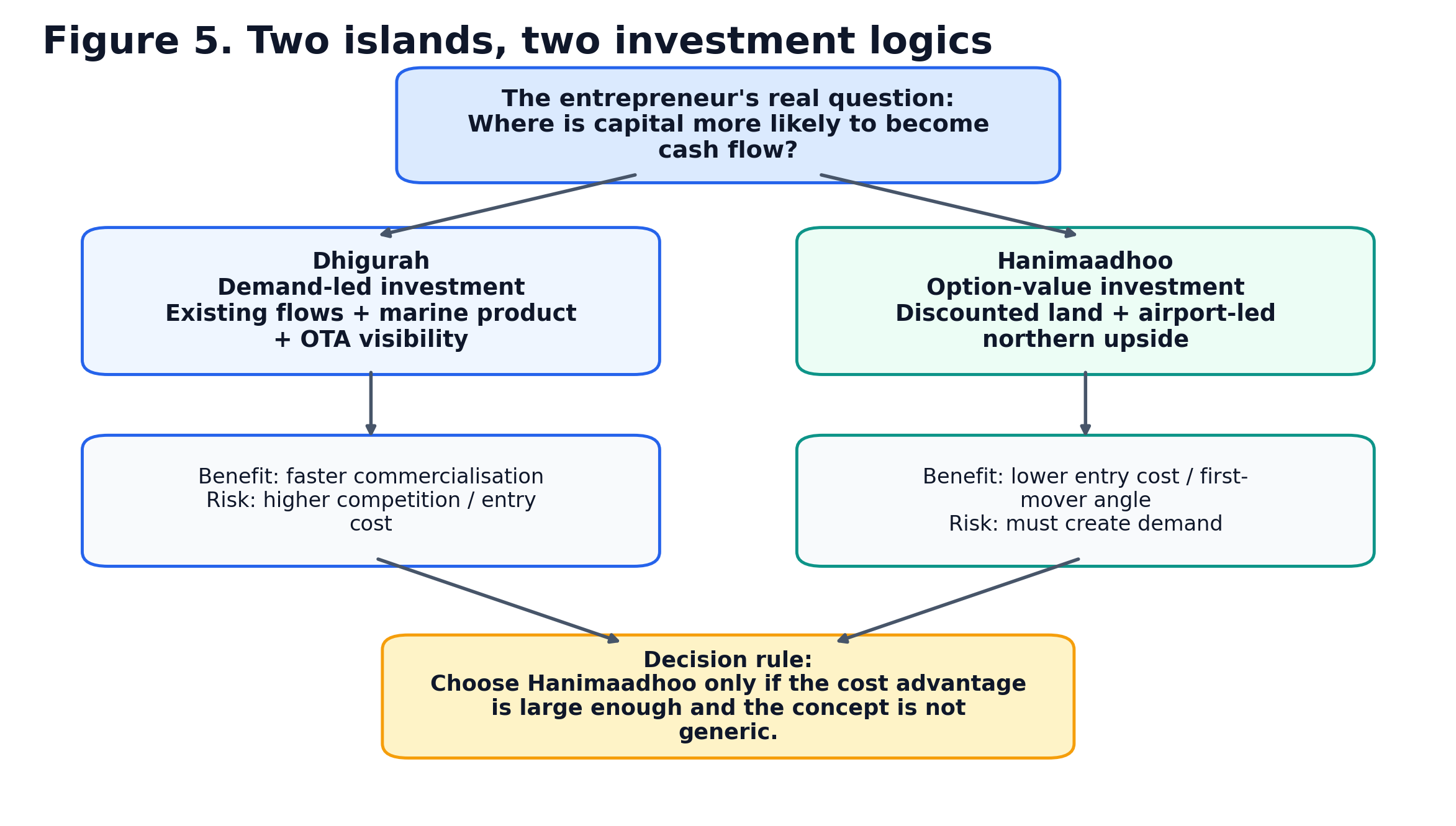
Hanimaadhoo and Dhigurah are not simply two locations. They represent two different investment logics.
Dhigurah is a demand-led investment. It already sits inside a recognised marine tourism corridor. Its appeal is easy to understand: whale sharks, manta experiences, diving, snorkelling, public speedboat access, and an existing guesthouse ecosystem. Competition exists, but competition is also evidence. It tells us that guests already search, book, travel, review, and spend there.
Hanimaadhoo is different. It is an option-value investment. Its story is not mainly about today’s guesthouse traffic. It is about what the north of the Maldives could become as airport infrastructure improves and as travellers look beyond the heavily commercialised central and southern guesthouse islands. Hanimaadhoo has space, quietness, and a potential early-mover angle. But it also has a thinner market today.
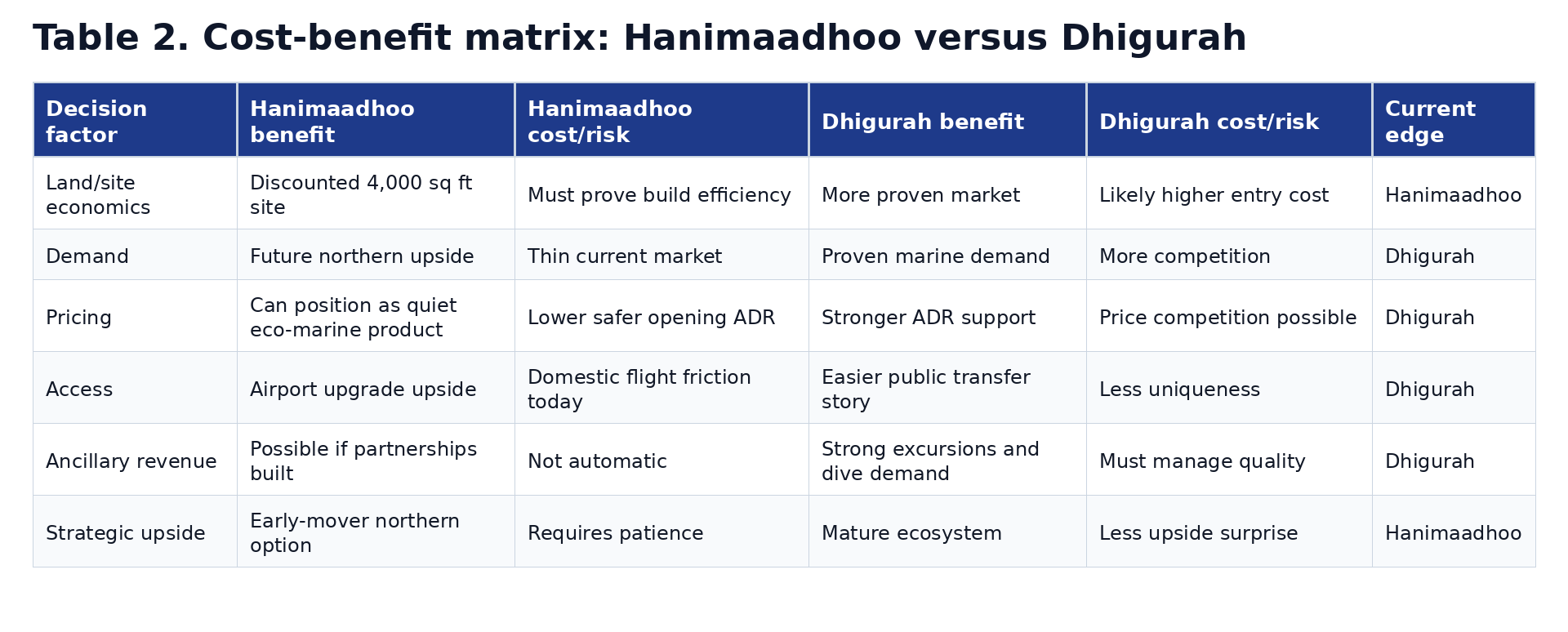
That is the core investment tension: Dhigurah offers stronger proof of current demand; Hanimaadhoo offers possible future upside.
Why the Indicators Matter
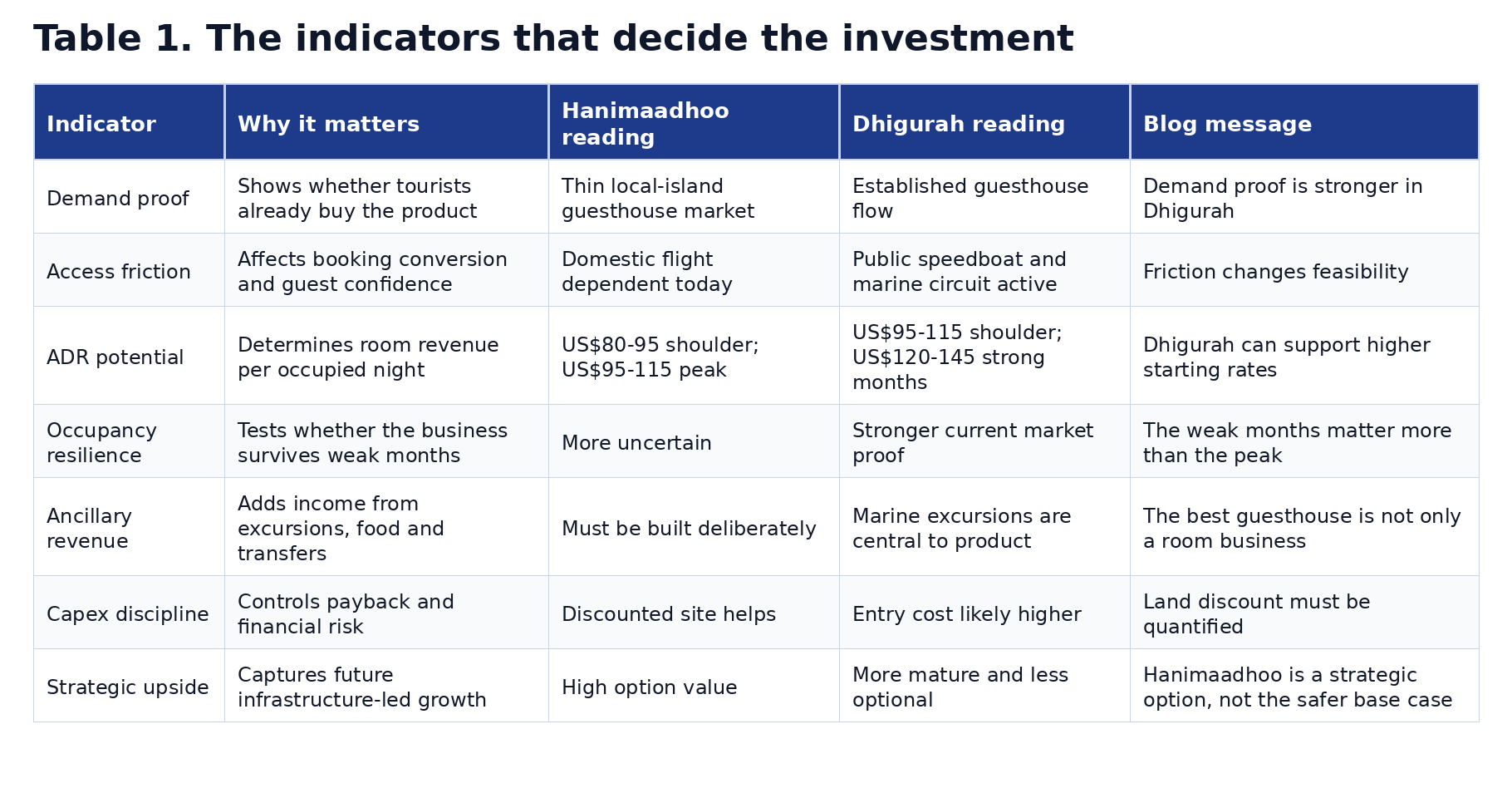 For a small guesthouse, I would not begin with national arrivals alone. National arrivals can rise while a specific island struggles. The better indicators are more practical: occupancy, ADR, access friction, island demand proof, guest segment fit, ancillary revenue potential, capex per key, and seasonality.
These indicators matter because they connect directly to cash flow. A guesthouse with 12 rooms does not need a million tourists. It needs enough of the right tourists, at the right price, across enough months, with enough extra spending on food, transfers, and excursions.
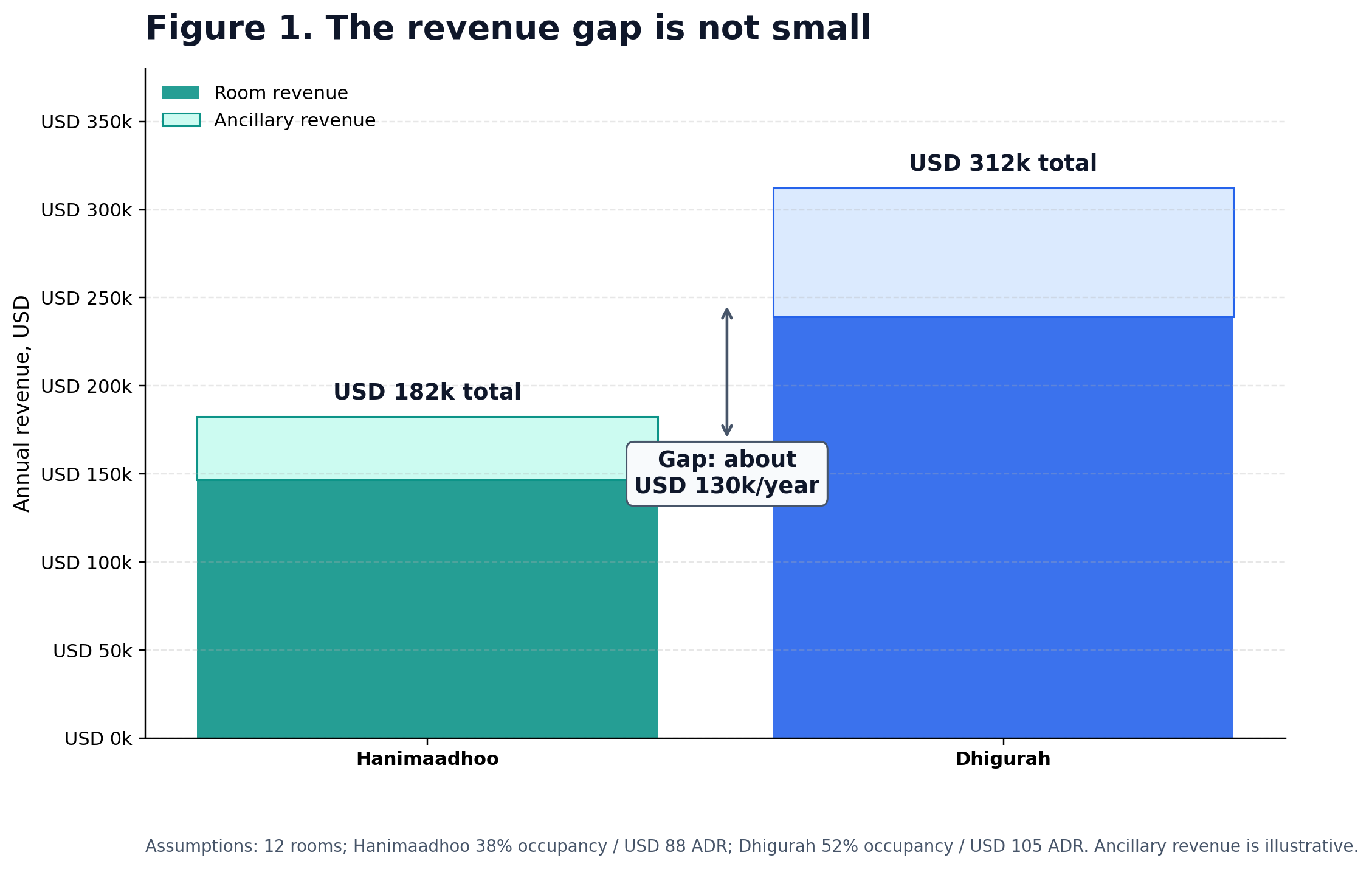
The base-case model is deliberately conservative. It assumes a 12-room guesthouse, not an aggressive 15-room build. Hanimaadhoo is tested at 38% occupancy and US 88 ADR, producing about US 146,000 in annual room revenue. Dhigurah is tested at 52% occupancy and US 105 ADR, producing about US 239,000.
That creates a room-revenue gap of roughly US$93,000 per year before ancillary income. Once excursions and marine activities are included, Dhigurah’s total revenue advantage could become wider because its product is already activity-led.
This is where the discounted Hanimaadhoo land becomes important. The land discount is not irrelevant. It is central. But it has to be quantified.
The Land Discount Test
The key question is not whether the Hanimaadhoo site is cheap. The question is whether it is cheap enough.
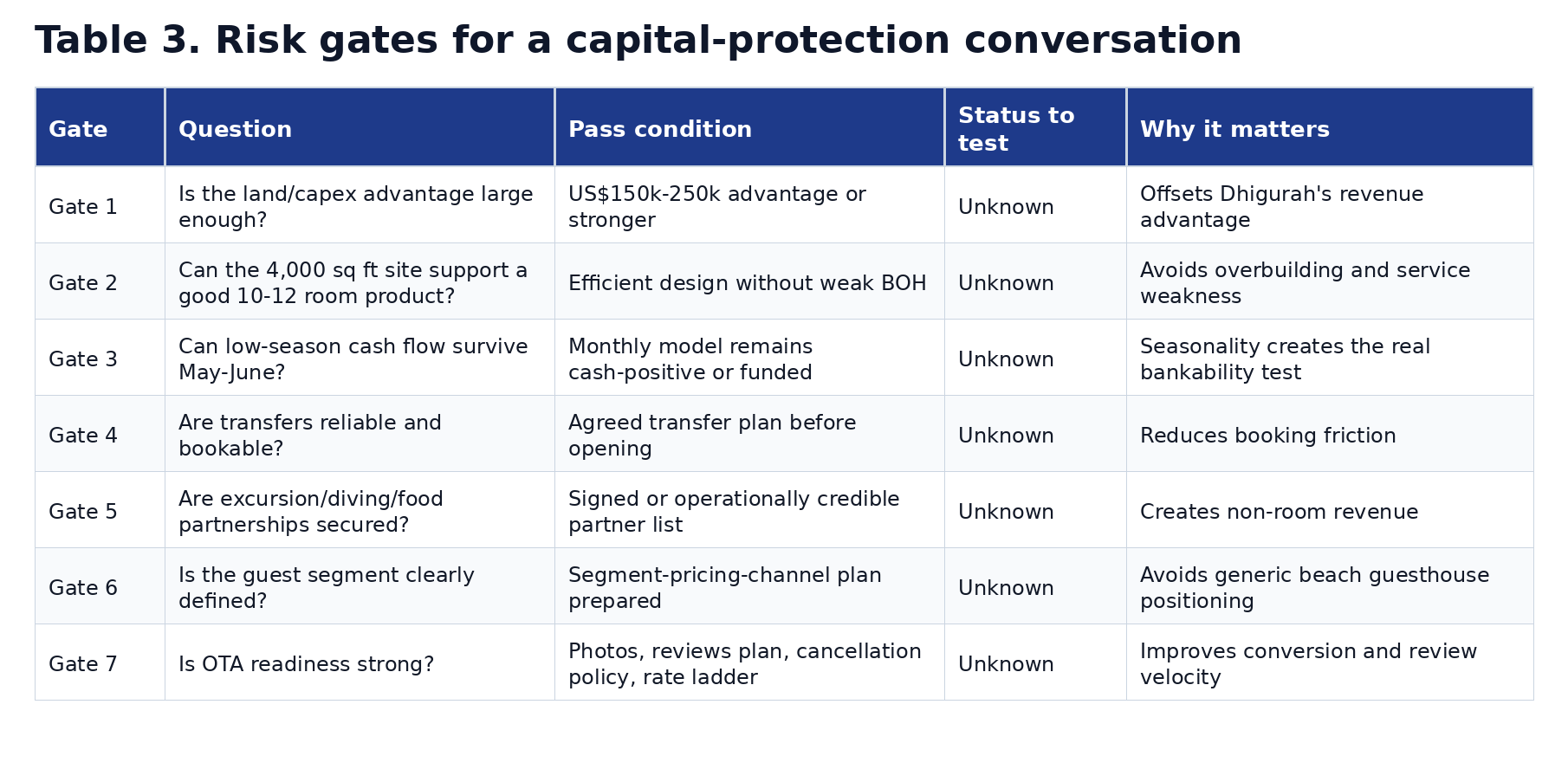
Based on the revenue difference, Hanimaadhoo becomes financially compelling only if the land discount or construction advantage reduces the all-in project cost by roughly US$150,000–250,000 compared with a comparable Dhigurah investment. If the advantage is smaller than that, Dhigurah’s stronger revenue base may still dominate the decision.
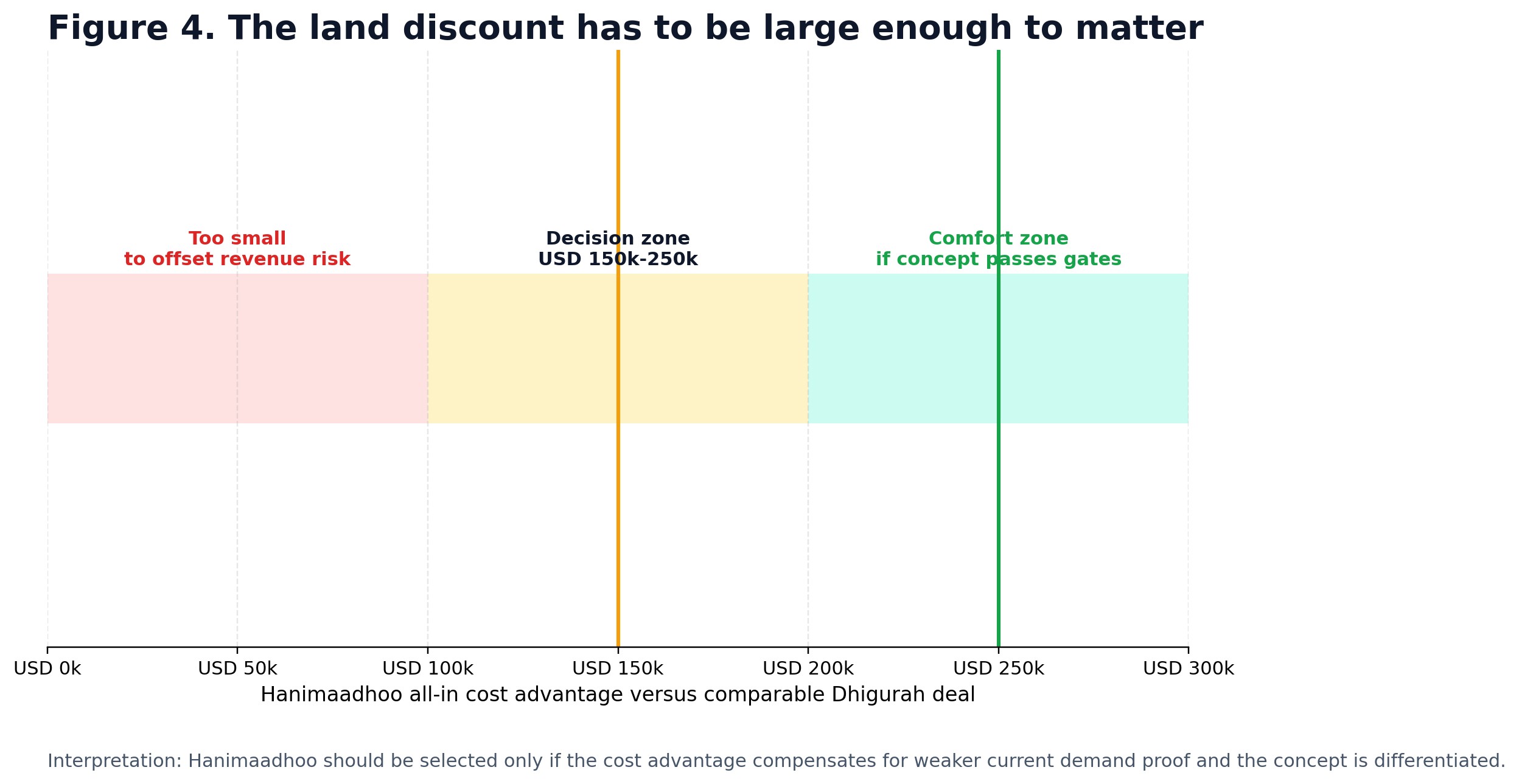
This is the turning point in the analysis. The entrepreneur should not ask, “Can I build in Hanimaadhoo?” He should ask, “Does Hanimaadhoo’s cost advantage compensate for its weaker current demand proof?”
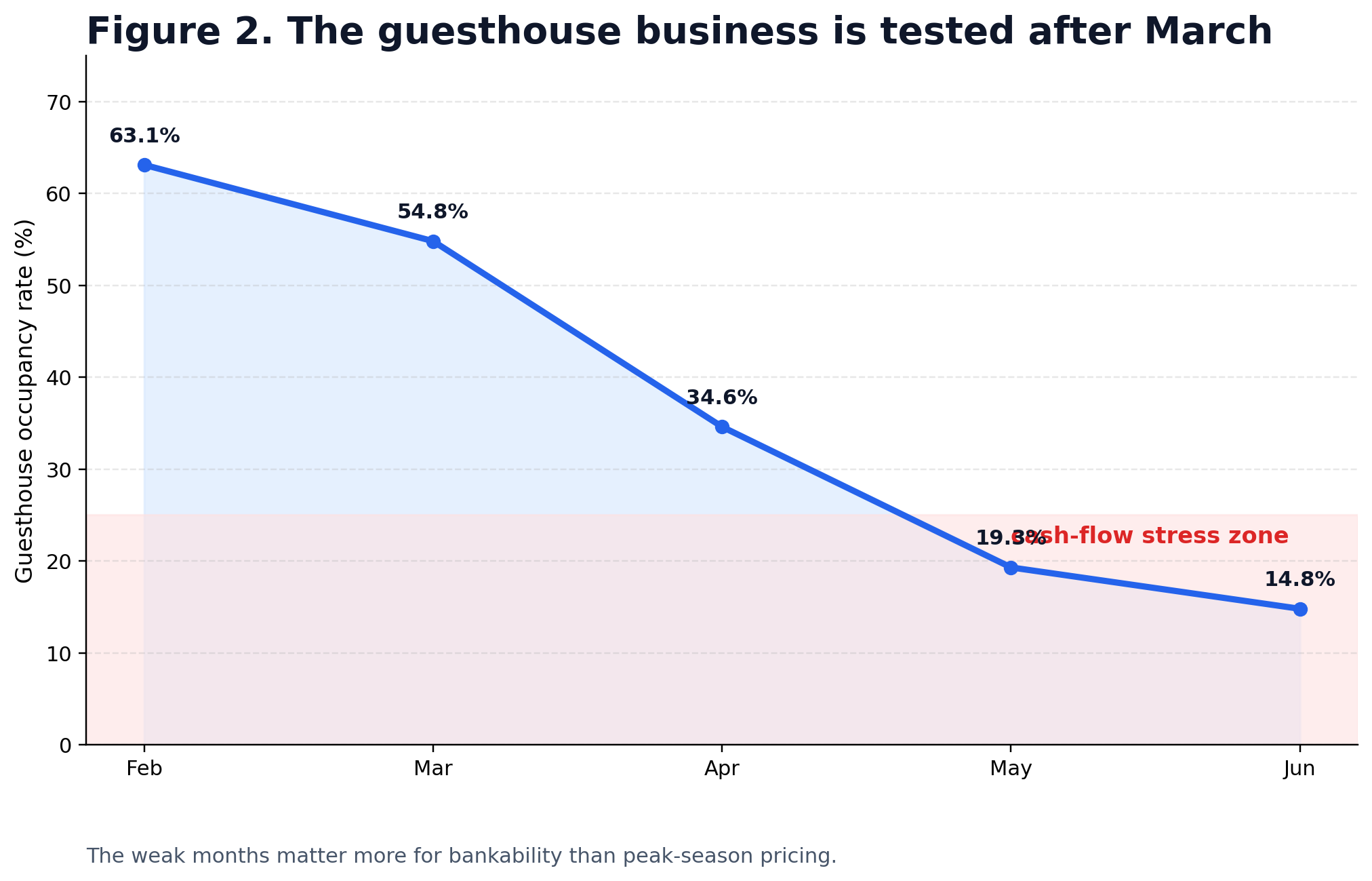
This is perhaps the most important chart in the whole decision. Peak season can make almost any guesthouse look feasible. The real test comes after March. If occupancy falls sharply in April, May, and June, the business must still pay staff, utilities, debt service, OTA commissions, maintenance, and marketing.
That is why I would never make this decision using annual revenue alone. The entrepreneur needs a monthly cash-flow model. A guesthouse does not fail in the spreadsheet average. It fails in the weak month.
Weighted Decision Matrix
A good decision matrix does not remove judgement. It disciplines judgement. It forces us to say what matters most.
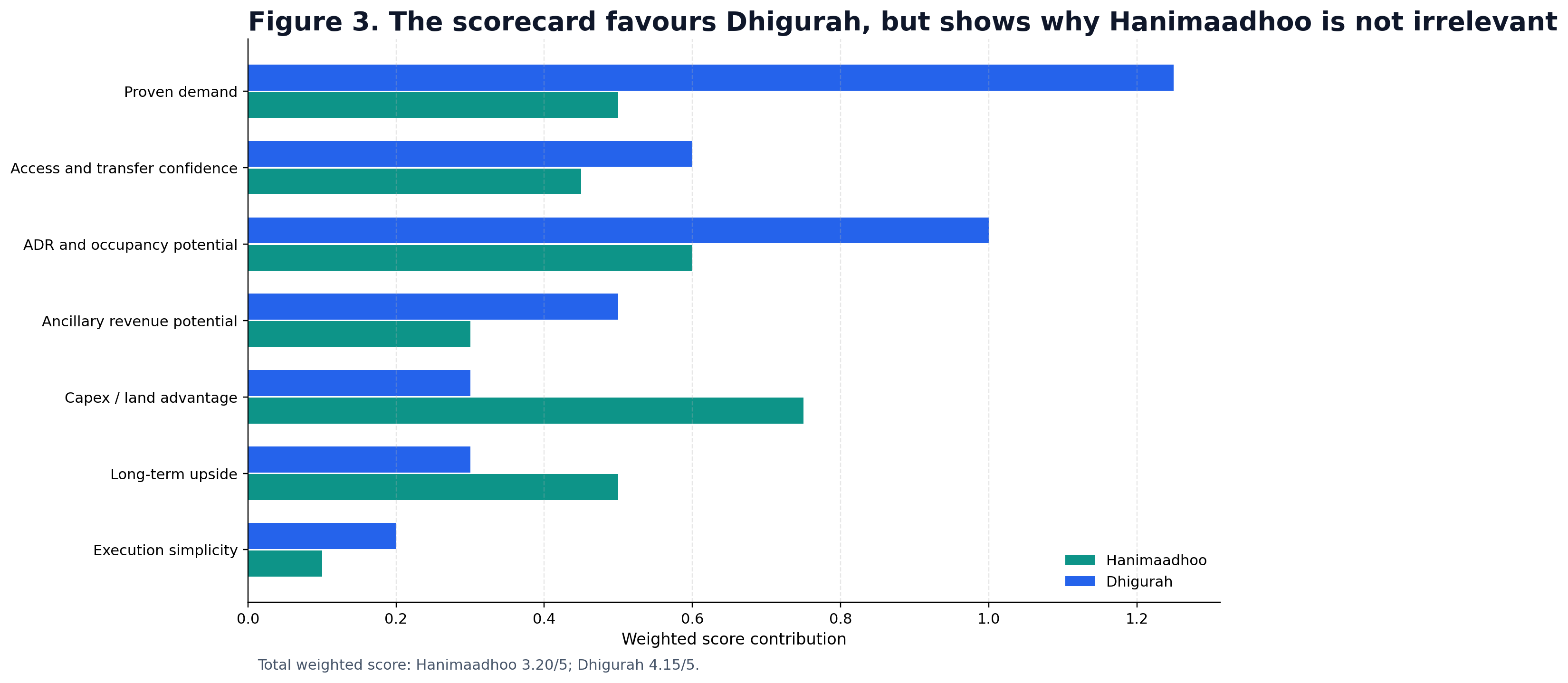
The matrix does not say Hanimaadhoo is a bad idea. It says Hanimaadhoo must clear a stricter test. Its strengths are real: discounted land, lower competition, future northern upside, and the possibility of creating a more distinctive product. But its weaknesses are also real: thinner current demand, greater market-making burden, and higher dependence on execution.
The Product Strategy Must Fit the Island
The mistake would be to build the same guesthouse in both places.
In Dhigurah, the product should be activity-led: divers, freedivers, whale-shark travellers, couples, small groups, and value-conscious guests who want a marine experience without resort prices. The guesthouse should be designed around early breakfasts, wet-gear storage, excursion coordination, good photography, fast OTA response, and strong review management.
In Hanimaadhoo, the product should be place-led. It should not try to imitate Dhigurah. Its better story is quietness, space, northern identity, eco-marine experiences, good food, slower travel, and a sense of discovering a less commercialised Maldives. But that requires more deliberate design. A standard room-only guesthouse would be exposed.
My Reading of the Decision
If the entrepreneur wants the best probability of early cash flow, Dhigurah is the stronger commercial case. The demand already exists. The tourism circuit is already visible. The marine story is already understood by the market.
Hanimaadhoo can work, but only under specific conditions. First, the discounted site must create a large enough cost advantage, ideally in the US$150,000–250,000 range. Second, the project should be planned around 10–12 rooms rather than forcing 15 rooms onto a 4,000 sq ft site. Third, the concept must be differentiated. Fourth, transfer, diving, food, and excursion partnerships must be secured before opening. Fifth, the business must be tested month by month against low-season cash flow.
Final Decision Rule
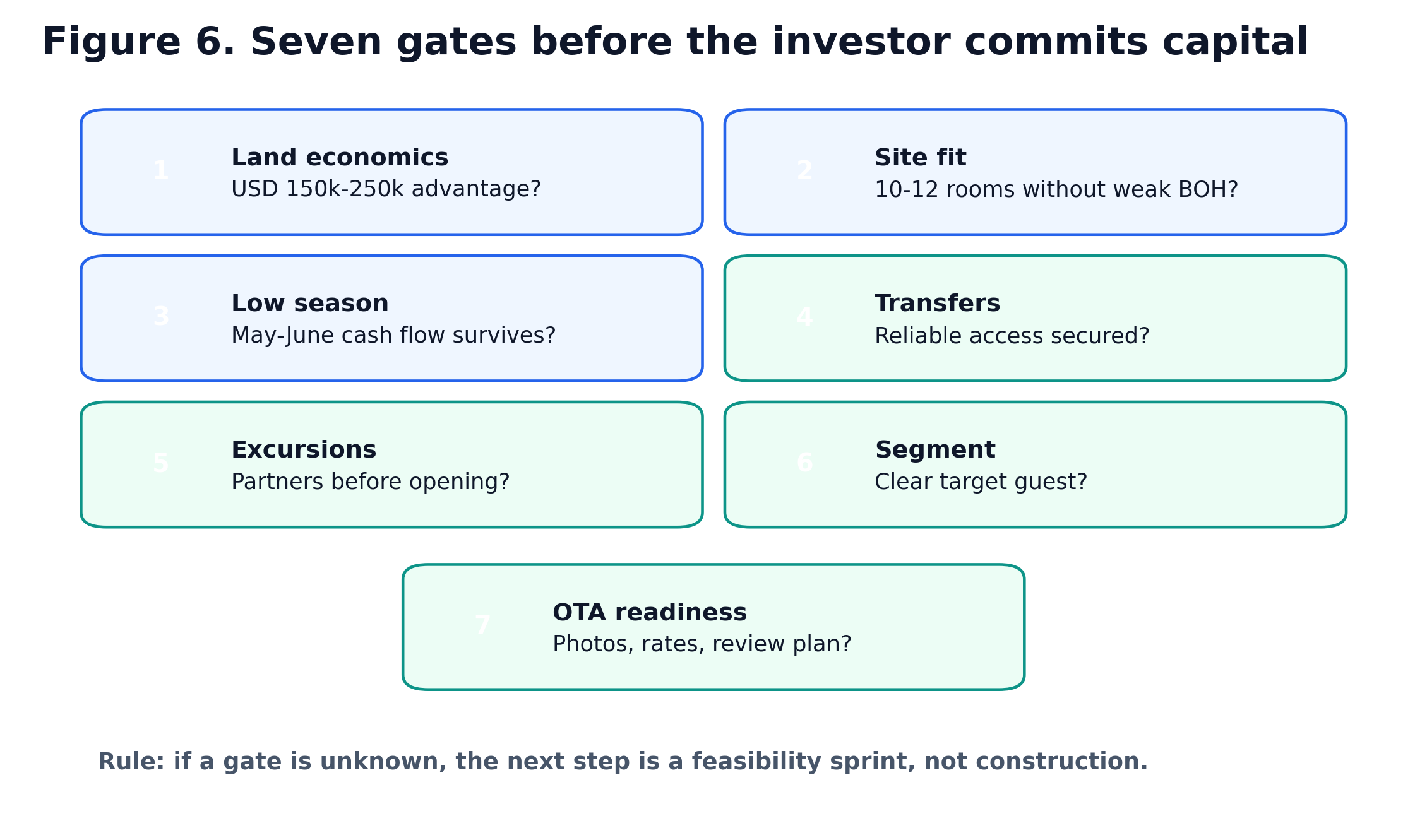
The conclusion is not that one island is good and the other is bad. The conclusion is more precise: Dhigurah is the stronger business. Hanimaadhoo is the stronger strategic option only if the numbers make the option cheap enough.
That is what cost-benefit analysis should do. It should not kill ambition. It should protect capital from beautiful stories that have not yet become bankable realities.
Contact MTO for Decision Matrices Pack
Disclaimer: This article is for informational purposes only and does not constitute investment advice.
Appendix