The Right to Walk: Tourism, Space, and the Maldivian Beach
26 Jun 2026, 02:25 · by i.zuhuree · 12 min read · Tourism · EN
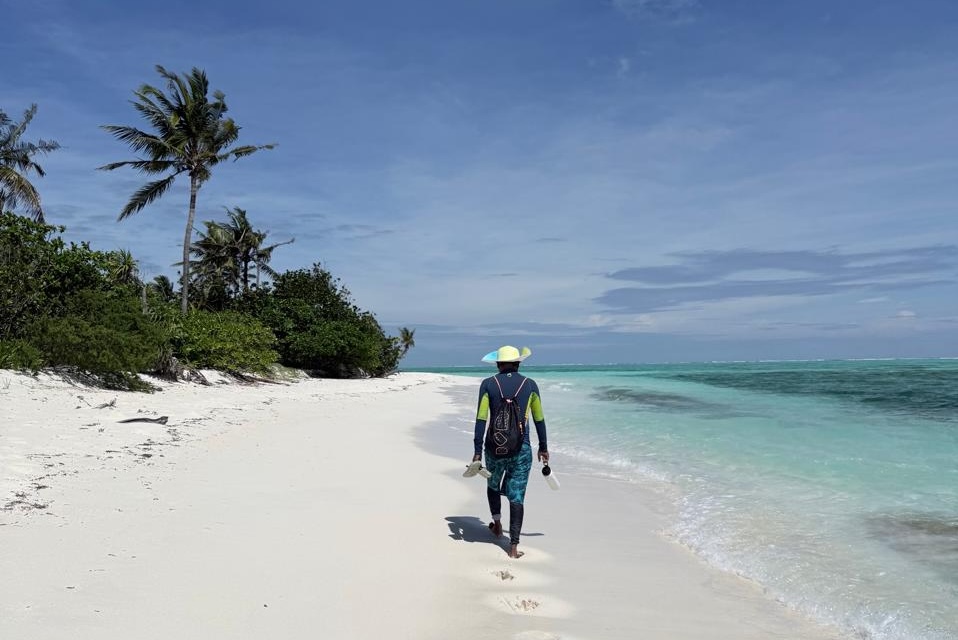
A walk on a beach becomes a reflection on memory, public space, and how Maldives can measure and protect Maldivians’ right to freely access their beaches.
Free tourism insights
Get Free Tourism Insights
Receive selected MTO insights, tourism data alerts, and new resource updates by email.
Get Free Tourism InsightsI am taking a break and traveling to one of my favourite spots in the Maldives. I went snorkelling, crossed the lagoon, and visited an uninhabited island.
Yes, there are islands in the Maldives that do not announce themselves. They do not have a reception jetty with polished timber. They do not have a welcome drink waiting under a thatched roof. They do not have a brand name, a host, a buggy, a signboard, or a guard asking for a room number.
This island was like that. Just white sand. A blue lagoon. A reef line in the distance. Coconut palms leaning into the wind. And that deep Maldivian silence that is never really silent: the small crash of water, the scrape of sand under your feet, the leaves moving behind you, the wide sky above.
So, I began walking along the beach.
It was a quiet walk, but not an empty one. Every step seemed to carry memory. I have walked on this island before. I have walked on many beaches like this: on inhabited islands, uninhabited islands, picnic islands, fishing islands, and islands that do not appear in any tourism brochure.
Before me, my father’s generation walked on beaches like this. Before them, our forefathers crossed these sands, pulled boats ashore, collected firewood, dried fish, climbed palms, rested under shade, and read the weather from the clouds, the stars, the wind, and the reef.
For thousands of years, Maldivians did not experience the beach as a product. We experienced it as home. That is why one question stayed with me as I walked:
How long will I be able to walk freely on this beach?
Beach And Tourism
Tourism is now part of the Maldivian story. It has shaped our economy, our infrastructure, our employment, our national income, our place in the world, and even the way outsiders imagine us. In many ways, modern Maldives was built through tourism. Yet, tourism also changes the meaning of space that surround us. Space that we have enjoyed for centuries.
A beach that was once simply a beach becomes an asset. A reef becomes a product. A sandbank becomes an excursion. A lagoon becomes a view. An island becomes a lease. A shoreline becomes a boundary.
At first, this change is almost invisible. Nobody announces that belonging has changed. Nobody says, “From today, this place means something different.” And over time, the map in our minds begins to shift.
Places once used casually become places that require permission. Islands once visited freely become places under management. Beaches once shared through habit become beaches controlled through contracts, guards, schedules, or social discomfort.
And slowly, almost without noticing, we may begin to lose the simplest freedom of all: the right to walk freely on these beaches.
Tourism-Space Bargain
From 1972 to around 2010, the Maldives managed this tourism-space problem through one of the most unusual tourism models in the world: one island, one resort.
The logic was simple and powerful. Tourists stayed on separate resort islands. Maldivians lived on inhabited islands. Tourism consumption happened largely away from local communities. The model reduced cultural friction, created clear property rights, allowed high-value pricing, and placed many environmental responsibilities inside the resort boundary.
In economic language, the model internalised some of the costs. In everyday language, it kept things separate.
Separation created its own paradox. Tourism became the main engine of national transformation, yet many Maldivians experienced it from a distance. They worked in it, supplied it, depended on it, taxed it, and celebrated its success. But they did not always share its most beautiful spaces.
The resort island became the postcard image of the Maldives. The ordinary Maldivian beach remained outside the postcard. That was the old bargain. It generated national wealth. It created a globally recognised tourism model. It also left behind a question that never fully disappeared: who gets to enjoy the geography that made the Maldives valuable in the first place?
When the Boundary Began to Blur
Then the boundary shifted. Guesthouse tourism expanded. Local island tourism grew. Picnic islands, sandbank trips, reef excursions, dive sites, Instagram beaches, and domestic leisure all became part of a larger tourism economy. The old line between “tourist space” and “local space” became less clear.
This change has brought many good things. It has allowed local entrepreneurs to enter tourism. It has created income on inhabited islands. It has supported cafés, restaurants, dive schools, laundry services, guesthouses, transport operators, guides, and small businesses. It has allowed visitors to see more than the curated resort image of the Maldives. It has made tourism more inclusive. But inclusion also brings pressure.
Every island is now in demand. Every beach has potential value. Every reef can be marketed. Every sandbank can be sold as an experience. Even uninhabited islands that nearby communities once used informally are now increasingly seen through the lens of lease value, excursion value, investment value, or future development value.
This is where the emotional question becomes economic. A beach is not just sand.
In tourism economics, it is a public good bundled into a private product. A guesthouse may sell a room, but part of what the tourist is buying is access to the island beach. A resort may sell a villa, but part of the value comes from the lagoon, reef, silence, and view. A speedboat operator may sell an excursion, but part of what makes that excursion valuable is an island nobody built.
The beach is free in nature, but not free in consequence. When more people want the same place, the pressure appears in different forms: crowding, waste, reef damage, cultural discomfort, informal exclusion, and the quiet feeling among locals that they are becoming visitors in their own seascape.
The Invisible Value of a Beach
As I walked along that beach, I kept thinking about something we rarely measure.
What is the value of this beach to Maldivians?
Not its lease value. Not its resort value. Not its Instagram value. Not even its value to a tourist who visits for one afternoon. I mean its value to the people who belong to this geography.
Economists have a language for this. They would say the beach is not only a physical place, but a public good, or more precisely, a common environmental good. It is open, shared, and valuable even when nobody pays directly to use it. But that language can feel too cold for something so intimate.
A beach is where children learn the sea. It is where families visit on weekends. It is where young people swim, elders sit, fishers rest, and communities remember themselves. It has use value because people actually use it. It has option value because even when we do not visit every week, we value knowing that we can. It has cultural value because families and communities attach memory to it. It has bequest value because we want our children to inherit the same freedom of access.
This is why the beach is difficult to price. The market sees what can be sold. A lease can be priced. A villa can be priced. A transfer can be priced. A picnic package can be priced. But the quiet value of knowing that your daughter can walk freely on a beach your father’s generation may also have known, that value rarely appears in any tourism balance sheet. And yet, if we do not measure it, it becomes invisible. Invisible value is easy to lose.
A Way to Measure Belonging
One way to begin is to estimate what I would call the Maldivian Beach Access Value.
In simple terms, the question is this:
How much value does a Maldivian household receive from being able to freely, safely, and meaningfully access a beach, island, sandbank, or reef area?
A model could be written like this:
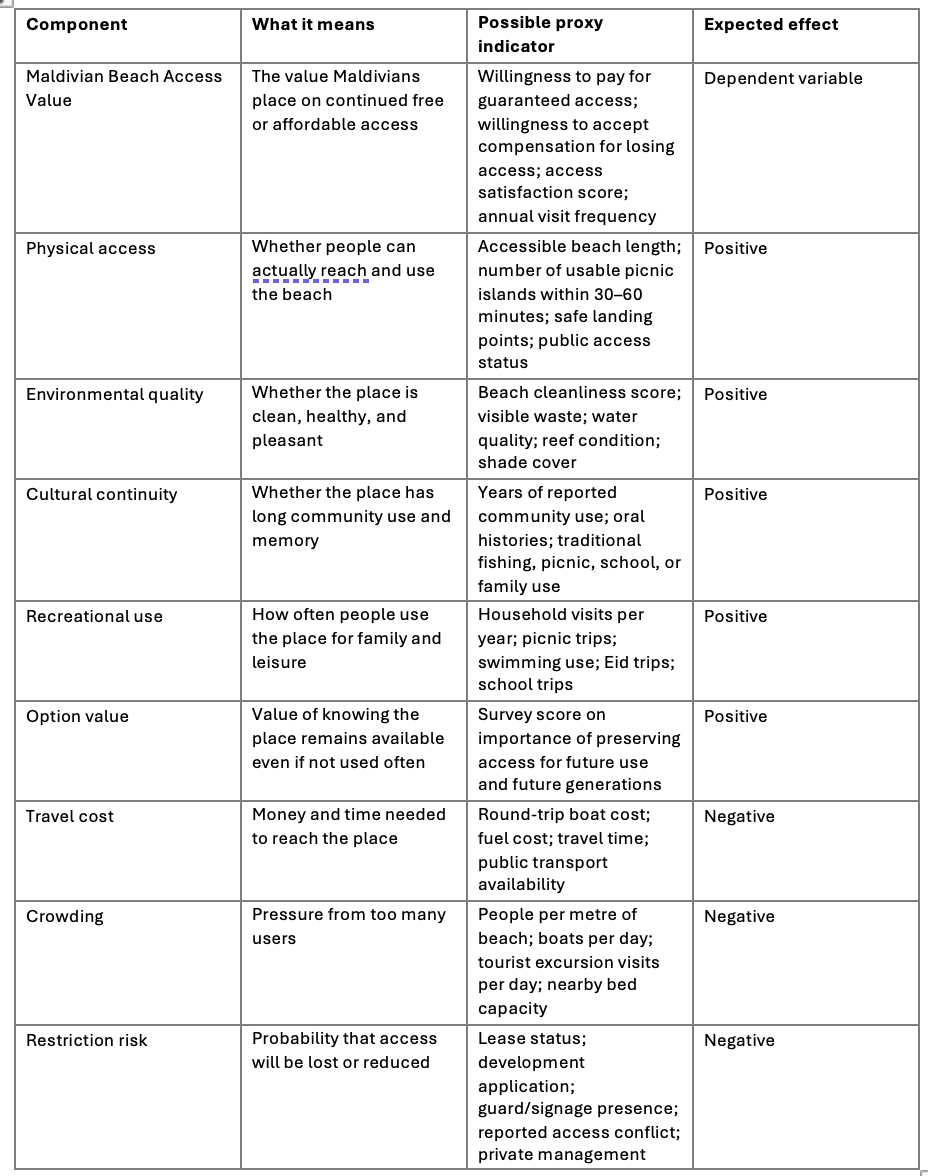
MBAVᵢⱼₜ = β₀ + β₁Accessⱼₜ + β₂Qualityⱼₜ + β₃Cultureᵢⱼₜ + β₄Useᵢⱼₜ + β₅Optionᵢⱼₜ − β₆TravelCostᵢⱼₜ − β₇Crowdingⱼₜ − β₈RestrictionRiskⱼₜ + εᵢⱼₜ
Where MBAVᵢⱼₜ is the Maldivian Beach Access Value for household i, using beach j, in year t.
This may look technical, but the intuition is simple. A beach becomes more valuable to Maldivians when it is easy to reach, clean, safe, culturally meaningful, and freely usable. It becomes less valuable when it is far away, expensive to reach, crowded, polluted, restricted, or uncomfortable to use.
The positive side of the equation captures what makes the beach valuable: access, environmental quality, cultural connection, recreational use, and the option of future use. The negative side captures what reduces that value: travel cost, crowding, and the risk of losing access through leasing, commercialisation, restriction, or informal exclusion.
The purpose is not to reduce belonging to mathematics. The purpose is to make belonging visible in a system that already measures beds, arrivals, revenue, taxes, and leases.
Collecting Data is Not Easy But Needed
There are several ways to collect this data.
The simplest is a household survey. Ask Maldivian households how often they use nearby beaches, how much they spend to reach them, how important access is to family life, and how they would feel if access were lost. This gives a social-access dataset.
A stronger method is the travel-cost approach. If a family spends money on fuel, food, boat hire, and time to visit a nearby uninhabited island, and still chooses to go several times a year, that behaviour reveals that the beach has real recreational value. The cost of reaching the beach becomes a lower-bound estimate of its value.
A third method is contingent valuation. Households could be asked how much they would be willing to pay each year into an atoll-level access and conservation fund if it guaranteed clean, safe, continued public access to selected picnic islands and beaches. Another version would ask how much compensation they would require if a beach they regularly used became unavailable.
This second question may be especially important in the Maldives, because we are not only valuing a new benefit. We are often valuing the possible loss of something people feel they already have.
A fourth method is a choice experiment. People could be shown different island-access scenarios. One island is free but crowded and poorly maintained. Another has a small access fee but clean beaches, toilets, shade, and waste management. Another is farther away but less crowded. Another is closer but shared with tourist excursions.
By observing the choices people make, we can estimate the relative value of cleanliness, distance, crowding, facilities, and guaranteed access.
This is how an emotional issue can become measurable without losing its human meaning.
The point is not to say that an equation can fully capture the feeling of walking on a beach your grandfather may have known. It cannot. The point is to stop pretending that only commercial value is real value.
If a resort lease has value, local access also has value. If a tourist’s willingness to pay matters, a Maldivian family’s willingness to preserve access also matters. If the state can count arrivals, beds, receipts, and taxes, it should also be able to count how many beaches Maldivians can still reach freely. Because what we do not count, we often fail to protect.
An Empty Island Full of Claims
The island I visited looked empty. But in reality, it was full of invisible claims. The state may see future lease value. A nearby community may see ancestral access. A guesthouse operator may see an excursion route. A resort may see privacy and brand protection. A tourist may see paradise. A fisherman may see a reef fishing point. A young Maldivian family may see the only nearby place where children can enjoy a proper picnic.
All of them may be right. That is the difficulty. The conflict is not always between good and bad. It is often between different kinds of value: economic value, cultural value, recreational value, environmental value, emotional value, national value.
And when all these values meet on one beach, the weakest claim is often the informal one.
Local belonging is often not written down. It is remembered. It is practised. It is assumed. It lives in the phrase, “We have always gone there.” But in a modern tourism economy, what is not written down can easily become weak.
One Picnic Island Is a Positive Signal
The government’s promise to develop one picnic island in each atoll matters. It recognises something important: Maldivians also need space. Not only housing space. Not only harbour space. Not only economic space. Also leisure space. Breathing space. A place to take children, cook food, swim safely, sit under shade, and feel the old relationship between people and island.
As I walked along the beach, I kept thinking that one picnic island per atoll is not the full answer. It is a beginning. It is a signal. The deeper question is larger than picnic infrastructure. The real question is whether Maldivians will retain a meaningful right to the seascape in a tourism economy.
Because if we are not careful, we may build a strange future: a country globally marketed for its beaches, where ordinary Maldivians must ask permission to enjoy them.
That would be a quiet tragedy. Not dramatic. Not sudden. Not the kind of thing that appears in one headline. But a slow narrowing of belonging. One island leased here. One beach restricted there. One reef crowded. One sandbank commercialised. One picnic place made unavailable. One generation growing up with less informal access than the generation before.
My Daughter After Me
As I walked, I was not thinking only about tourism models or economic valuation. I was thinking about my daughter, just a few feet behind me. I wondered what this beach would mean to her as she grows older. Would she feel what I felt — that quiet sense of belonging, that ease of walking without asking, that feeling that the island was not owned by her but somehow still part of her?
Or would she inherit a Maldives where every beautiful shoreline has a manager, a booking system, a lease boundary, or a guard?
That question stayed with me longer than the walk.
The Maldives does not need to choose between tourism and her people. That is not the choice. Tourism is part of our national story now. It has shaped our economy, our aspirations, our islands, and our place in the world.
But we do need to remember something older than tourism. The beach is not only where tourism happens.
It is where the Maldivian story began. And perhaps the right to walk — quietly, freely, without being stopped — is one of the simplest ways of keeping that story alive.