Tourism Industry Insight: Cross-Trained Staff Can Create Hidden Capacity in Hotels
05 Sep 2026, 04:06 · by IzuCT · 4 min read · Updates · EN
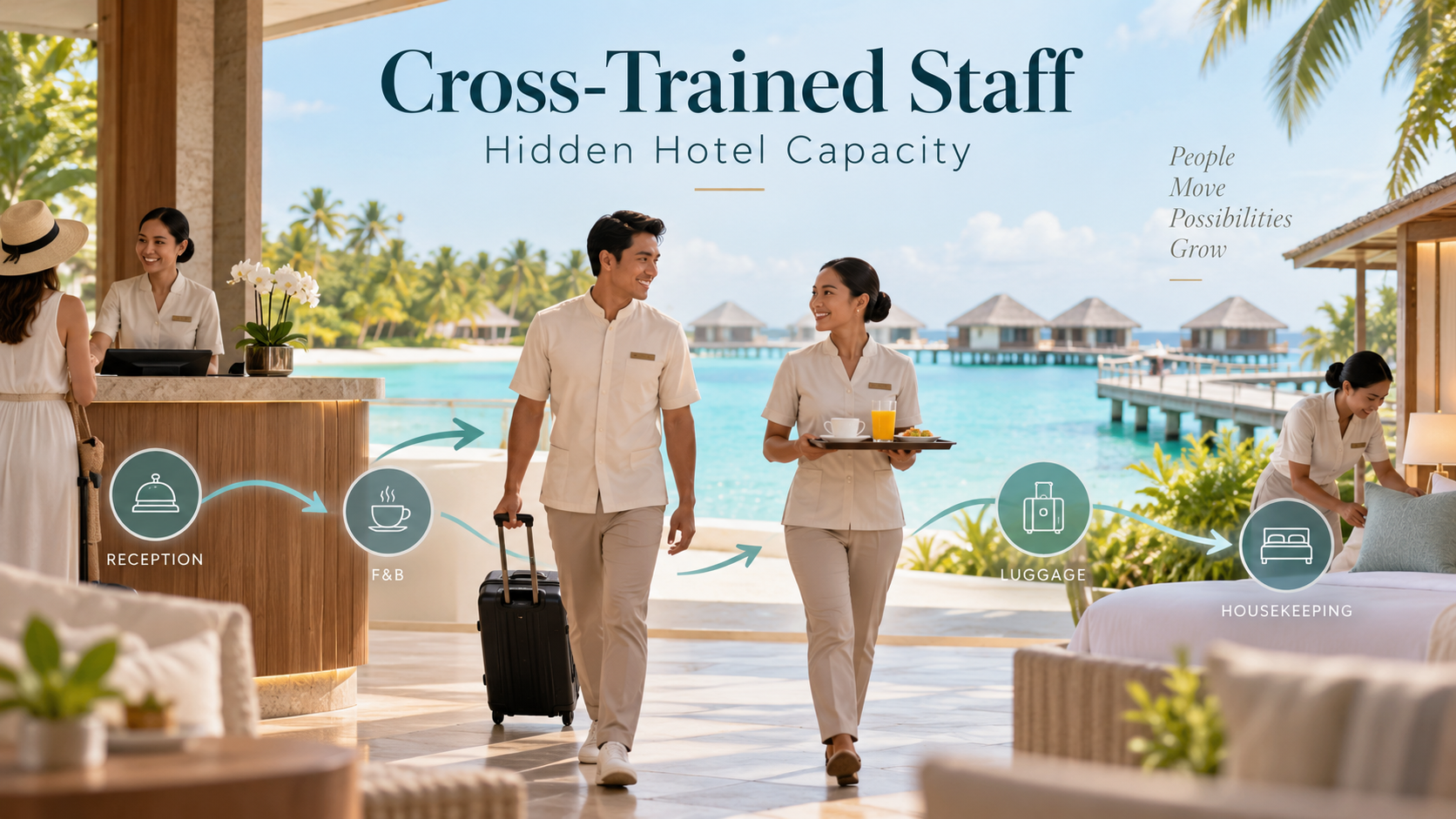
The most valuable extra capacity in a hotel may not be another employee. It may be an existing employee who can competently move where demand suddenly appears.
At 7:30 a.m., breakfast is unusually busy. Two hours later, the pressure has moved to housekeeping as early departures release rooms for incoming guests. By noon, a delayed international flight has compressed several transfers into one arrival wave, and reception suddenly needs help. In an illustrative resort, total staffing for the day has not changed at all. Yet one department feels overstaffed while another is briefly overwhelmed.
The problem is not simply labour shortage. It is labour being in the wrong place at the wrong moment.
Specialisation creates efficiency, flexibility absorbs surprises
Hotels naturally divide work into departments because specialisation improves productivity. A trained housekeeper cleans rooms faster than an employee who rarely enters housekeeping; an experienced front-office agent resolves complicated guest issues more efficiently than a generalist.
But specialisation carries a hidden cost when demand fluctuates.
Operations researchers distinguish between dedicated workers, who perform particular tasks efficiently, and flexible workers who can serve more than one demand stream. Research on service systems finds that cross-trained employees can reduce delays, although excessive flexibility may also carry training costs or lower task-specific efficiency. The optimum is therefore usually not “everyone can do everything,” but an intelligent mixture of specialists and flexible capacity.
That distinction matters in hospitality because demand does not arrive evenly. Rooms turn over in clusters. Restaurants experience meal peaks. Airport transfers create arrival waves. Weather can move guests suddenly from outdoor activities into restaurants, spas or indoor spaces.
In the Maldives, the one-island-one-resort operating model makes this especially visible. Accommodation, transport, food, recreation, utilities and guest services operate inside one tightly connected system. A disturbance in one part can quickly become workload somewhere else.
Cross-training behaves like operational insurance
Consider two illustrative employees during an afternoon arrival surge. One normally works in guest relations but is trained to support basic check-in procedures. Another works in recreation but can assist with luggage coordination when excursions are quiet.
Neither replaces the specialist team.
Instead, each provides something closer to an option.
In finance, an option has value because it gives its holder the ability to act when circumstances change. Cross-training creates similar operational value. Management does not need to move the employee every day. The value lies in being able to move that capacity when queues, absences, weather or arrival patterns make it useful.
That matters when hotels are already facing staffing constraints. A 2025 American Hotel & Lodging Association survey found that 65% of surveyed hotels reported staffing shortages, with housekeeping and front desk among the most frequently affected functions. The precise labour conditions differ by destination, but the operational principle travels well: recruiting more people is only one way to increase capacity.
The Maldives also has a deeper human-capital reason to think this way. Earlier IZUCT analysis argued that skills should be treated as productive tourism assets, not merely as staffing inputs. Cross-training extends that idea by making each employee’s knowledge useful across more situations.
Measure skill coverage, not only headcount
A hotel staffing report usually shows how many employees are scheduled. A more revealing view would show which functions those employees can safely cover.
Managers could map critical operating tasks against qualified backup staff: check-in support, luggage coordination, breakfast service, basic reservations, guest messaging, room inspection or excursion administration. The useful question becomes: if demand jumps here for ninety minutes, where can competent support come from?
This does not mean abandoning departmental expertise. Training should be limited to tasks that can be performed safely, legally and to the required service standard. But even modest flexibility can matter when operating pressure is temporary.
The economics also connects with the true cost of an occupied room. Labour is partly a fixed commitment. Increasing the usefulness of already-scheduled labour can therefore improve productivity without requiring the same increase in headcount. Likewise, when unused tourism capacity puts pressure on margins, indiscriminate staffing cuts can weaken service precisely when flexibility would be more valuable.
Return to the resort at 7:30 a.m. The breakfast rush, housekeeping peak and afternoon arrival surge were not three separate staffing problems. They were three movements of the same daily workload.
A hotel cannot remove variability from tourism. Flights will bunch, weather will change, guests will arrive early and departments will experience different peaks.
But it can become better at moving capability toward the pressure.
That is the hidden capacity created by cross-training: not more people, but more ways for the people already present to keep the guest experience flowing.