Tourism Industry Insight: Make AI Guest Service More Useful
12 Sep 2026, 18:36 · by IzuCT · 4 min read · Tourism · EN
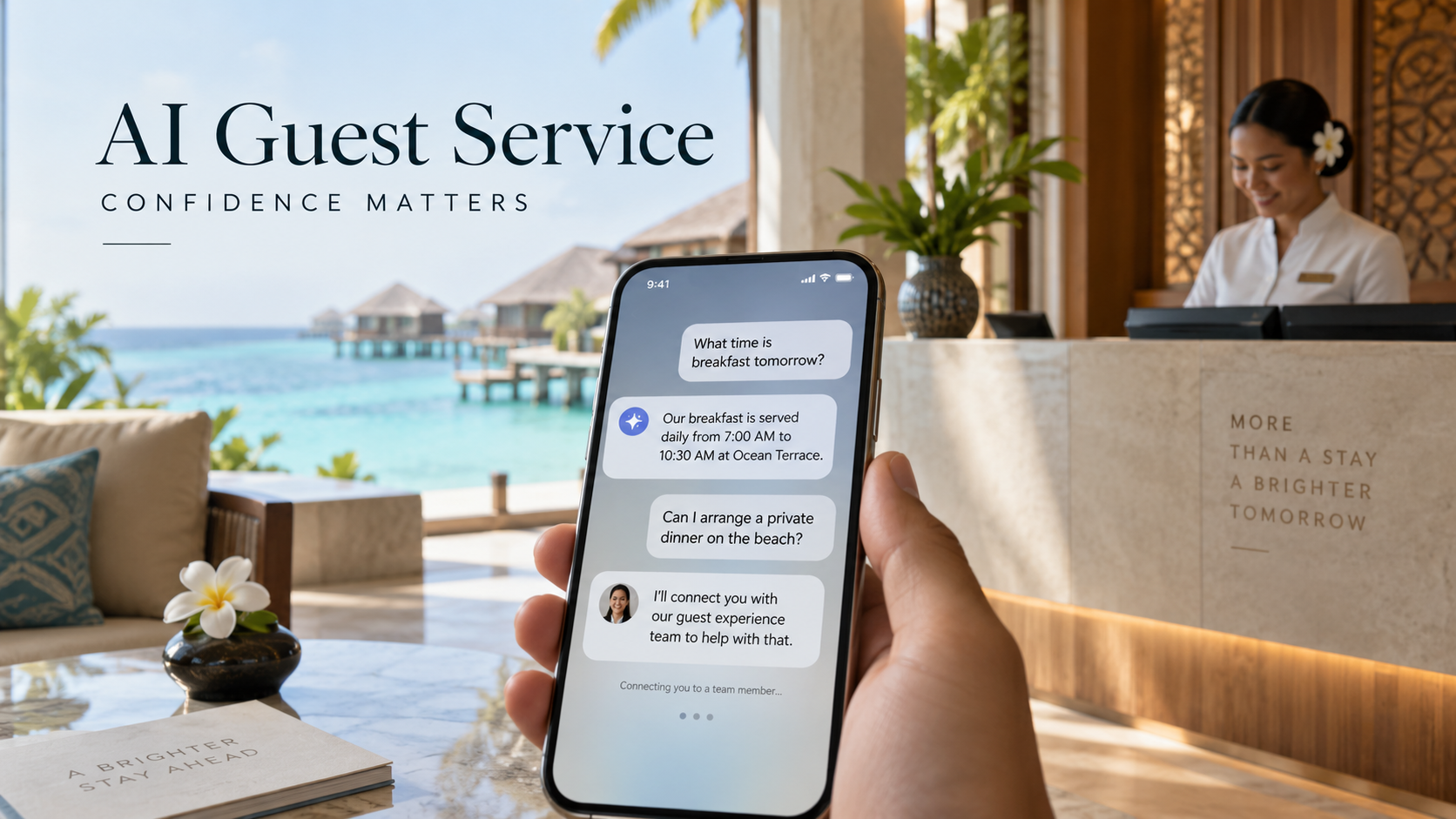
AI can answer thousands of guest questions instantly. Its real operational value may come from knowing which questions it should not answer alone.
Free tourism insights
Get Free Tourism Insights
Receive selected MTO insights, tourism data alerts, and new resource updates by email.
Get Free Tourism InsightsAt 11:40 p.m., a resort guest sends two messages. The first asks what time breakfast opens. The second asks whether a 3:30 p.m. seaplane departure leaves enough time to catch an international flight from Malé. An AI assistant can answer both in seconds. But the consequences of being wrong are completely different. A mistaken breakfast time creates irritation. A mistaken transfer answer could mean a missed flight. The useful question, therefore, is not simply whether AI can answer. It is when AI should answer without human review.
Not every correct-looking answer carries the same risk
Decision theory gives hotels a practical way to think about automation. The expected cost of an AI answer depends on two things: the probability that it is wrong and the consequence if it is wrong.
Suppose, illustratively, an automated answer has a 2% chance of error. If the likely cost of an error is USD 5 in inconvenience or service recovery, the expected loss is only ten cents. If the same 2% error could trigger a USD 1,000 missed-flight problem, the expected loss rises to USD 20. The model is simplified, but the principle is powerful: the acceptable confidence threshold should rise with the cost of being wrong.
This is consistent with the broader risk-based approach in NIST’s AI Risk Management Framework, which emphasises mapping and managing AI risk according to context rather than treating every use case alike. Booking.com’s 2025 global survey of more than 37,000 consumers also found strong appetite for AI in travel planning, but only 6% said they fully trusted AI and just 12% were comfortable allowing it to make decisions independently.
Build lanes, not one chatbot rule
For hotels and travel businesses, the practical answer is to divide guest questions into risk lanes.
Low-risk, stable questions—breakfast hours, Wi-Fi instructions, check-out time, restaurant location—can often be automated if the underlying information is current. Medium-risk questions, such as package inclusions, room upgrades or cancellation terms, may require the AI to quote only verified system data or ask for confirmation. High-risk questions involving live transport, payments, exceptions, safety, visa rules or contractual promises should trigger human review when confidence is below a defined threshold.
This matters particularly in the Maldives, where the one-island-one-resort model ties accommodation closely to transport and other operating systems. As the article on why the cheapest transfer can cost a resort more showed, uncertainty around transfers can destroy value quickly. An AI assistant that answers confidently from yesterday’s schedule may therefore be worse than one that says, “I need to verify this.”
The best automation may be an escalation system
Hotels should measure more than chatbot response time. Useful metrics include the share of enquiries resolved without intervention, escalation rate, correction rate, repeat-question rate, guest satisfaction after automated conversations and, crucially, error severity.
A system that automates 90% of messages but occasionally makes expensive promises may be inferior to one that automates 70% and escalates intelligently. The objective is not maximum automation. It is minimum total service loss.
This complements the logic in Cross-Trained Staff Can Create Hidden Capacity in Hotels. AI can absorb repetitive informational work, while people concentrate on ambiguous or consequential cases. It also supports the principle behind How Simpler Choices Can Make Hotel Booking Easier: good systems reduce cognitive burden rather than merely adding more options.
There is a financial angle too. As The Price the Guest Pays Is Not the Revenue You Keep argues, staff time is part of the real economics of direct business. AI can reduce that cost—but only if savings are not offset by rework, compensation and damaged trust.
Return to the guest messaging at 11:40 p.m. Breakfast hours can probably be answered instantly. The airport connection deserves verification.
That small distinction captures the next stage of useful tourism AI. The strongest system will not be the one that speaks most often or sounds most human. It will be the one that understands the economic consequence of uncertainty and knows when confidence is not high enough.
In hospitality, intelligence is not only answering quickly. Sometimes it is recognising when a human should take over.