Tourism Industry Insight: How Simpler Choices Can Make Hotel Booking Easier
03 Sep 2026, 19:37 · by IzuCT · 4 min read · Tourism · EN
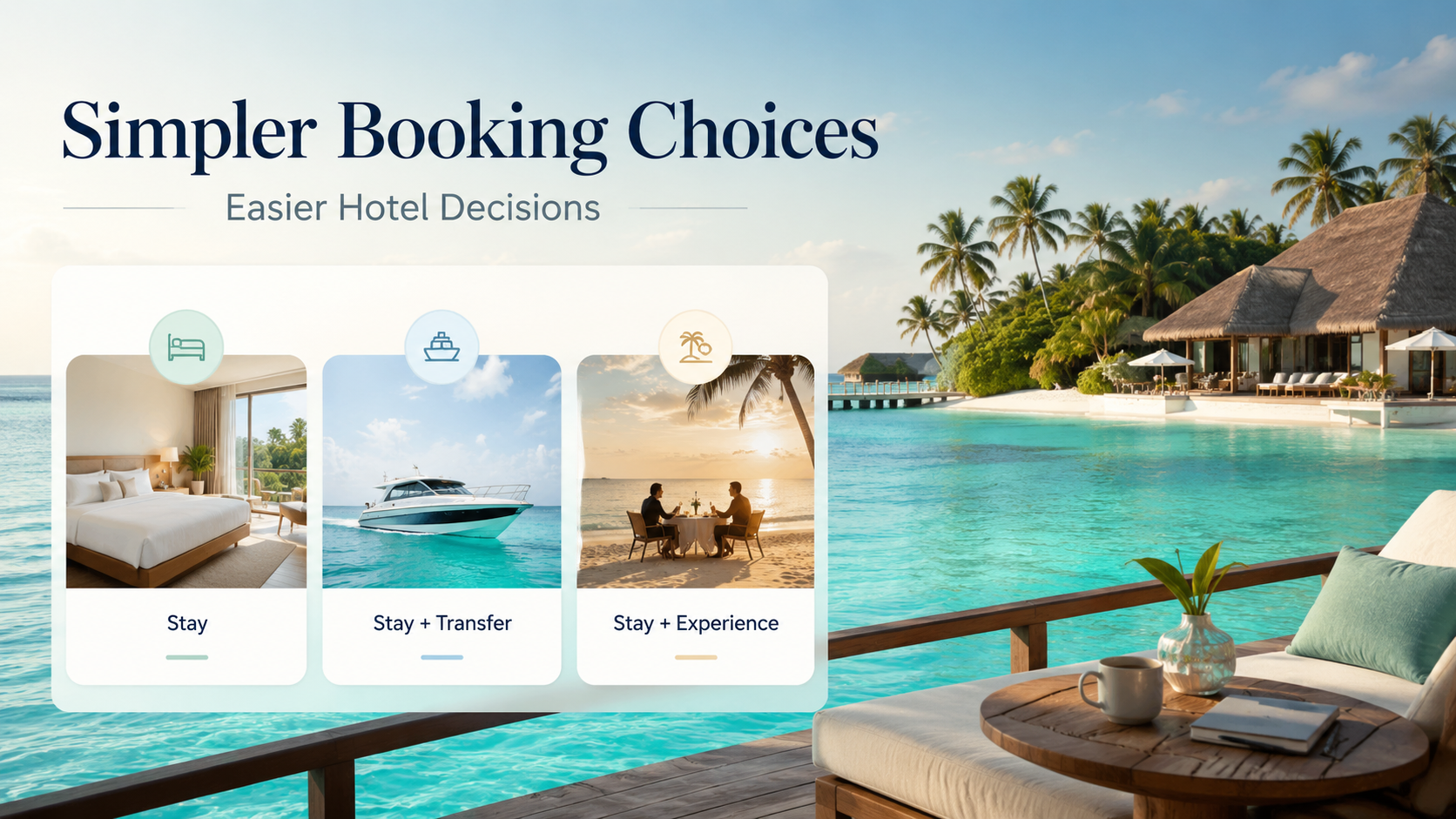
More room types, packages and rate plans can appear to give travellers greater freedom. Sometimes the better sales strategy is helping them choose with less effort.
Free tourism insights
Get Free Tourism Insights
Receive selected MTO insights, tourism data alerts, and new resource updates by email.
Get Free Tourism InsightsA traveller finds a Maldivian guesthouse she likes. Then the simple decision becomes complicated. There are four room categories, three meal plans, refundable and non-refundable rates, scheduled or private transfers, and several activity bundles. In an illustrative case, just those choices can produce 4 × 3 × 2 × 2 = 48 possible combinations. Nothing is necessarily wrong with any individual option. Yet together they create a different problem: before choosing a holiday, the traveller must solve a small optimisation exercise.
More choice has quietly become more work.
When variety turns into cognitive cost
Economics usually treats additional choice as valuable because consumers can find something closer to their preferences. But behavioural research adds an important qualification: once the comparison becomes sufficiently difficult, additional options can generate choice overload.
Hotel booking provides unusually clear evidence. A 2022 experimental study of online hotel booking found that larger choice sets increased perceived overload, while the way information was presented affected how strongly travellers experienced it. Earlier eye-tracking research found that when travellers faced a list of 20 hotels, many simplified the decision by concentrating more heavily on price. More recent 2026 tourism experiments similarly found that large choice sets can increase decision difficulty and regret while reducing satisfaction.
The underlying mechanism is limited attention.
Every additional attribute creates another comparison: sea view versus larger room, breakfast versus half-board, flexible cancellation versus lower price. The difficulty grows faster when attributes interact. Four independent decisions do not feel like four decisions when their combinations produce dozens of possible outcomes.
This is particularly relevant to operators already thinking carefully about choosing the right package. The commercial objective is not to eliminate flexibility. It is to prevent flexibility from becoming friction.
Keep complexity behind the booking screen
Imagine that the same guesthouse reorganises those 48 possible combinations into three starting choices.
Essential includes the room and breakfast. Island Easy adds the scheduled transfer. Experience adds transfer plus an activity credit. Guests who want something different can still customise later.
The business has not removed its capabilities. It has changed their architecture.
That distinction matters. A property may need detailed internal rules for transfers, activities, meal costs and cancellation conditions to build a profitable package. The guest does not necessarily need to confront every operational permutation before deciding whether to book.
Price presentation deserves the same discipline. When service charge, tax, Green Tax and mandatory transport appear progressively, the traveller must repeatedly recalculate the decision. Showing the final amount the guest actually pays reduces one important dimension of uncertainty.
There is also a strategic pricing implication. When people feel overwhelmed, they often use simplifying rules. Price is an easy rule because it reduces many dimensions to one number. A property that presents excessive complexity may therefore unintentionally push customers towards precisely the comparison it would prefer to avoid: “Which one is cheapest?”
That makes the case for adding recognisable value instead of relying automatically on discounts even stronger. Benefits work best when travellers can understand them quickly.
Measure decision friction, not just traffic
Hotels usually monitor website visits, enquiries and conversion. A useful next layer is to ask where the decision becomes difficult.
Does abandonment rise after the rate-plan page? How long do travellers remain there? Which options are rarely selected? How often do guests contact the property to ask what is included? Does introducing a recommended package increase conversion without reducing retained revenue?
The goal is not always the smallest possible menu. Research suggests that filtering and good information presentation can reduce overload even when many choices remain available.
This also changes how operators should view competitor variety. Seeing another property advertise fifteen rate plans does not mean fifteen plans are necessary. As with competitor pricing, another hotel’s structure is information, not an instruction.
Return to the traveller facing those 48 combinations. She did not visit the booking page hoping to become an expert in hotel revenue architecture. She wanted confidence that the holiday would suit her.
That is the deeper opportunity. Hospitality businesses can keep enormous flexibility inside their operating systems while presenting a much simpler decision to the guest. The best choice architecture does not reduce freedom. It organises freedom so that the traveller can see the path forward.