Tourism Industry Insight:: Nearby Experiences Win More of the Guest’s Holiday
17 Sep 2026, 02:33 · by IzuCT · 4 min read · Tourism · EN
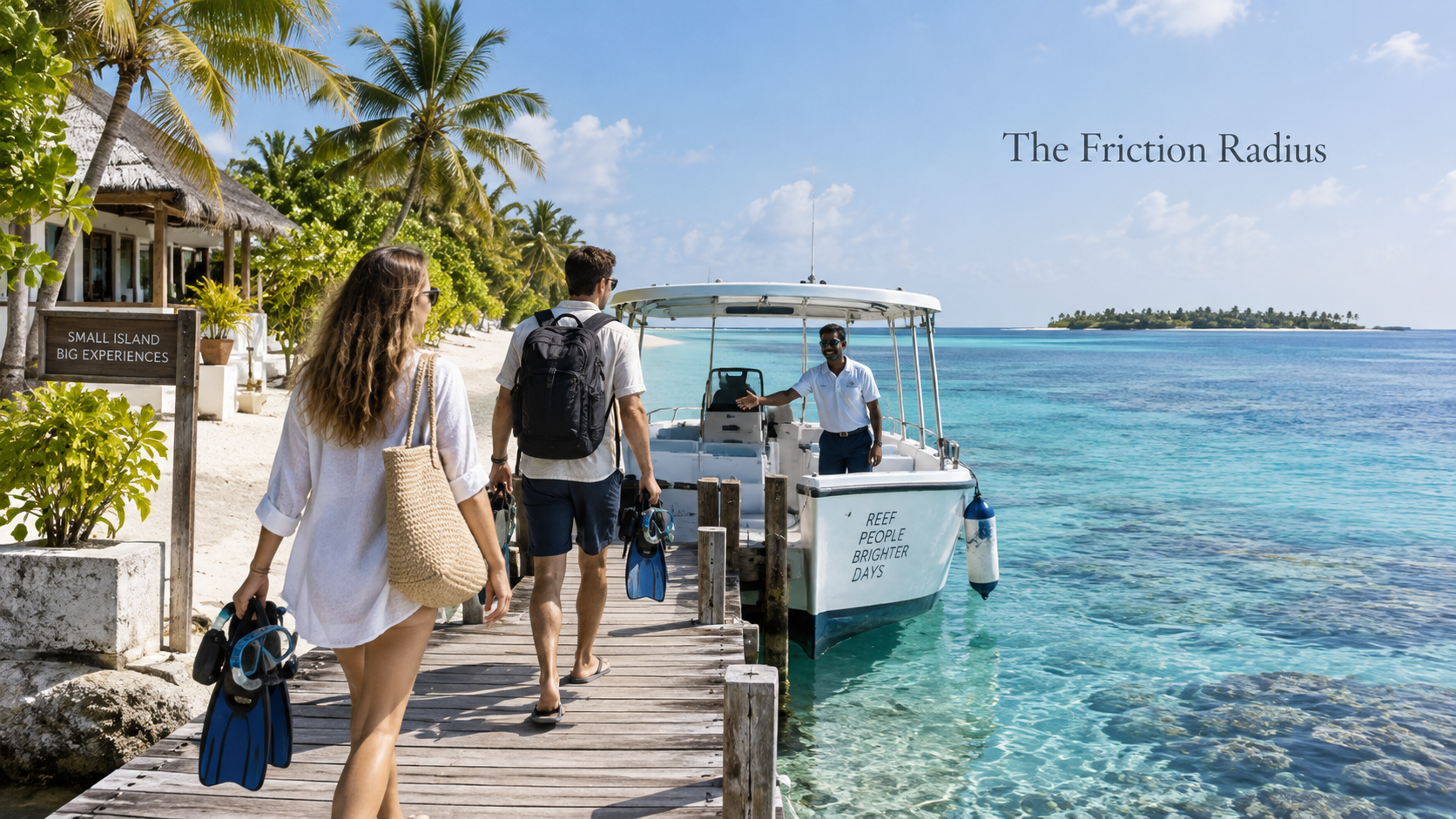
Attractions do not compete only on quality and price. The time, effort and uncertainty required to reach them can quietly determine how much tourism value they capture.
Free tourism insights
Get Free Tourism Insights
Receive selected MTO insights, tourism data alerts, and new resource updates by email.
Get Free Tourism InsightsA guest on a Maldivian local island has two appealing choices after breakfast. One snorkelling trip leaves from a jetty five minutes away. Another visits a better-known reef but requires a twenty-minute walk, a boat connection and confirmation from an operator she has not met. The second experience may objectively be better. Yet the first is easier to say yes to. By late afternoon, the nearby excursion has another passenger while the more distant one has an empty seat. Geography has entered the purchase decision without appearing on the price list.
Distance has a hidden price
Transport economics calls this generalised cost. The traveller does not experience price as money alone.
A simple representation is:
Generalised cost = money + value of travel time + waiting + effort + uncertainty.
Two excursions both priced at USD 60 can therefore have very different effective costs. If one requires five minutes of walking and the other consumes forty minutes of movement, waiting and coordination, the second asks the guest to spend more of another scarce currency: holiday time.
Tourism economics has long observed “distance decay”—interaction generally weakens as spatial friction increases. A 2026 study of tourism flows across 14 East African destinations found that geographical distance continued to reduce tourism demand even after airfare was considered, suggesting that monetary transport cost does not capture the entire burden of distance. Research on tourist-attraction accessibility similarly shows that travel time remains important to how tourism supply and demand connect spatially.
The scale is different, but the operating principle travels well: accessibility is part of the product.
The island is a network, not a collection of attractions
This becomes especially important in local-island tourism.
A guesthouse may advertise diving, restaurants, sandbanks, cultural walks and fishing. But the commercial value of those experiences depends partly on how easily a guest can move among them. The article Stop Copying Competitor Prices and Build a Rate That Fits Your Island already shows why island characteristics belong inside accommodation value. Accessibility extends that logic from the room to the guest’s daily movement.
Packages can reduce this friction. Choosing the Right Package explains how including transfers and activities can give travellers useful certainty. The benefit is not only financial bundling. A coordinated package removes decisions, messages, waiting and navigation.
The same mechanism explains why the cheapest transfer can cost a resort more. A low-cost transport arrangement may consume expensive holiday time. Inside the destination, smaller fragments of friction can accumulate in exactly the same way.
Resorts partly solve this through spatial integration. The one-island-one-resort model concentrates accommodation, dining, recreation and transport coordination within one managed system. Local-island tourism has a different strength—multiple independent businesses and community experiences—but that makes coordination more important.
Measure minutes between experiences
Operators can start with a simple map.
For each major guest activity, record the door-to-experience time: minutes from leaving the accommodation to beginning the activity. Add the number of coordination steps required—messages, payments, transport changes or confirmations—and compare these with actual booking uptake.
The useful question is not whether 20 minutes is inherently too far. It is whether participation drops sharply beyond a particular friction level.
A dive centre might discover little difference between five and ten minutes, but substantially lower spontaneous bookings when an activity requires a separate transfer. A destination organisation might find that adding a scheduled shuttle creates more value than another promotional campaign because existing attractions suddenly become easier to consume.
This matters more as stays become shorter. The Maldives’ Seven-Night Tourism Reset argued that destinations need stronger experience design when each visitor has fewer days available. A shorter holiday increases the value of every hour saved.
Return to the guest choosing between those two snorkelling trips.
She did not necessarily reject the better reef. She may simply have chosen the experience with the lower total friction.
That distinction changes destination development. Building another attraction is not always the highest-value investment. Sometimes the stronger intervention is a reliable shuttle, a common booking point, coordinated departure times, clearer walking routes or one message that confirms the whole journey.
Tourism competitiveness therefore depends partly on what might be called the friction radius: how much worthwhile experience a traveller can access easily from where they stay.
The richer that radius becomes, the larger the destination can feel—without becoming physically any bigger.