Tourism Industry Insight: Turning Changing Skies into Better Island Experiences
01 Nov 2026, 09:09 · by IzuCT · 4 min read · Tourism · EN
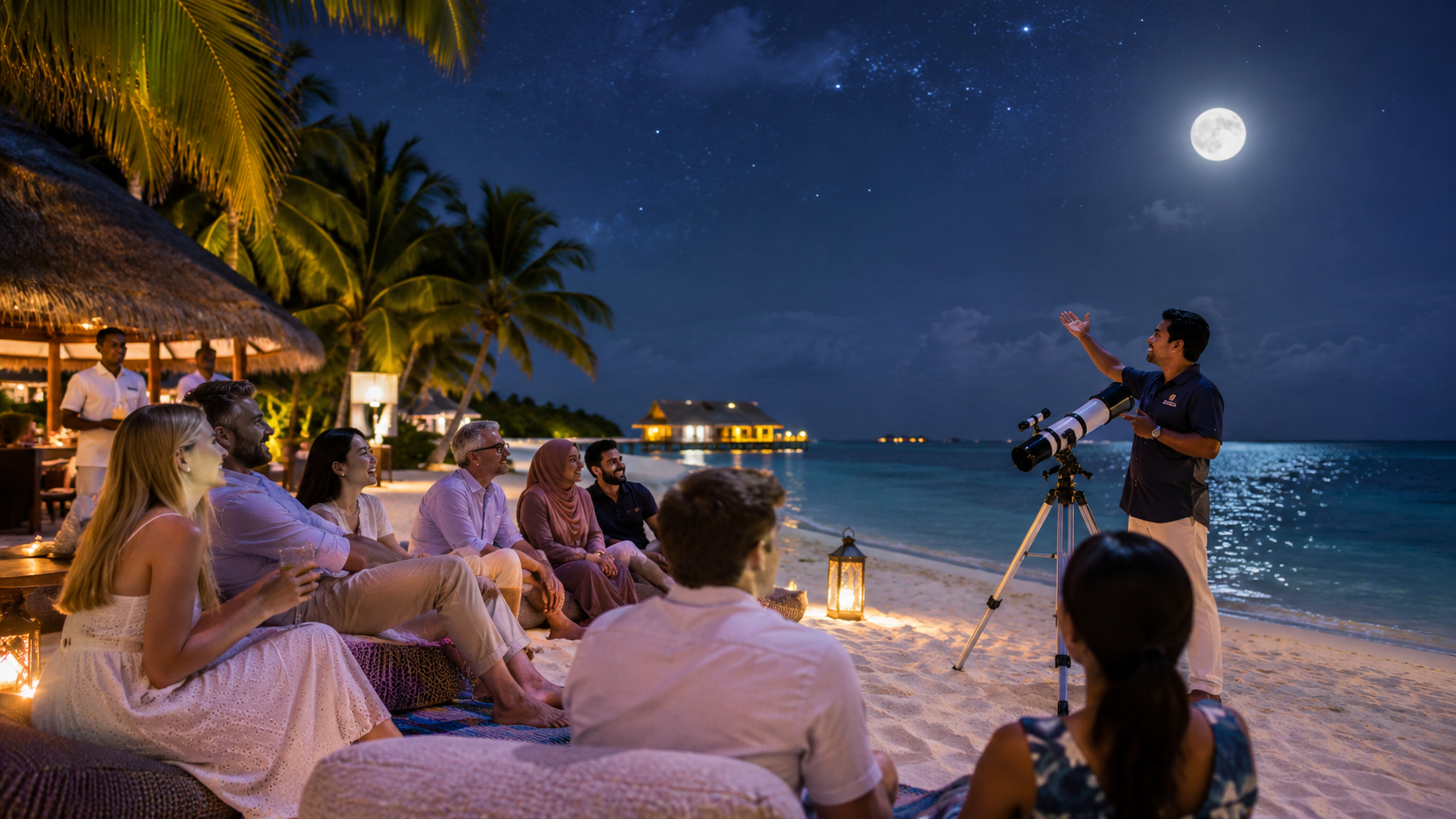
The Maldives sells remarkable sunsets, but the changing Moon offers another opportunity: designing memorable nighttime experiences around predictable celestial conditions.
Free tourism insights
Get Free Tourism Insights
Receive selected MTO insights, tourism data alerts, and new resource updates by email.
Get Free Tourism InsightsAt 8:30 p.m., guests gather on a Maldivian beach for an advertised stargazing session. The sky is cloudless, the telescope is ready, and the guide is enthusiastic. Yet a nearly full Moon illuminates the sand, washing out many faint stars. The following week, under a darker sky, another group might see far more with the naked eye. Neither evening is a failure of hospitality. They are different products created by a predictable natural cycle. Why do resorts schedule night-sky experiences as though every clear evening were interchangeable?
A calendar changes the product
The Moon reflects sunlight, and its changing position determines how much of its illuminated face we see. NASA's explanation of lunar phases establishes that the cycle repeats approximately every 29.5 days. Around a new Moon, skies are generally darker; around a full Moon, moonlight obscures faint stars while illuminating the lagoon. Moonrise and moonset also matter: some evenings offer useful dark windows even when the Moon is not new.
This creates a scheduling advantage. A restaurant can serve the same menu every night, but a stargazing excursion cannot promise identical skies. Its quality depends jointly on lunar illumination, cloud cover, artificial light and guest expectations. Lunar conditions are predictable months ahead; clouds are not. Good product design uses the predictable variable while managing uncertainty in the others.
A 2025 study of visitors to Canada's Jasper Dark Sky Festival reported high satisfaction and learning, although its findings cannot establish willingness to pay for Maldivian excursions. Guidance from DarkSky International also emphasises protecting wildlife, residents and nighttime environments. The commercial opportunity is plausible, not a measured local premium.
Sell two kinds of night, not one promise
Imagine an illustrative resort offering twenty evening sessions monthly. Ten are marketed as “deep-sky evenings” during darker lunar windows; ten as “moonlit lagoon evenings,” emphasising the Moon, coastal scenery and guided interpretation. Neither category automatically sells better. The advantage is allowing guests to select experiences aligned with conditions rather than judging every evening against an impossible photograph.
The earlier analysis of smarter resort lighting explains why controlling glare and light spill improves nighttime conditions. But a dimmer pathway cannot change lunar illumination. Similarly, the discussion of accurate hotel photographs reminds operators that dramatic astrophotography may reveal details invisible to the unaided eye. Marketing should distinguish what guests can see naturally from what requires optical equipment or photography.
The promise also needs a weather policy. Flexible timing can rescue guest experiences, but clouds cannot be removed by a better telescope. Alternatives might include a later session, a different guided activity or a refund under stated conditions. A specific celestial spectacle should never be guaranteed when visibility remains uncertain.
Measure experience quality before setting a premium
A resort could begin with one viewing location and a three-month pilot. Record lunar phase, Moon altitude, cloud conditions, nearby lighting, attendance, satisfaction, refunds and staff time. Compare similar offers across conditions and traveller segments. Establish a minimum visibility threshold for each advertised activity, communicating decisions before guests leave their rooms.
The article on giving guests information when they can use it suggests sending a brief sky update on the afternoon of the session. Maintaining a consistent commercial promise is equally important: booking pages, concierge messages and on-site descriptions should agree on what is conditional.
Price only after establishing costs and demand. An illustrative USD 40 session with ten guests generates USD 400 in gross receipts, not profit. Staffing, equipment, setup, cancellation exposure and applicable taxes still matter. The useful comparison is incremental contribution per session, alongside satisfaction and delivery reliability.
Return to the group on the moonlit beach. Their evening could have been excellent if sold as an opportunity to explore the Moon, observe its surface and enjoy a luminous coastline. The disappointment arose because the promise described a different sky. A week later, a darker night might support an entirely different encounter with the stars.
The Moon cannot be controlled, but its calendar can be read. That turns a natural constraint into a planning tool: match the experience to the sky, describe it accurately and let guests choose. Luxury need not manufacture the same night twice. It can make each night's difference worth discovering.