Why Weight Changes but Mass Does Not
28 Apr 2026, 16:50 · by IzuCT · 6 min read · Science · EN
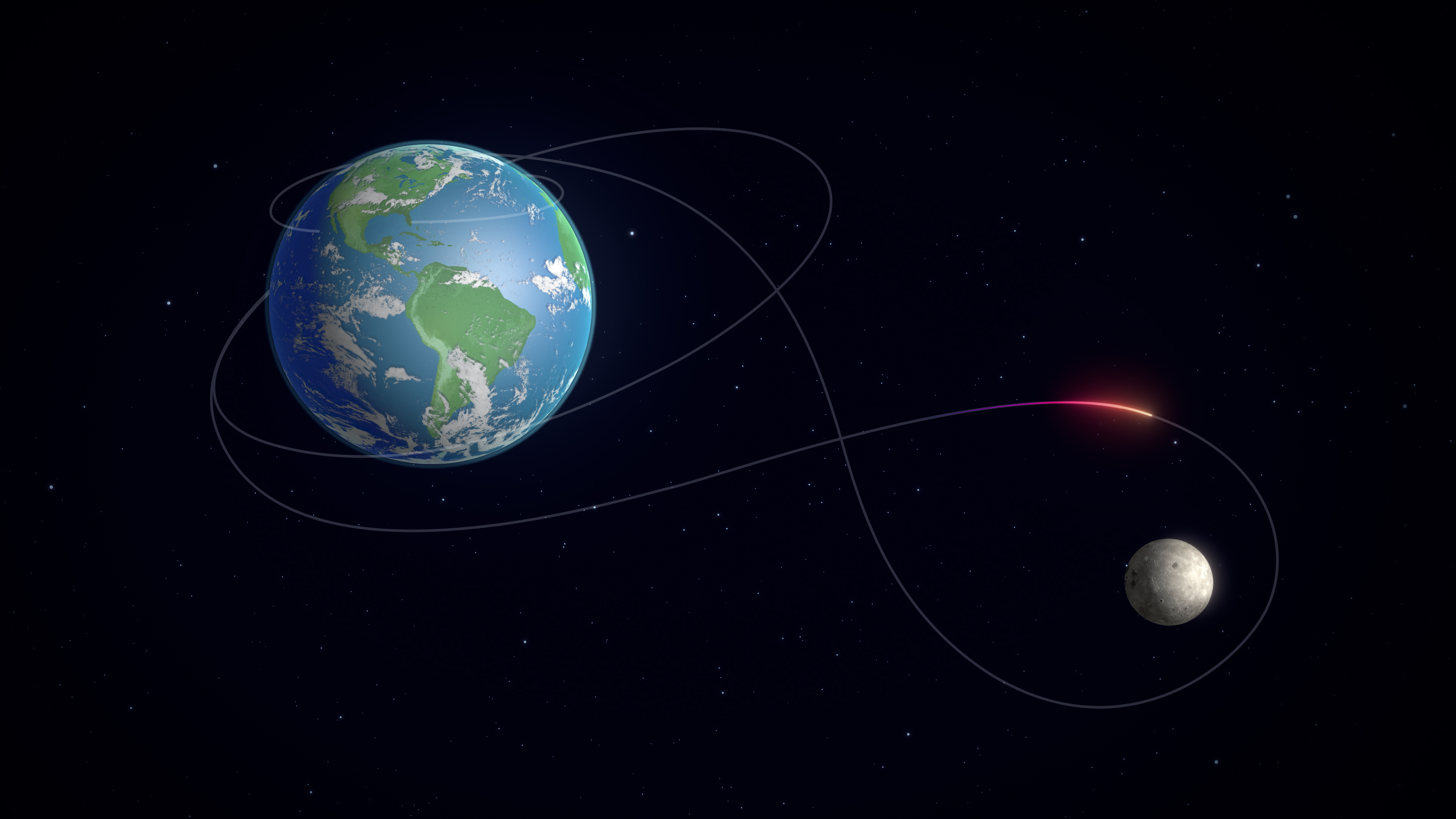
A few weeks ago, NASA’s Artemis II mission launched four astronauts on a crewed lunar flyby, then returned safely to Earth after nearly 10 days. NASA describes the mission as a free-return journey around the Moon, using the gravity of the Earth and Moon to help guide the spacecraft home. Reuters also reported the launch as the first crewed lunar mission in over half a century.
Artemis II is a perfect reminder that gravity is not just a classroom idea. NASA says the mission followed a free-return trajectory around the Moon, and its visualisations show the spacecraft looping round the Moon before naturally heading back towards Earth. That path depends on gravitational attraction, not on “space having no gravity”.
There is another useful link to the syllabus here. Cambridge expects students to know that weight is a gravitational force, that gravitational field strength is force per unit mass, and that the acceleration of free fall near the Earth is approximately constant. So when you study weight, you are really studying how gravity affects both force and motion
The big idea in simple terms
Mass tells you how much matter an object has. Weight tells you how strongly gravity pulls on that mass.
That is the key separation.
A textbook, a crate, or an astronaut does not suddenly gain or lose matter just because it moves to a different place. So its mass stays the same. But if the gravitational field changes, the pull on that object changes, so its weight changes.
Mass is not weight
This is where many students lose easy marks.
- Mass is measured in kilograms (kg).
- Weight is measured in newtons (N).
- Mass is a property of the object.
- Weight depends on the gravitational field.
So if a 50 kg object is taken from Earth to the Moon, its mass is still 50 kg. What changes is its weight, because the Moon’s gravitational field is weaker than the Earth’s.
The key rule
The relationship is:
weight = mass × gravitational field strength
W = mg
Near the Earth’s surface, Cambridge gives the acceleration of free fall as approximately 9.8 m/s², and also states that gravitational field strength is equivalent to the acceleration of free fall. That is why g can appear in N/kg or m/s², depending on the context.
Why it works
Gravitational field strength tells you how much force acts on each kilogram of mass.
So if the field strength is 9.8 N/kg, every 1 kg experiences a force of 9.8 N downward.
That means:
- 1 kg weighs 9.8 N
- 2 kg weighs 19.6 N
- 10 kg weighs 98 N
The pattern is proportional: double the mass, double the weight.
Why students get confused
Students often mix up three different ideas:
- They say weight is measured in kg.
- They define weight as “the amount of matter”.
- They confuse weight with gravitational field strength.
Cambridge’s June 2024 examiner report specifically noted that some candidates wrongly thought weight was gravitational force per unit mass, instead of gravitational force on an object. That is exactly the distinction you must keep clear.
Free fall: the motion side of the same idea
This topic is not only about definitions. It also connects to motion.
If an object falls near the Earth and air resistance is small, gravity provides a nearly constant downward force. That means the object accelerates downward at about 9.8 m/s². If air resistance becomes important, the motion changes, and eventually the object may reach terminal velocity. Cambridge expects students to describe this qualitatively.
So there is one underlying idea:
- gravity causes a force called weight;
- that force can cause acceleration in free fall.
Check your understanding
Question: A metal toolbox has a mass of 12 kg. What is its weight on Earth if g=9.8 N/kgg = 9.8 \, \text{N/kg}
g=9.8N/kg?
Answer:
W=mg=12×9.8=117.6 NW = mg = 12 \times 9.8 = 117.6 \, \text{N}
W=mg=12×9.8=117.6N
So the toolbox weighs 117.6 N.
Diagram to draw
Diagram to draw: a box labelled “toolbox” with one downward arrow labelled weight, W. If the box is standing on the floor, add one upward arrow labelled normal contact force. This helps you separate the force of gravity from other forces acting on the object.
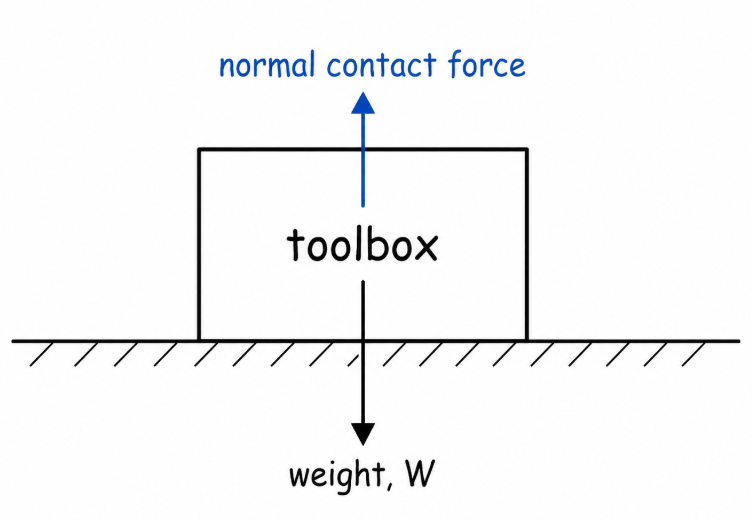
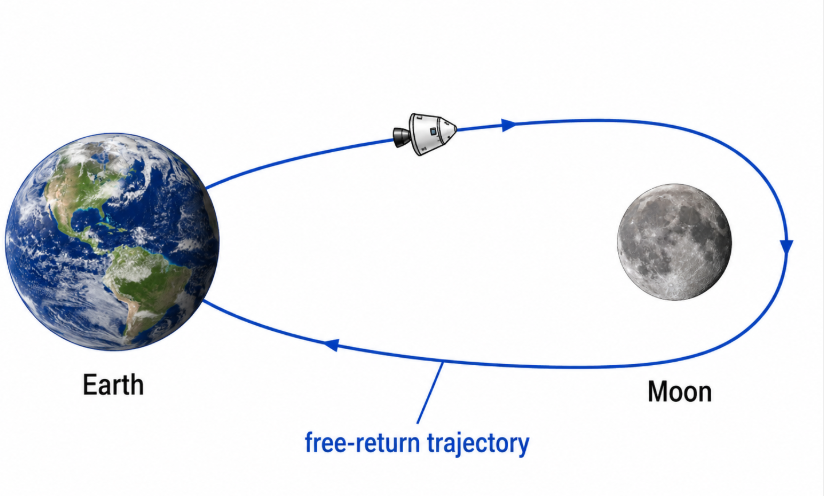
Diagram to draw: Earth on the left, Moon on the right, and a curved spacecraft path that loops around the Moon and returns to Earth. Label it free-return trajectory. This links the classroom idea of gravity to the real path used by Artemis II.
What examiners are really testing here
Examiners are not only checking whether you remember a formula. They are looking for whether you can:
- distinguish clearly between mass and weight;
- use the correct units, kg and N;
- identify weight as a force;
- explain that a change in gravitational field changes weight, not mass;
- connect weight to free-fall acceleration;
- use careful wording in definitions and explanations.
A strong answer is usually very plain and direct. It does not try to sound clever. It simply says the right thing, with the right unit, in the right order.
Worked question
Question
A supply crate for a lunar mission has a mass of 40 kg.
(a) Calculate its weight on Earth, where g=9.8 N/kgg = 9.8 \, \text{N/kg}
g=9.8N/kg.
(b) The same crate is taken to a place where g=1.6 N/kgg = 1.6 \, \text{N/kg}
g=1.6N/kg. State its mass there and calculate its weight.
(c) The crate is dropped from rest near the Earth. Ignore air resistance. Calculate its speed after 3.0 s.
Approach
First, decide which quantity is being asked for.
- If the question asks for weight, use W=mgW = mg
- W=mg.
- If it asks whether mass changes, think about whether the amount of matter changes.
- If it asks about falling speed from rest, use the motion idea:
- v=u+atv = u + at
- v=u+at
Full worked solution
(a) Weight on Earth
W=mg=40×9.8=392 NW = mg = 40 \times 9.8 = 392 \, \text{N}
W=mg=40×9.8=392N
Answer: 392 N
(b) On the weaker gravitational field
The mass stays 40 kg, because mass does not depend on location.
Now calculate the new weight:
W=mg=40×1.6=64 NW = mg = 40 \times 1.6 = 64 \, \text{N}
W=mg=40×1.6=64N
Answer: mass = 40 kg, weight = 64 N
(c) Speed after 3.0 s
Object starts from rest, so:
u=0u = 0
u=0
Using v=u+atv = u + at
v=u+at:
v=0+(9.8×3.0)=29.4 m/sv = 0 + (9.8 \times 3.0) = 29.4 \, \text{m/s}
v=0+(9.8×3.0)=29.4m/s
Answer: 29.4 m/s downward
What the examiner is looking for
- correct use of kg for mass and N for weight;
- clear statement that mass does not change;
- accurate substitution into the equation;
- correct unit for speed, m/s;
- where appropriate, a direction such as downward.
Common mistakes and fixes
Mistake 1: writing mass as 64 N
Fix: mass must be in kg, never N.
Mistake 2: saying the mass becomes smaller in a weaker gravitational field
Fix: weaker gravity changes weight, not mass.
Mistake 3: forgetting the direction in part (c)
Fix: if the object is falling, the velocity is downward.
Mistake 4: using the wrong value of gg
g
Fix: always use the value given in the question.
Quick Recap
- Mass is the amount of matter in an object.
- Weight is the gravitational force acting on that mass.
- Mass is measured in kg.
- Weight is measured in N.
- Gravitational field strength tells you force per unit mass.
- Near Earth, free-fall acceleration is about 9.8 m/s².
- A weaker gravitational field means a smaller weight, not a smaller mass.
- This is why objects can have the same mass but different weights in different places.
Final Thinking
- Astronauts in orbit are still under gravity, so why do they appear weightless?
- If gravity can pull a spacecraft back towards Earth, why does it not simply fall straight down all the time?