Guesthouse Pricing Series: How to Price Excursions Without Losing Money
29 Jul 2026, 11:56 · by IzuCT · 8 min read · Tourism · EN
Excursion pricing should begin with the boat’s full operating cost, expected—not maximum—passengers, channel deductions and weather risk. Clear minimum-participant, charter, wildlife and cancellation rules protect margins while delivering fair, transparent experiences for guests and operators.
Free tourism insights
Get Free Tourism Insights
Receive selected MTO insights, tourism data alerts, and new resource updates by email.
Get Free Tourism InsightsThe first four articles in this series established the room-pricing system: calculate the real cost, understand retained revenue, read the competitive market and adjust rates according to booking pace.
Excursions introduce a different economic problem.
A room waits for the guest. A boat must leave the harbour. Once the engine starts, fuel is burned, crew are paid and equipment is committed whether the vessel carries four guests or twelve. The empty seats travel too—but they contribute nothing. This is why an excursion that appears popular can still lose money.
The latest Maldives Visitor Survey indicates strong demand: 67% of respondents identified snorkelling as an experience they sought during their visit. Yet demand for an activity does not automatically create profit. Operators must price the departure, not merely copy the advertised price of another excursion.
Begin with the trip, not the passenger
Every marine activity has two kinds of cost.
Fixed trip costs
These arise whenever the boat departs:
fuel required for the planned route;
captain and crew;
snorkelling guide or marine biologist;
vessel hire or depreciation;
maintenance and insurance reserves;
mooring, communications and permits;
safety equipment; and
weather and disruption reserves.
Variable cost per guest
These increase when another participant joins:
lunch and refreshments;
drinking water;
equipment cleaning and depreciation;
towels and consumables;
entrance or conservation fees; and
transaction or administration costs.
Fuel must be calculated from actual vessel consumption, not from memory. This became especially important after STO increased the official diesel price from MVR 13.92 to MVR 17.54 per litre in March 2026. A price based on last year’s fuel cost may no longer protect the trip.
The basic calculation is:
Required activity price per guest = [(Fixed trip cost ÷ Expected guests) + Variable cost per guest] ÷ (1 − distribution cost − target margin)
The most important term is not maximum passengers. It is expected guests.
Full-day snorkelling excursion: a worked example
Consider a full-day shared excursion with two reef stops, a sandbank lunch and snorkelling equipment.
The vessel can legally carry 12 paying guests. However, comparable trips historically average eight.
Illustrative fixed trip costs
Cost item | USD |
|---|---|
Fuel | 205 |
Captain and crew | 120 |
Snorkelling guide | 85 |
Maintenance and insurance reserve | 75 |
Weather and disruption reserve | 40 |
Mooring, communications and permits | 55 |
Total fixed trip cost | 580 |
Illustrative variable cost per guest
Cost item | USD |
|---|---|
Lunch and drinks | 20 |
Equipment cleaning and depreciation | 6 |
Towels and consumables | 2 |
Administration and incidentals | 2 |
Variable cost per guest | 30 |
Assume:
expected guests: eight;
distribution cost: 15%;
target operating margin: 20%.
The required price becomes:
[(USD 580 ÷ 8) + USD 30] ÷ (1 − 0.15 − 0.20)
= USD 157.69
The operator might therefore establish a base price of approximately USD 160 per guest before applicable taxes
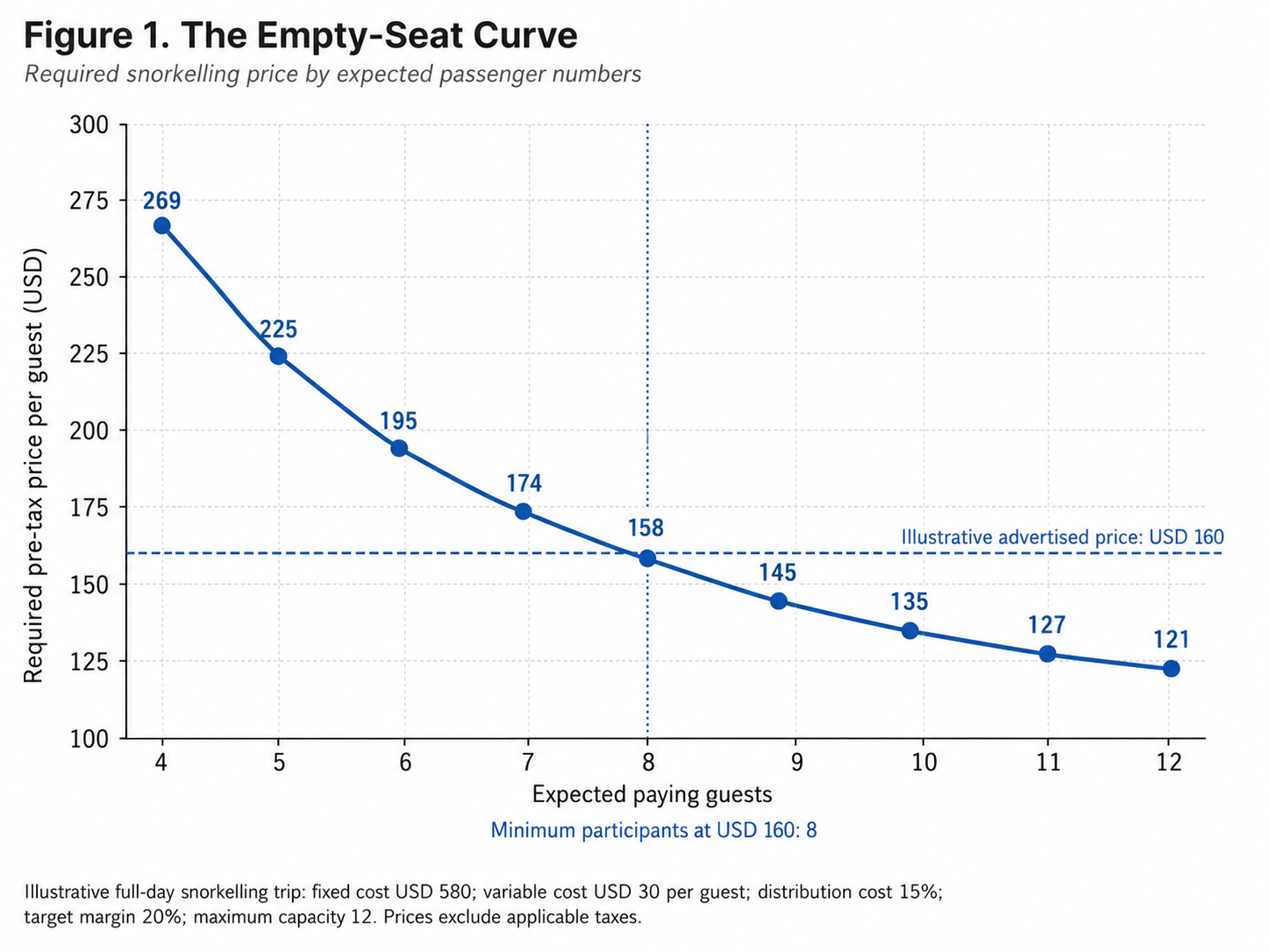
The example demonstrates why a trip should be priced using expected participation rather than maximum vessel capacity.
At 12 guests, the required price is approximately USD 121. At six guests, it approaches USD 195. At four guests, it rises above USD 269.
The boat has not become more expensive. The same fixed cost is being divided among fewer passengers.
Calculate the minimum number of participants
Operators often advertise “minimum participants required” without showing how the number was determined.
It can be calculated directly:
Minimum guests = Fixed trip cost ÷ [Price × (1 − distribution cost − target margin) − variable cost per guest]
Using an advertised pre-tax price of USD 160:
Minimum guests = 580 ÷ [(160 × 0.65) − 30] = 7.84
The trip therefore needs at least eight paying guests to achieve the planned margin.
This provides three honest choices when only six guests have booked:
postpone or cancel according to the published terms;
offer guests the option of paying a supplement; or
operate with a deliberately lower margin for a documented commercial reason.
Silently operating every underfilled trip eventually converts the excursion desk into a loss centre.
Maximum capacity is a safety limit, not a pricing assumption
A 12-passenger boat should not automatically be priced as though every departure will carry 12 guests.
Expected participation should come from:
completed trips in the same season;
day of the week;
guesthouse occupancy;
booking lead time;
source-market behaviour;
weather history; and
the number of competing departures.
A new operator without sufficient history can begin conservatively, perhaps pricing around six or eight guests, then revise the assumption after recording several months of departures.
The national weather calendar is useful, but local operating data is better. The Maldives Meteorological Service identifies the southwest monsoon, normally from mid-May to November, as the wetter season, while January to March is generally the northeast or drier monsoon. Actual wind, rainfall and sea conditions differ across atolls and days, so the operator’s cancellation record should eventually replace broad seasonal assumptions.
Build a weather and disruption reserve
Weather risk should not be treated as an unexpected surprise every week.
A practical reserve is:
Weather reserve per completed trip =
Annual weather-related cost ÷ Number of completed trips
Weather-related costs may include:
food prepared before cancellation;
crew already called to work;
fuel used before turning back;
refunds and payment charges;
complimentary replacement activities; and
rebooking administration.
A newly established business may begin with an indicative reserve of 5–10% of expected trip costs, but this is only a starting assumption. The correct reserve should come from the operator’s own history.
Safety must remain outside the discount calculation. Maldives regulations require tourist establishments to maintain passenger manifests, use compliant marine vessels and ensure water-sports staff are trained in safety, emergency response and first aid. Operators must also consider current weather conditions, brief guests and maintain emergency plans.
Internationally, ISO 21101 provides a safety-management framework for adventure-tourism providers of different types and sizes. The practical implication is straightforward: safety planning, trained personnel, communications and emergency readiness are part of the cost of the activity—not optional extras added after the price is chosen.
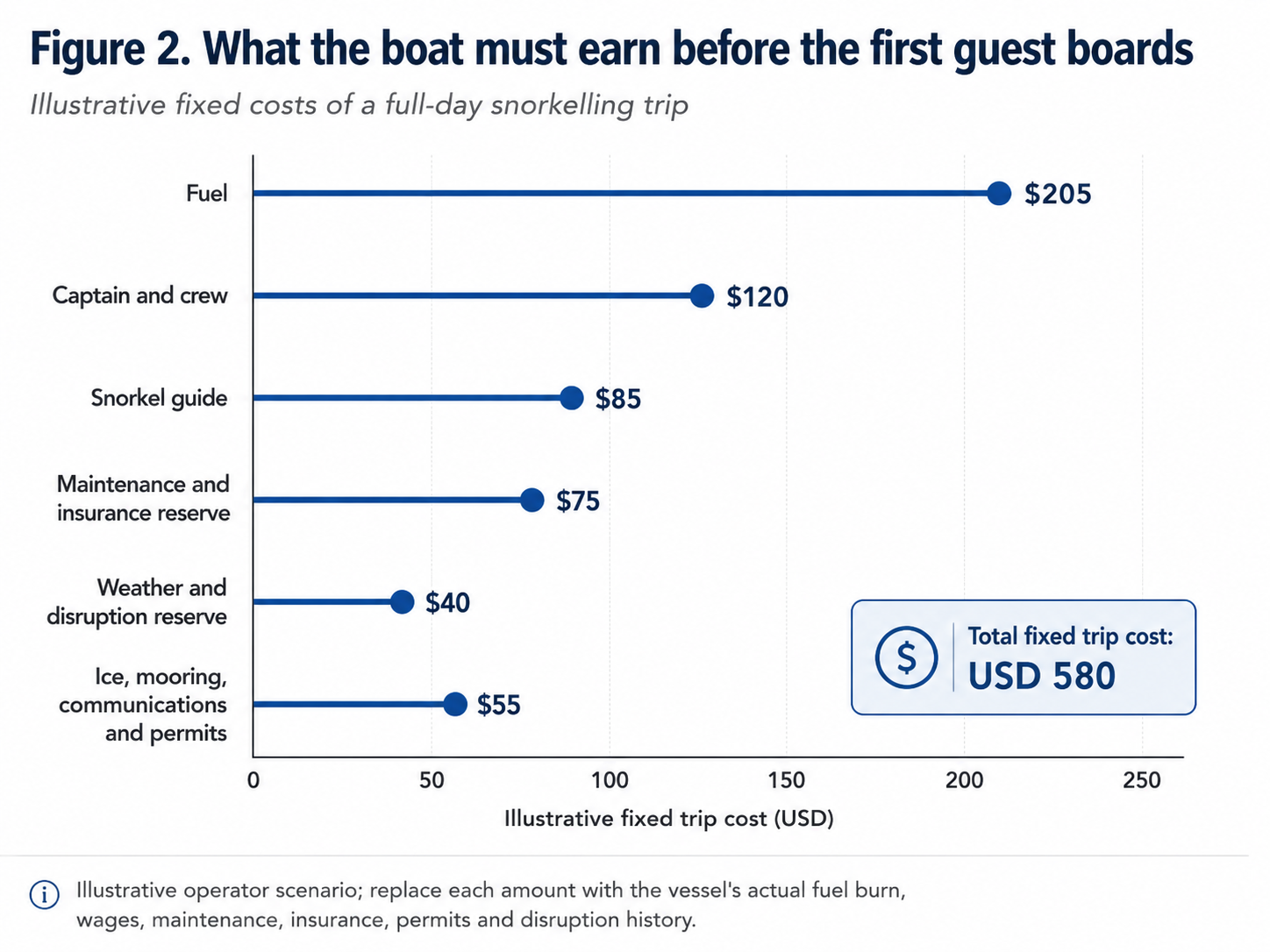
The amounts are illustrative and must be replaced with the operator’s actual costs.
Shared trips and private charters are different products
A shared-trip price divides fixed cost among expected participants.
A private charter places nearly the entire fixed cost on one booking.
The private-charter calculation is:
Required charter price = [Fixed trip cost + total variable guest costs] ÷ (1 − direct-selling cost − target margin)
Suppose two guests request the same vessel privately. With USD 580 in fixed costs, USD 60 in guest costs, 3% direct payment costs and a 25% target margin:
USD 640 ÷ 0.72 = approximately USD 889 before tax
The private price should not simply equal two shared tickets. The guests are purchasing control of the vessel, route, timing and capacity.
A charter may also require additional time, personalised food, photography, fishing gear or a specialist guide. These should be priced separately rather than absorbed into the margin.
Wildlife is valuable precisely because it is not scheduled
A whale shark, manta ray or pod of dolphins is not an employee of the excursion company.
Wildlife-focused trips must therefore avoid guaranteeing sightings. The International Whaling Commission advises operators to create realistic expectations because they cannot control weather or the daily distribution of animals. They can control guiding quality, education, customer care and responsible interaction.
Sell the experience as:
a responsible search;
a guided marine journey;
access to likely habitats;
interpretation by knowledgeable guides; and
an agreed alternative itinerary.
Protected areas can also impose permit, guide, timing and interaction requirements. In South Ari Marine Protected Area, for example, operators must obtain permission for snorkelling and follow whale-shark interaction rules governing distance, behaviour and time in the water. These requirements affect practical capacity and must be included in the operating plan and price.
Write cancellation and substitution rules before selling
A clear policy should distinguish four situations.
Operator cancellation for safety:
Provide a full refund, free rebooking or an equivalent alternative chosen by the guest.
Minimum participants not reached:
Offer rebooking, a private-upgrade supplement or a refund.
Wildlife not sighted:
Do not automatically promise a refund when the trip operated as described. A partial credit or repeat-trip offer may be used as a commercial gesture, but it should be priced into the product.
Planned site becomes inaccessible:
Substitute an itinerary of comparable duration and value, or refund the difference when the replacement is materially cheaper.
A substitution should not turn a full-day whale-shark excursion into an inexpensive nearby reef snorkel while retaining the original price.
Tax is collected, not earned
Where the excursion is supplied as a tourism-sector service by a guesthouse, travel agency or other qualifying tourism supplier, the current Tourism GST rate is 17%. The precise treatment depends on the legal supplier and invoicing arrangement.
For the illustrative USD 160 base price:
Guest-facing price including 17% TGST = USD 187.20
The USD 27.20 tax component is not excursion revenue.
Distribution commissions should also be calculated according to the actual contract. Some channels charge commission on the tax-inclusive price, while others use a different base. Operators should test each channel using net retained revenue.
Earlier econometric research found that international tourist arrivals to the Maldives were relatively less sensitive to destination prices than to factors such as income, transport and security. That national-level result does not mean individual excursion prices can be set without regard to value or competition. It means operators should avoid assuming that the cheapest product is automatically the strongest tourism strategy.
Price the departure, not the brochure
Before publishing an excursion rate, record:
actual fuel consumption;
crew and guide costs;
maintenance and insurance reserves;
variable cost per participant;
expected—not maximum—passengers;
minimum participants;
commission by sales channel;
applicable tax;
weather disruption history;
wildlife and protected-area rules; and
cancellation obligations.
The sea appears open and limitless. The economic space inside a boat is much smaller.
Each departure has a fixed number of seats, a measurable cost and a limited opportunity to earn. Once the boat returns, the empty capacity cannot be stored for tomorrow.
Profitable excursion pricing begins by recognising that simple fact.
Next in the series
How to Price Transfers Without Hiding the Real Cost
The next article will examine vessel capacity, one-way and return legs, empty positioning trips, airport waiting time, fuel, luggage, private transfers and the cost of transport disruption.