Guesthouse Reality Check: A Decision Tool for Entrepreneurs
29 Jun 2026, 05:45 · by i.zuhuree · 9 min read · Tourism · EN
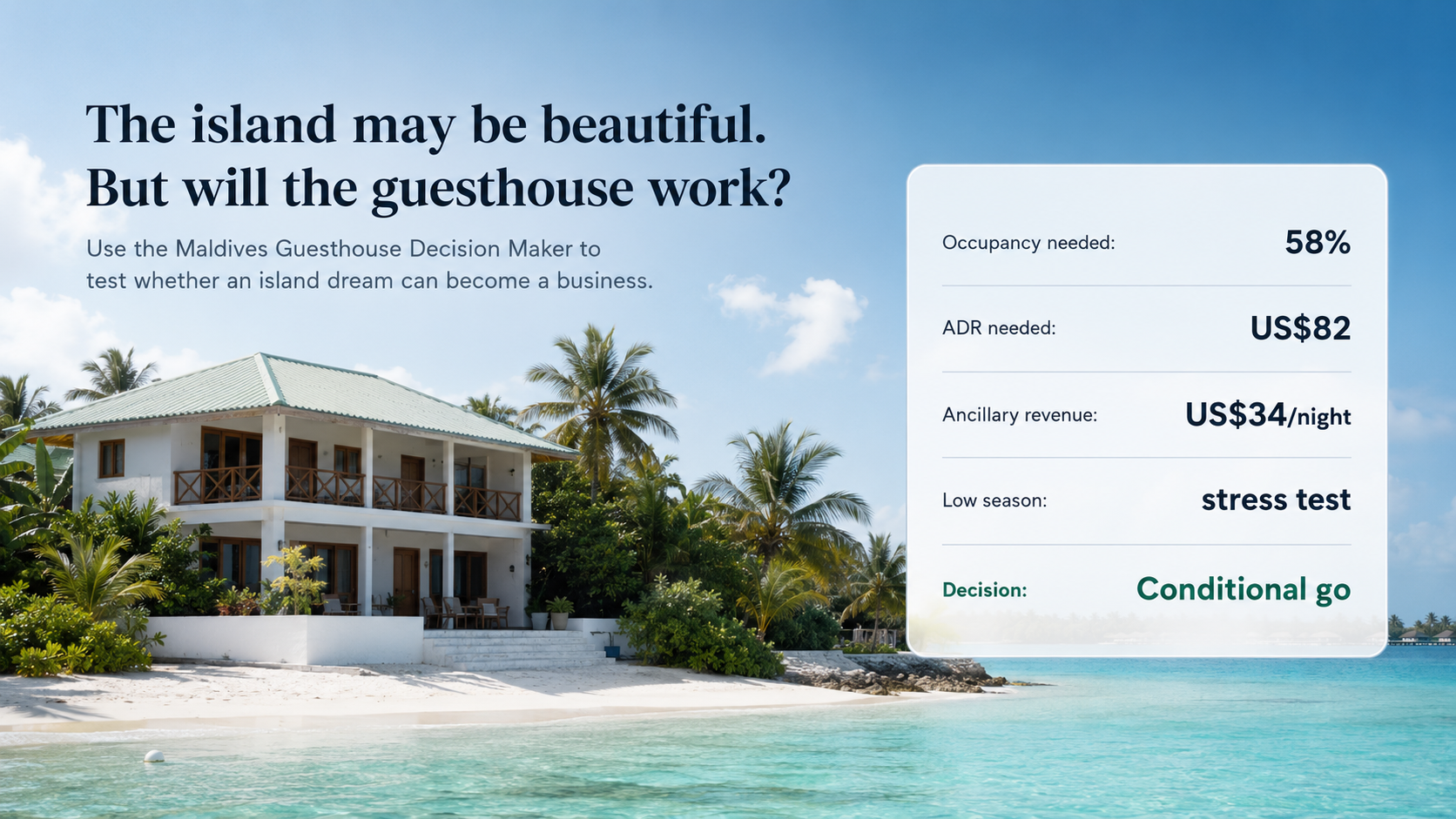
The Maldives Guesthouse Decision Navigator helps entrepreneurs test whether an idea can survive real tourism conditions: occupancy, pricing, ancillary income, costs, debt, seasonality, and low-season risk—before building or borrowing capital.
Free tourism insights
Get Free Tourism Insights
Receive selected MTO insights, tourism data alerts, and new resource updates by email.
Get Free Tourism InsightsA few weeks back, I wrote about a question that many Maldivian entrepreneurs quietly carry in their minds: should I build a guesthouse on this island, or should I look somewhere else? The example was specific. Hanimaadhoo or Dhigurah. A discounted plot of land in the north, or a more established guesthouse island in Alif Dhaal Atoll.
Today, I wanted to move from one comparison to a more general tool that any entrepreneur can use before entering the guesthouse segment.
The result is the Maldives Guesthouse Decision Navigator.
It is not designed to impress investors with a complicated spreadsheet and matrices. It is designed to answer a simple question: What must be true for this guesthouse idea to work?
At the Maldives Tourism Observatory, this is the work we want to support: better tourism decisions, grounded in data, shaped by local knowledge, and useful to real entrepreneurs. If you are planning a guesthouse, start with the Decision Maker.
And if the tool raises questions you want to explore more deeply, book a consultation with us. Because the goal can not be merely to build more rooms.
The Problem with Beautiful Assumptions
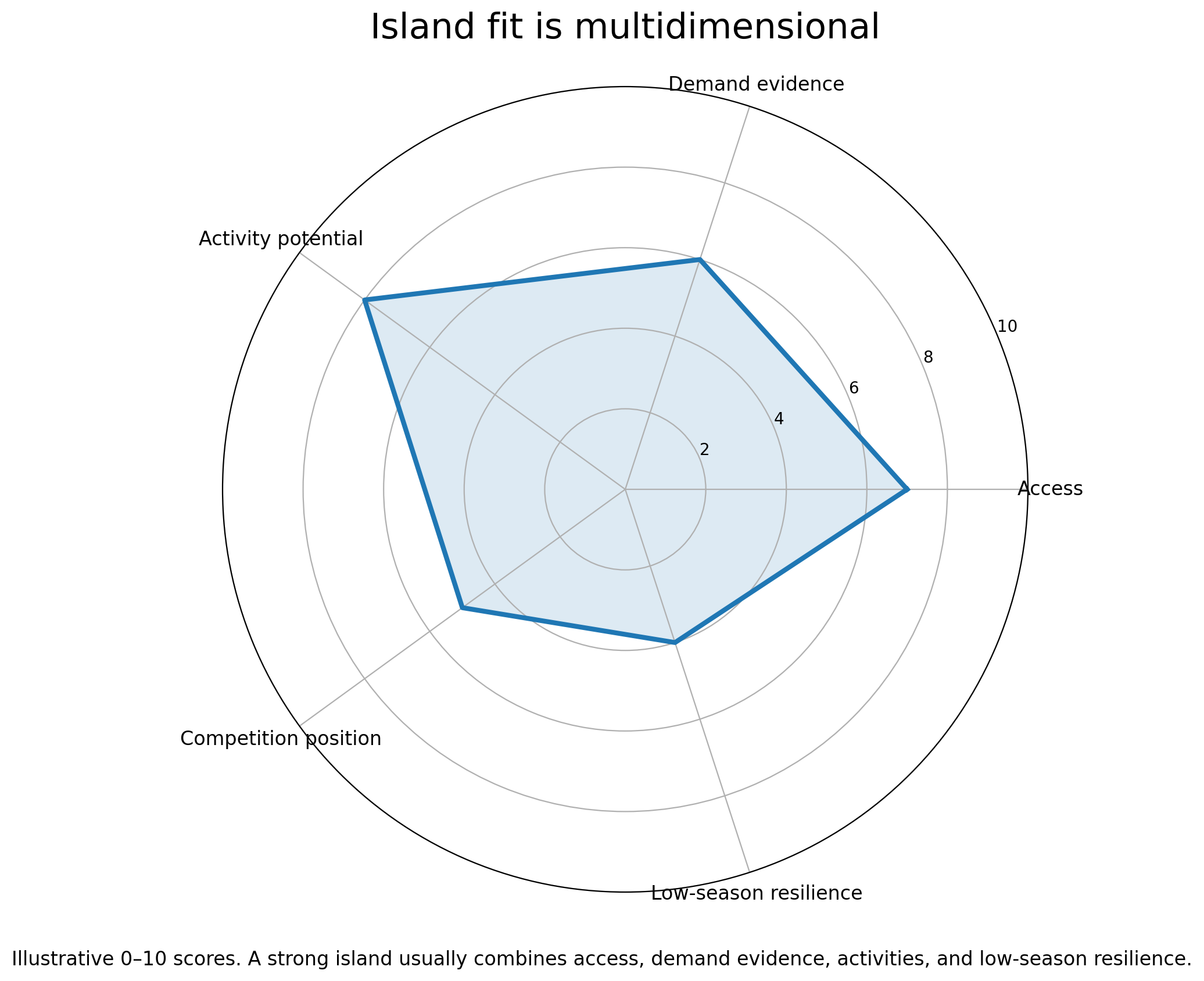
Every island has a story. One island has a new airport nearby. Another has a famous reef. Another has family land available at a discount. Another has fewer competitors. These stories matter. They are the beginning of strategy. But they are not enough.
A business can be built on hope, but it cannot repay a loan with hope. It cannot pay staff with ambition. It cannot survive May and June because the entrepreneur believes the island has “potential.” Potential has to pass through numbers.
This is where many guesthouse decisions become weak. Entrepreneurs often begin with the wrong question: “How many rooms can I build?” The better question is: “How many room-nights can I sell, at what price, in which months, with what extra spending, after commissions and costs?”
That sounds technical, but it is really a human question. Will guests come? Will they pay? Will they eat at the property? Will they book excursions? Will they need transfers? Will they leave happy enough to review, return, or recommend? I can assure that Guesthouse is not the same as one island one resort.
The Decision Maker helps structure this thinking.
A Tool for the Early Stage, Before Money Gets Trapped
The most dangerous moment in a guesthouse project is not after the building is finished. By then, much of the capital is already trapped. The dangerous moment is earlier, when the idea still feels light.
A relative says the land is available. A contractor gives a rough estimate. A friend says tourists are increasing. Someone points to national arrival numbers. Someone else says, “If others can do it, we can do it.”
That is the moment when a decision tool is useful.
The Maldives Guesthouse Decision Maker is built for the pre-feasibility stage. It does not replace a full feasibility study, architectural plan, market survey, or financial model. Instead, it helps entrepreneurs decide whether an idea deserves deeper work. Think of it as the first telescope. Before we send a ship across the sea, we look at the horizon. Before we build, we test the conditions. Before we borrow, we ask what the business must generate to survive.
Minimum Data Entry, Maximum Clarity
One problem with financial tools is that they often ask too much too early. Entrepreneurs may not know exact payroll, final construction cost, laundry cost, OTA commission, electricity bill, or monthly occupancy. If the tool demands every detail, people either give up or enter guesses that feel precise but are not reliable.
So this Decision Maker asks for a smaller set of practical assumptions. How many rooms are planned? What occupancy seems realistic? What average daily rate can the property charge? How much extra revenue can each occupied room-night generate? What are the rough variable costs, fixed costs, debt payments, and target monthly cash flow?
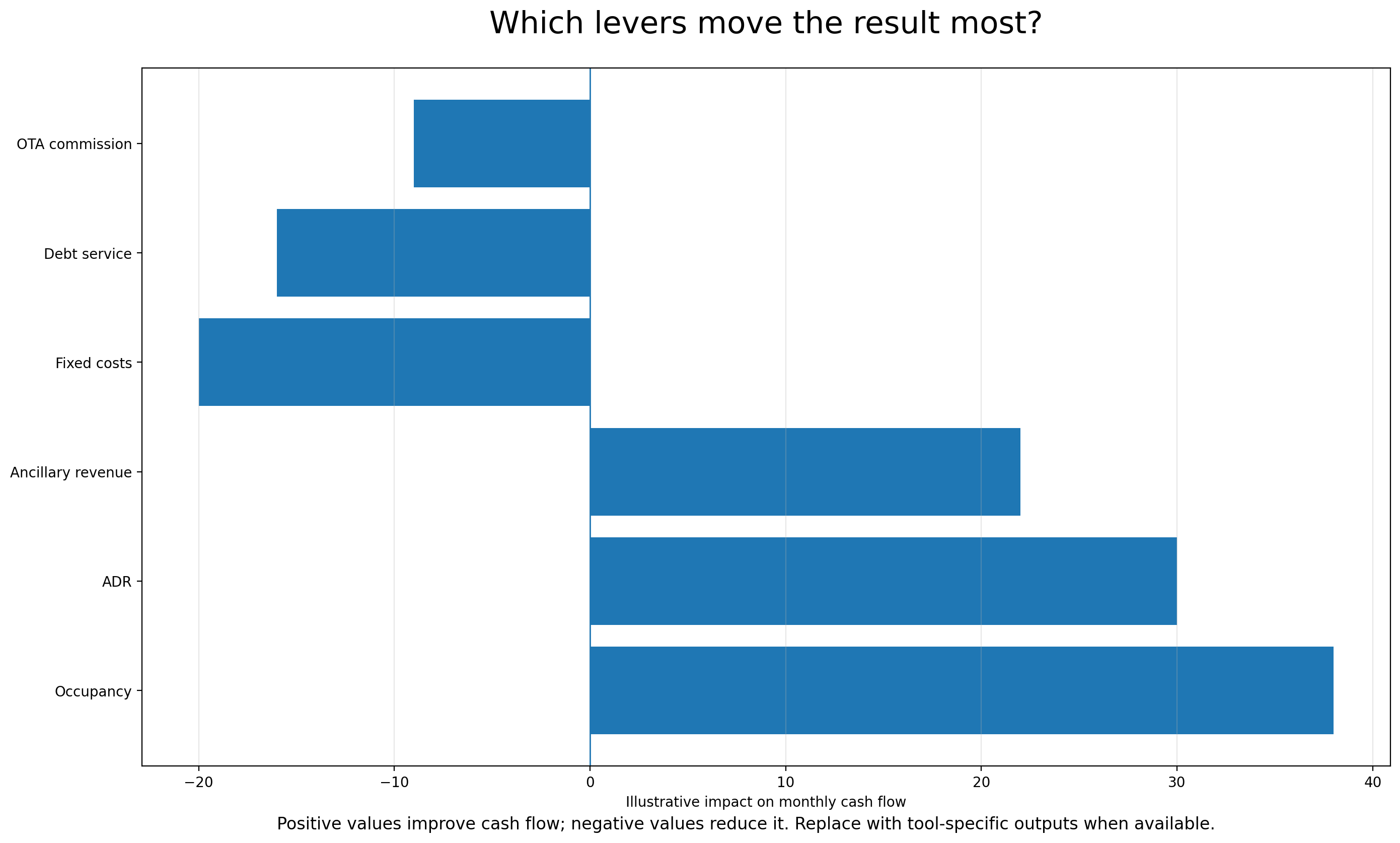
From these few numbers, the tool works backwards. Instead of only saying, “Here is your profit,” it asks: what would need to change for the project to reach the target? It can estimate the occupancy required. It can show the room rate needed. It can indicate how much ancillary revenue is necessary. It can test whether the planned number of rooms is enough. It can show whether fixed costs or debt service are too heavy. This is important because business decisions are rarely solved by one lever.
A weak project may not need only a higher room rate. It may need a smaller build, better food revenue, stronger excursions, lower debt, more direct bookings, a sharper segment strategy, or a different island.
The Hidden Power of Ancillary Revenue
Many entrepreneurs think first about the room rate.
This is natural. Rooms are visible. Booking platforms display room prices. Guests search by room. Investors often ask about ADR, or average daily rate. ADR simply means the average price charged per occupied room per night.
But in guesthouse tourism, the room is only one part of the economy.
A guest may sleep in the room, but the trip is larger than the bed. The guest may eat breakfast and dinner. They may book snorkelling, diving, fishing, sandbank trips, island hopping, airport transfers, photography, laundry, bicycle rental, or local experiences.
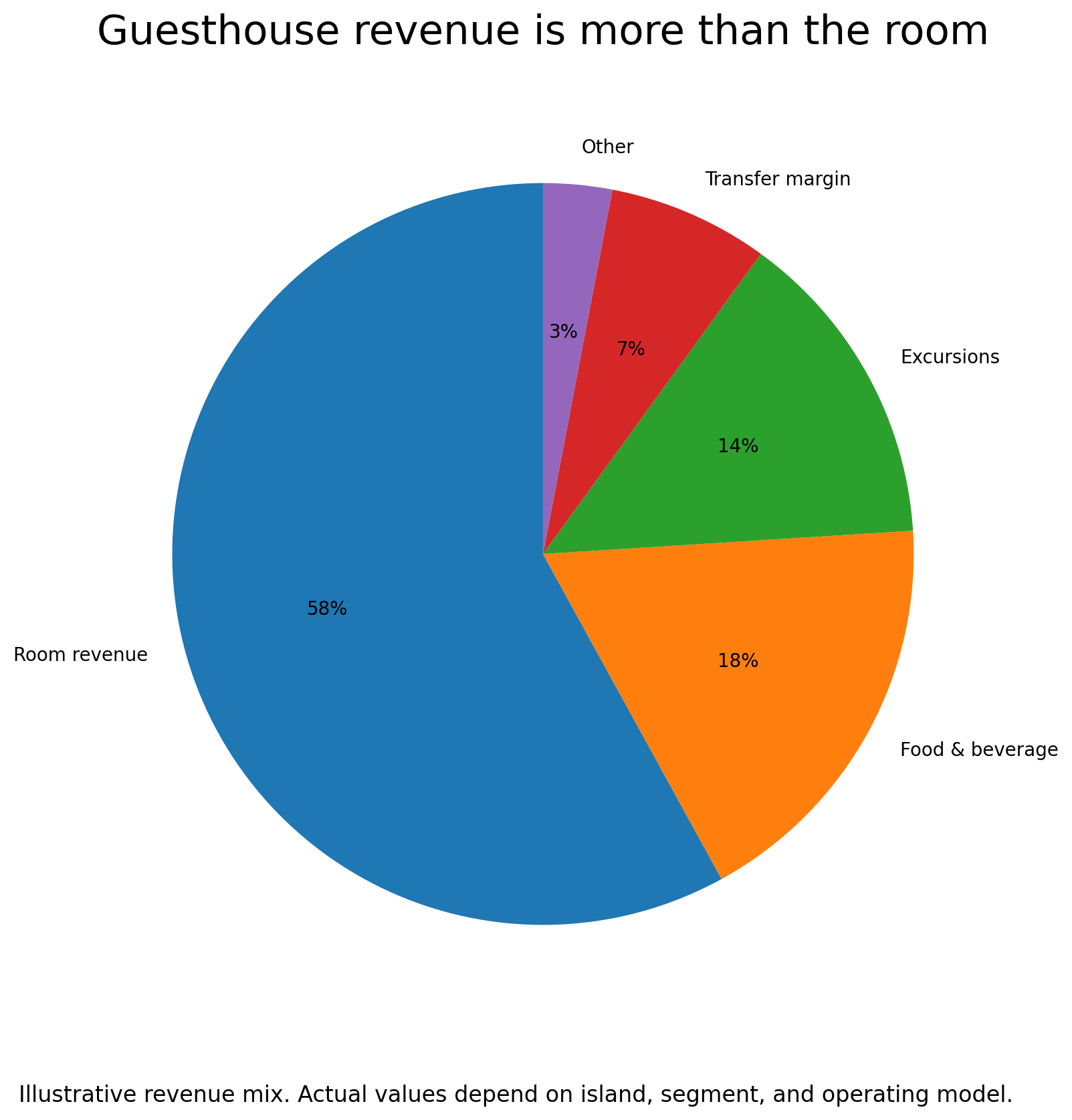
This extra income is called ancillary revenue.
A simple way to understand it is this: ancillary revenue is the money earned around the room, not just from the room. For some guesthouses, this can be the difference between a fragile business and a bankable one. A property with a modest room rate but strong excursion partnerships and food revenue may perform better than a property with a slightly higher room rate but no spending ecosystem.
This is especially important in the Maldives because islands are not identical products. Some are activity-led. Some are quiet and place-led. Some depend on diving. Some depend on families. Some depend on speedboat access. Some depend on long-stay guests. Some depend on domestic tourism or blended demand.
The Decision Maker forces entrepreneurs to ask a powerful question: if the room rate is limited, can the experience economy carry the business?
The Low-Season Test
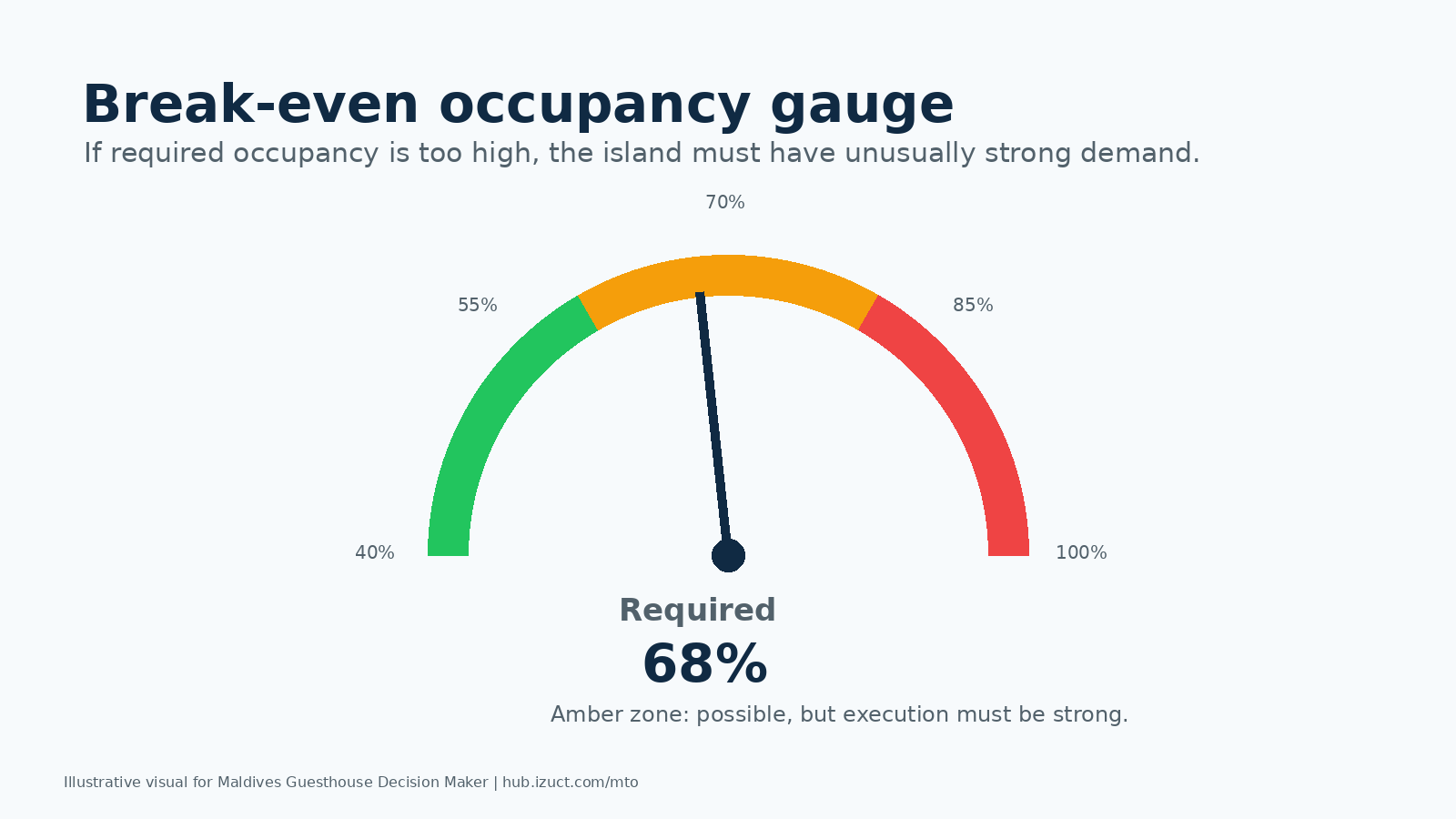
Peak season can make almost any idea look intelligent. The real test is the weak month. A guesthouse that looks comfortable at 60 percent annual occupancy may struggle if several months fall below the break-even point. Break-even occupancy means the minimum occupancy needed to cover costs. Below that point, the business is losing money.
This is why the tool includes low-season thinking.
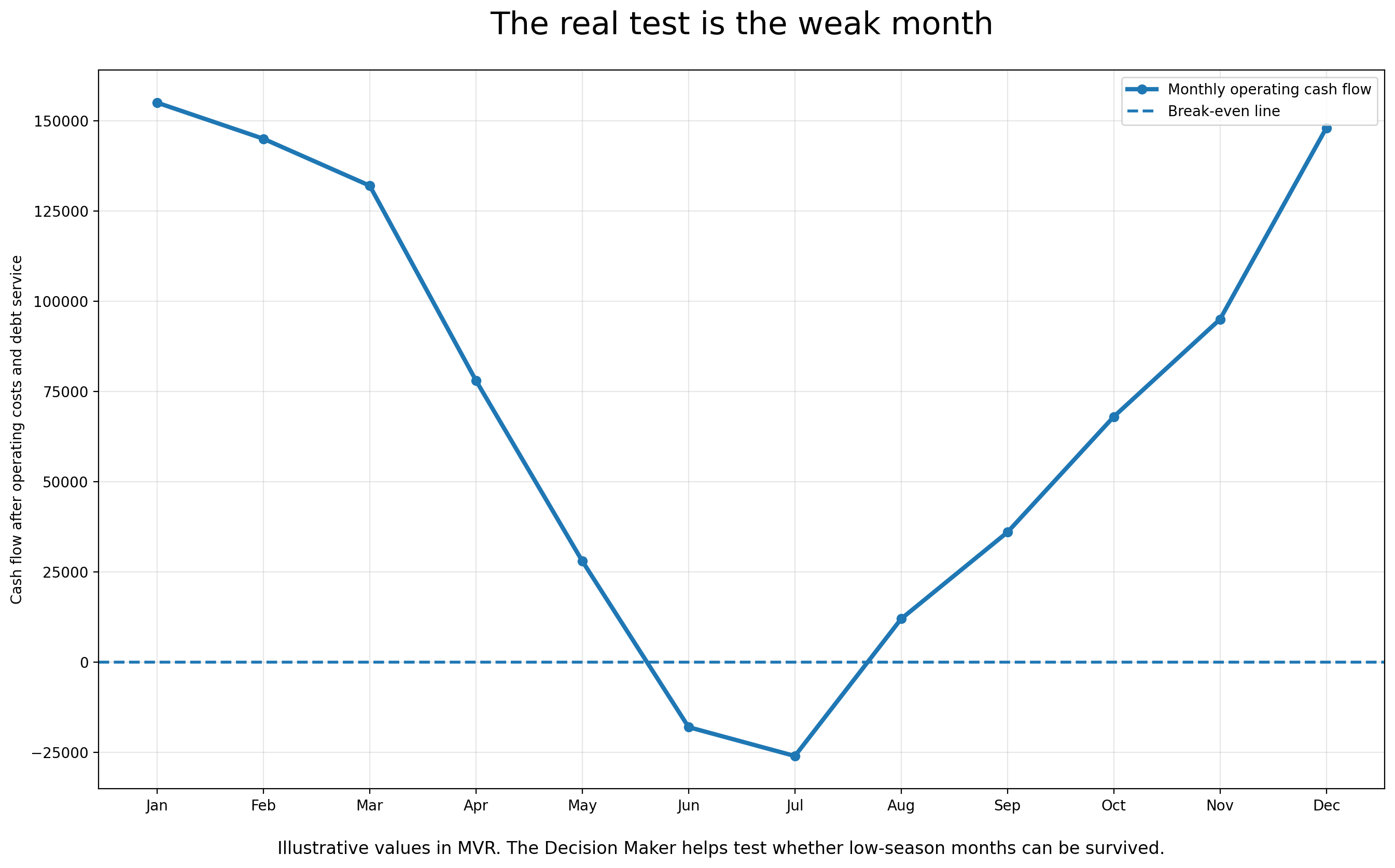
In tourism, averages can hide danger. A year is not one smooth line. It is twelve different battles. December is not June. February is not September. A guesthouse must survive the months when fewer people search, fewer people book, and discounting becomes tempting.
The Decision Maker helps entrepreneurs look at that pressure before they commit capital. It does not ask, “Can this work in a good month?” It asks, “Can this survive the month that will test your nerves?”
From Emotion to Decision Discipline
This tool is not against ambition. In fact, it protects ambition.
The Maldives needs serious local entrepreneurs. Guesthouses can widen the tourism economy, create local jobs, support cafés, guides, boat owners, farmers, fishers, laundry services, and young people entering hospitality. They can make tourism more geographically inclusive. But inclusion without analysis can become overbuilding. And overbuilding can lead to price wars, weak service, unpaid loans, disappointed guests, and pressure on island infrastructure.
The Decision Maker is built to encourage better entry, not discourage entry.
It helps an entrepreneur see whether the project needs a stronger concept before construction. It helps identify whether the island needs more demand proof. It helps show whether the business depends too much on OTA bookings, too little on ancillary income, or too much on debt. Most importantly, it changes the conversation.
Instead of saying, “I think this island will work,” the entrepreneur can say, “These are the conditions under which this island works.” That is a very different sentence.
A Tool, Not a Fortune Teller
No analytical tool can predict the future perfectly.
Tourism is affected by exchange rates, flight routes, political events, global income, fuel prices, social media, weather, competition, and the quality of execution. A tool cannot see everything.
But it can reduce avoidable mistakes.
It can expose impossible assumptions. It can reveal when a project depends on unrealistic occupancy. It can show when the room rate is too optimistic for the island. It can warn when the monthly debt burden is too large. It can remind the entrepreneur that food, transfers, excursions, and service design may matter as much as the building.
The purpose is not certainty.
The purpose is better judgement.
Why We Built This at MTO
The Maldives Tourism Observatory at hub.izuct.com/mto is being developed around one central belief: tourism decisions should be supported by evidence.
Not only national-level evidence. Not only arrival headlines. Not only beautiful marketing language. We need island-level thinking, accommodation-level thinking, price-level thinking, and entrepreneur-level decision support.
The Guesthouse Decision Maker is part of that wider effort.
It translates tourism analytics into something usable. It takes ideas such as occupancy, ADR, ancillary revenue, break-even, fixed cost, debt service, and low-season risk, and turns them into a practical decision conversation.
An entrepreneur should not need to be an economist to ask better questions.
But good questions can save capital.
Try the Decision Maker Before You Build
If you are considering a guesthouse investment in the Maldives, use the tool before you fall in love with the project.
Test your island. Test your room count. Test your assumed rate. Test what happens if occupancy is lower than expected. Test whether food and excursions need to become central to the business model. Test whether your debt payment is too heavy. Test whether a smaller, sharper concept may be better than a larger, weaker one.
The answer may not always be “go.”
Sometimes the answer will be: redesign the concept. Reduce rooms. Strengthen activities. Secure transfer partnerships. Build the food story. Target a different segment. Wait for stronger demand proof. Or choose another island.
That is not failure.
That is intelligence before commitment.
At the Maldives Tourism Observatory, this is the work we want to support: better tourism decisions, grounded in data, shaped by local knowledge, and useful to real entrepreneurs. If you are planning a guesthouse, comparing islands, reviewing a site, or trying to understand whether your idea is commercially realistic, start with the Decision Maker.
And if the tool raises questions you want to explore more deeply, book a consultation with us. Because the goal is not merely to build more rooms.
The goal is to build guesthouse businesses that can survive the low season, serve guests well, create local value, and become part of a stronger Maldivian tourism economy.
Every island has a story.
The task is to discover whether the story can become a business.