Maldives Resort Series: The Density Frontier
09 Sep 2026, 01:03 · by IzuCT · 4 min read · Tourism · EN
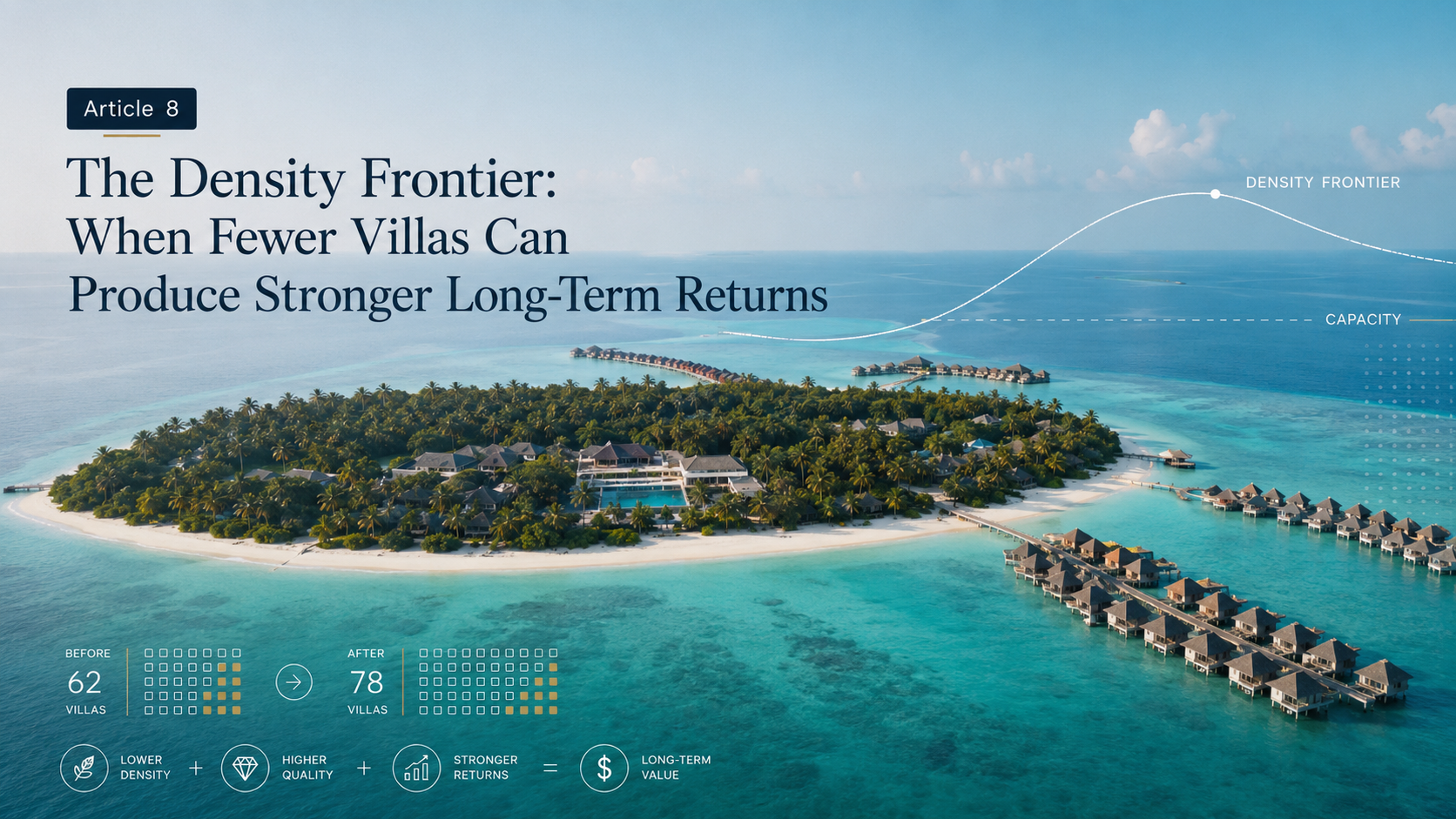
More villas can increase profit while reducing return on capital. Once infrastructure step-costs and effects on existing room value are counted, preserving scarcity may become the higher-return use of a Maldives resort island.
Free tourism insights
Get Free Tourism Insights
Receive selected MTO insights, tourism data alerts, and new resource updates by email.
Get Free Tourism InsightsCentral Question:
At what point does adding villas create less value than preserving scarcity, environmental quality and the capacity of the existing island?
Hypothesis:
Resort expansion creates value only while the contribution from incremental villas exceeds both their capital requirement and the shadow costs they impose on existing rooms and island systems.
Article
Thirty More Villas Look Like Thirty More Revenue Streams
A 220-villa resort has land and lagoon space for another 30 units.
At $650 ADR and 70% occupancy, the revenue case seems attractive.
Thirty villas create thousands of sellable nights.
But the island does not gain thirty villas in isolation.
It may also need more desalination, wastewater capacity, staff housing, kitchen production, laundry, power generation, boats, waste storage, paths, jetties and maintenance.
More subtly, it may gain more people on the beach, more buggies on paths and more diners competing for the same sunset tables.
The expansion can therefore increase revenue while reducing the value of the existing resort.
That is why “more keys” and “more value” are not synonyms.
The issue is especially important in a market where analysis of shadow inventory and unsold capacity already reminds us that physical rooms create economic value only when demand converts them into profitable occupied nights.
The Island Has a Carrying Function
A city hotel may add rooms vertically while sharing municipal roads, power, water and sewerage.
A Maldives resort internalizes far more of those systems.
The one-island model's bounded infrastructure means expansion can encounter step costs: the 231st villa may be the villa that requires a new generator, another staff block or wastewater upgrade.
Environmental capacity also matters. Research on Maldives resort reefs has documented how development, construction and local pressures can affect nearby coral environments, reinforcing the need to account for environmental effects rather than treating island area as empty real estate.
The economic shape is therefore nonlinear.
Testing 30 New Villas
Consider an illustrative 220-villa established resort contemplating expansion to 250 villas.
Assume:
new villas: 30;
total expansion capex, including shared infrastructure: $42 million;
required return: 10%, or $4.2m annual contribution;
expected occupancy: 70%;
ADR: $650;
room contribution margin: 72%;
ancillary contribution: $90 per occupied new-villa night;
additional annual fixed island-system cost: $700,000.
At 70% occupancy the new villas create about 7,665 occupied nights.
Their annual contribution before the capital hurdle is:
7,665 × ($650 × 72% + $90) − $700,000
≈ $3.58 million.
That is positive.
But against $42 million of new capital, it produces only about 8.5%.
The resort has become larger, but it has not met its 10% target.
The Expansion Threshold
What must change?
At 70% occupancy, the required ADR is approximately $763.
Alternatively, at $650 ADR, occupancy needs to reach approximately 80.2%.
Expansion case | Incremental operating contribution | Return on $42m |
|---|---|---|
70% occupancy, $650 ADR | $3.58m | 8.5% |
Required hurdle | $4.20m | 10.0% |
Base case + 1.5% erosion of existing-villa ADR | $3.08m | 7.3% |
Evidence classification: Illustrative Analytical Model.
The third line exposes the more important risk.
The Existing 220 Villas Are the Hidden Denominator
Suppose adding capacity, beach use and resort traffic causes only a 1.5% erosion in the achievable rate of the existing 220 villas.
At 70% occupancy and $650 ADR, the lost contribution is about $493,000 annually.
The expansion return falls from 8.5% to approximately 7.3%.
A seemingly minor effect on the established asset overwhelms a meaningful share of the new-villa economics.
This is the density externality.
The new villa competes not only with other resorts.
It can compete with the scarcity value of its own island.
Testing the Counterfactual
The credible alternative is to keep 220 villas and invest selectively in the existing product: villas, beach, reef, restaurants, service, energy efficiency or guest experience.
That strategy does not automatically win either.
The correct comparison is the risk-adjusted return on the best use of capital.
But “do nothing” has a real option value: management retains the possibility of expanding later when demand, infrastructure technology or pricing power improves.
Large resort construction is highly irreversible.
Once another 30 villas occupy shoreline and lagoon space, scarcity cannot easily be repurchased.
A Better Expansion Dashboard
Investment committees should therefore look beyond:
new keys × expected ADR × occupancy.
A stronger model asks:
What step-infrastructure does the expansion trigger?
What extra employee accommodation is required?
What happens to restaurant and spa capacity?
Does beach area per guest fall?
Does reef pressure rise?
Does the existing ADR premium weaken?
Is demand deep enough to absorb the new inventory?
The wider geographic analysis in where Maldives tourism capacity is actually concentrated reinforces the point that supply conditions differ enormously by atoll and cluster.
Thirty new villas in a capacity-constrained high-value island system are not equivalent to thirty villas elsewhere.
The Stronger Definition of Capacity
The maximum number of villas is an engineering question.
The optimal number of villas is an economics question.
It occurs where the marginal value of the next unit equals its full private, infrastructure, environmental and displacement cost.
That number can be lower than the island's physical maximum.
Sometimes leaving a piece of beach undeveloped is not a failure to monetize land.
It is how the rest of the island keeps its price.