Maldives Resort Series: Reducing transfer friction than cutting the villa rate
03 Sep 2026, 19:11 · by IzuCT · 4 min read · Updates · EN

A transfer subsidy can outperform a larger villa discount even when it converts fewer guests. The hidden equation is whether removing arrival friction preserves enough bookings while protecting room value and downstream resort contribution.
Central Question:
When does reducing transfer friction generate more economic value than cutting the villa rate?
Hypothesis:
For transfer-dependent Maldives resorts, a transfer credit can outperform a larger room discount when it preserves enough booking conversion while costing materially less per completed booking.
The First Price the Guest Feels
Imagine a couple considering seven nights at a Maldives resort. The villa costs $650 per night. They have already accepted the long-haul airfare. Then, near the final stage of booking, another number appears: several hundred dollars for the domestic transfer.
From the resort's accounting perspective, the villa and transfer belong to different cost centres. From the guest's perspective, they belong to one decision.
That distinction matters.
Earlier analysis on why transport is part of the Maldives tourism product shows that reaching the island carries not only a monetary cost but also time, waiting and uncertainty. My earlier discussion of why the cheapest transfer can cost a resort more makes the complementary point: optimizing the transport operation in isolation may reduce cost while increasing friction elsewhere in the guest journey.
The interesting management question is therefore not simply, “What should we charge for the transfer?” It is: Where should the resort spend its next dollar of acquisition incentive?
Two Discounts That Do Not Feel the Same
Hotel research increasingly suggests that consumers respond to how prices are structured, not merely to the total. Studies of partitioned hotel pricing find that separating mandatory or salient charges can affect perceptions of fairness and booking intention, while recent research on add-on pricing shows that consumers do not necessarily react to an add-on increase in the same way they react to the equivalent change in the base price.
The Maldives intensifies this mechanism because the transfer is usually unavoidable.
A guest cannot walk out of Velana International Airport and take a taxi to a resort 120 kilometres away. The transfer therefore sits somewhere between a transport purchase and an admission price to the island.
That makes a transfer subsidy economically unusual: it reduces a highly salient entry friction without necessarily reducing the perceived value of the accommodation itself.
A 100-Villa Resort Experiment
Consider an illustrative 100-villa luxury resort selling a seven-night stay at an ADR of $650.
Assume:
room contribution margin: 72%;
additional ancillary contribution per stay: $500;
therefore pre-incentive contribution per booking: $3,776;
10,000 comparable high-intent booking sessions;
no-offer conversion: 3.5%, producing 350 bookings.
Management is choosing among three strategies.
A 15% villa discount costs $682.50 per seven-night booking. Suppose it raises conversion to 4.4%, or 440 bookings.
A $400 transfer credit is less generous in dollar terms but directly attacks arrival friction. Suppose it raises conversion to 4.1%, producing 410 bookings.
The results are surprisingly close:
Strategy | Bookings | Contribution per booking | Total contribution |
|---|---|---|---|
Do nothing | 350 | $3,776 | $1.322m |
15% room discount | 440 | $3,093.50 | $1.361m |
$400 transfer credit | 410 | $3,376 | $1.384m |
Evidence classification: Illustrative Analytical Model.
The transfer offer converts fewer people than the room discount—yet produces approximately $23,000 more contribution in this experiment.
The Hidden Equation
The comparison becomes:
Bookings under transfer offer × contribution after transfer credit
versus
Bookings under room offer × contribution after room discount.
Under these assumptions, the transfer strategy needs only:
3,093.5 / 3,376 = 91.6%
as many bookings as the discounted-room strategy.
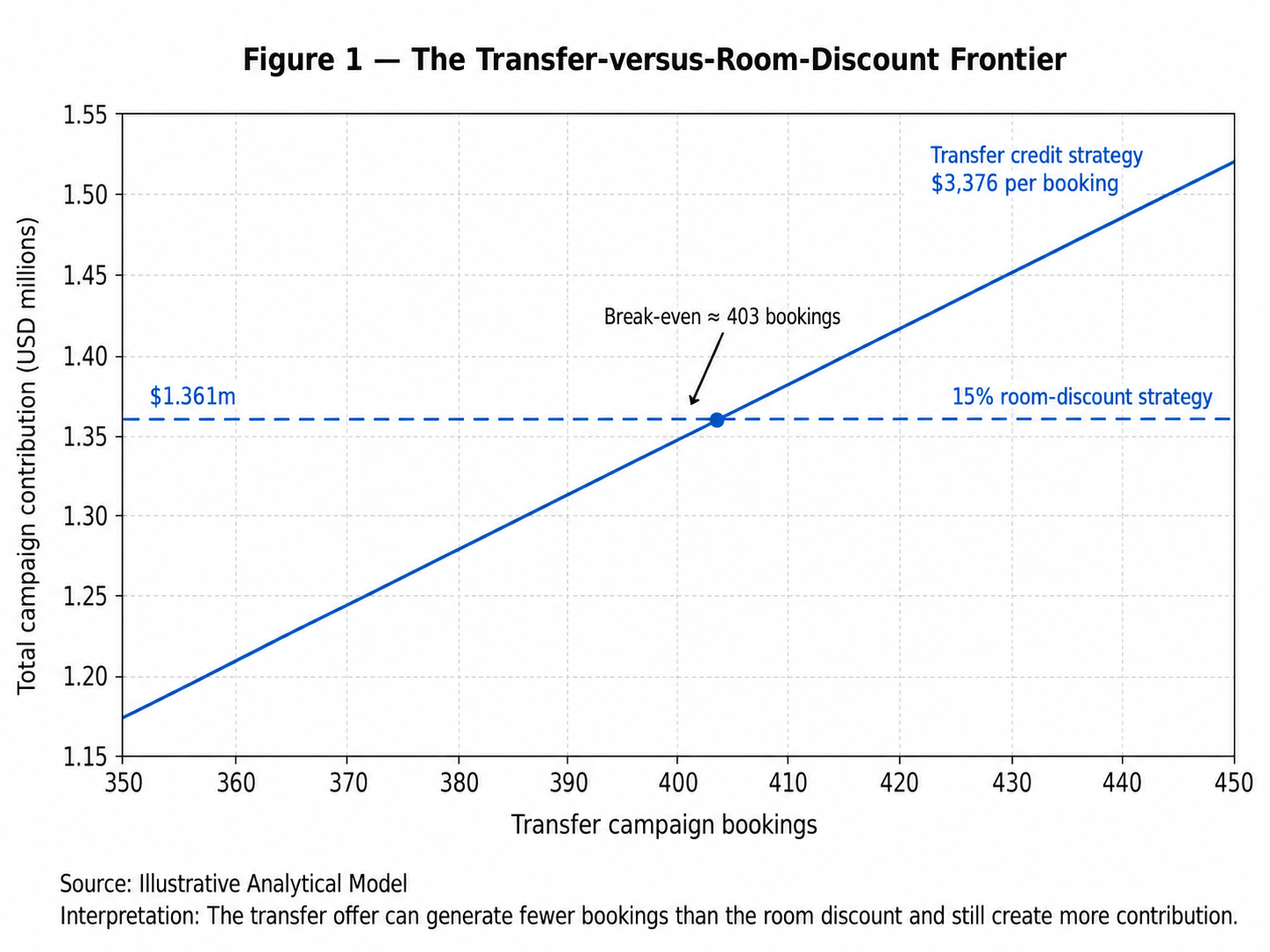
If the room discount generates 440 bookings, the transfer offer needs about 403 bookings to be economically superior.
Our illustrative transfer campaign produces 410.
This creates a practical rule: If a $400 transfer credit retains more than about 92% of the bookings generated by a 15% room discount, subsidising the transfer creates more contribution.
That threshold will change with ADR, length of stay, transfer subsidy and contribution margin. The equation matters more than the particular number.
Why the Maldives Changes the Answer
At a city hotel, transport is largely outside the hotel's product boundary.
On a resort island, it is part of the architecture of the stay.
Transfer pricing can affect conversion. Conversion affects occupied villa nights. Villa nights generate F&B, spa, diving and excursion contribution. Longer stays can spread the psychological burden of transfer costs across more nights.
The transfer is therefore connected to room economics even when the accounting system says otherwise.
This is also why adding value instead of immediately discounting rooms can be powerful. A resort should compare incentives by guest-perceived value divided by resort economic cost, not by their face value.
A Better Promotional Question
Instead of asking, “Should we run 15% off?”
Revenue and commercial teams can ask:
Which part of the trip price creates the greatest booking resistance?
What does removing that resistance cost?
How much conversion must the alternative preserve?
What downstream contribution accompanies the booking?
A room discount communicates, the villa is worth less today.
A transfer credit can communicate something different: we are making the journey to something valuable easier.
That distinction can be worth money.