Maldives Tourism Brief: By Mid Sep 2.2 Million Looks Reachable. Matching 2025 Is Harder.
16 Sep 2026, 18:16 · by IzuCT · 4 min read · Tourism · EN

September is doing what September often does in Maldives tourism: slowing the system just before the stronger final quarter.
Free tourism insights
Get Free Tourism Insights
Receive selected MTO insights, tourism data alerts, and new resource updates by email.
Get Free Tourism InsightsA tourism target looks simple in December. By September, it becomes arithmetic.
The latest Maldives Tourism Observatory data provides 15 official observations for September. From 1–15 September, the Maldives received about 69,700 tourists. The latest seven-day average is 4,673 arrivals per day, slightly above the previous seven days, suggesting that the pace has stabilised rather than deteriorated further.
That weakness should not be surprising. In September’s Strange Valley: Why Maldives Tourism Demand Falls Between Summer and Winter, I argued that September is a remarkably persistent trough between summer demand and the stronger final quarter.
The more interesting question now is what happens when the valley ends.
Three finish lines
By combining the August cumulative total with September arrivals, the Maldives has received approximately 1.522 million tourists through 15 September.
From here, three benchmarks matter.
The first is 2.2 million, the revised 2025 government target that the Maldives exceeded last year. The second is the 2,246,516 tourists actually achieved in 2025. The third is the Government's current 2.5 million target for 2026.
Across the remaining 107 days of the year, reaching those numbers requires averages of roughly 6,337, 6,772 and 9,141 arrivals per day, respectively.
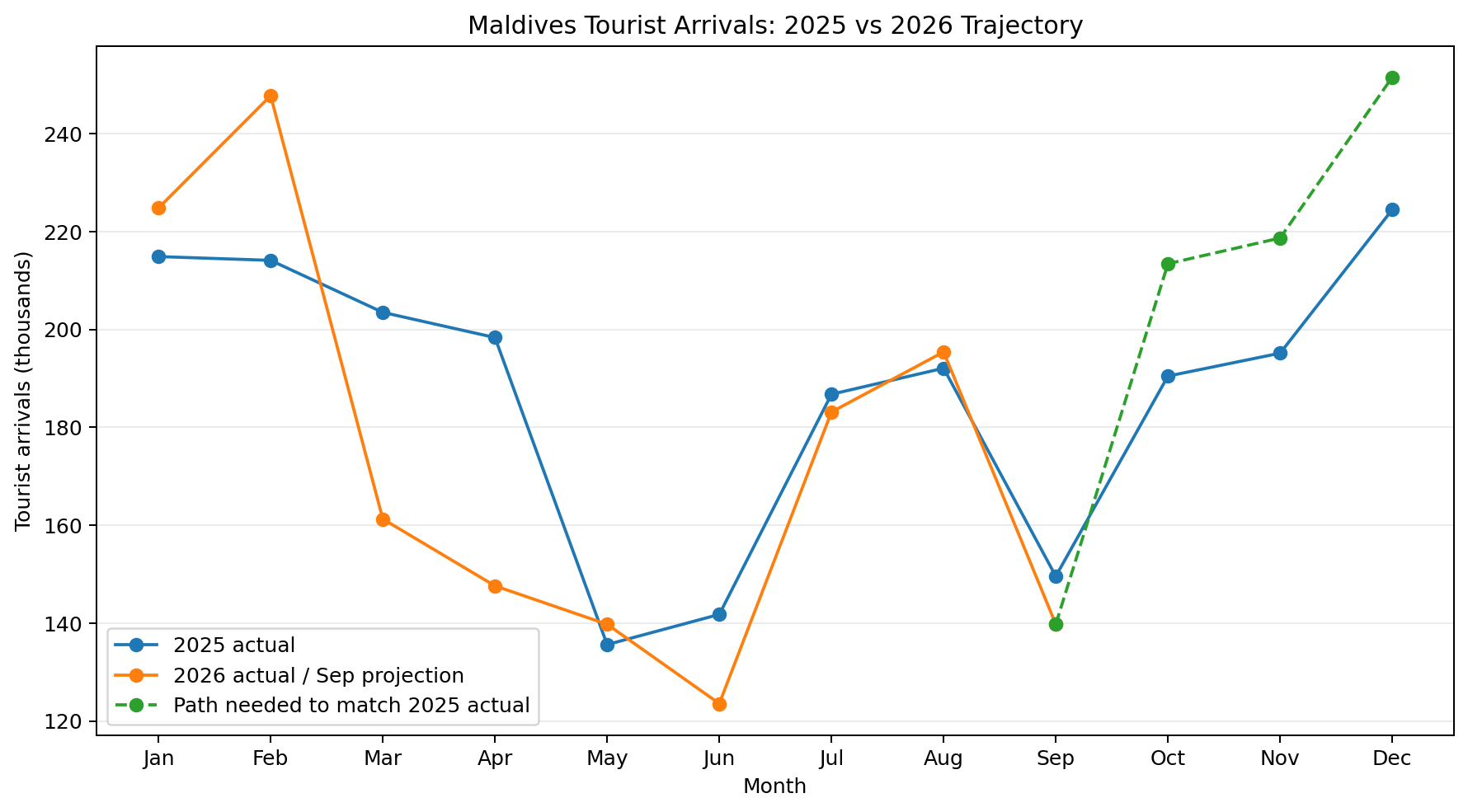
The latest 4,673-per-day pace therefore looks insufficient when viewed in isolation.
But September should not be viewed in isolation.
Q4 changes the calculation
If the latest September pace continues for the rest of the month, September would finish close to 140,000 arrivals, leaving the Maldives with roughly 1.592 million tourists entering October.
Last year's October–December period produced approximately 610,000 arrivals.
To finish 2026 at 2.2 million, Q4 would then need to perform roughly in line with last year.
To equal the 2025 record, Q4 would need around 654,000 arrivals, or approximately 7.3% growth.
Reaching 2.5 million would require roughly 908,000 Q4 arrivals—almost 49% above Q4 2025.
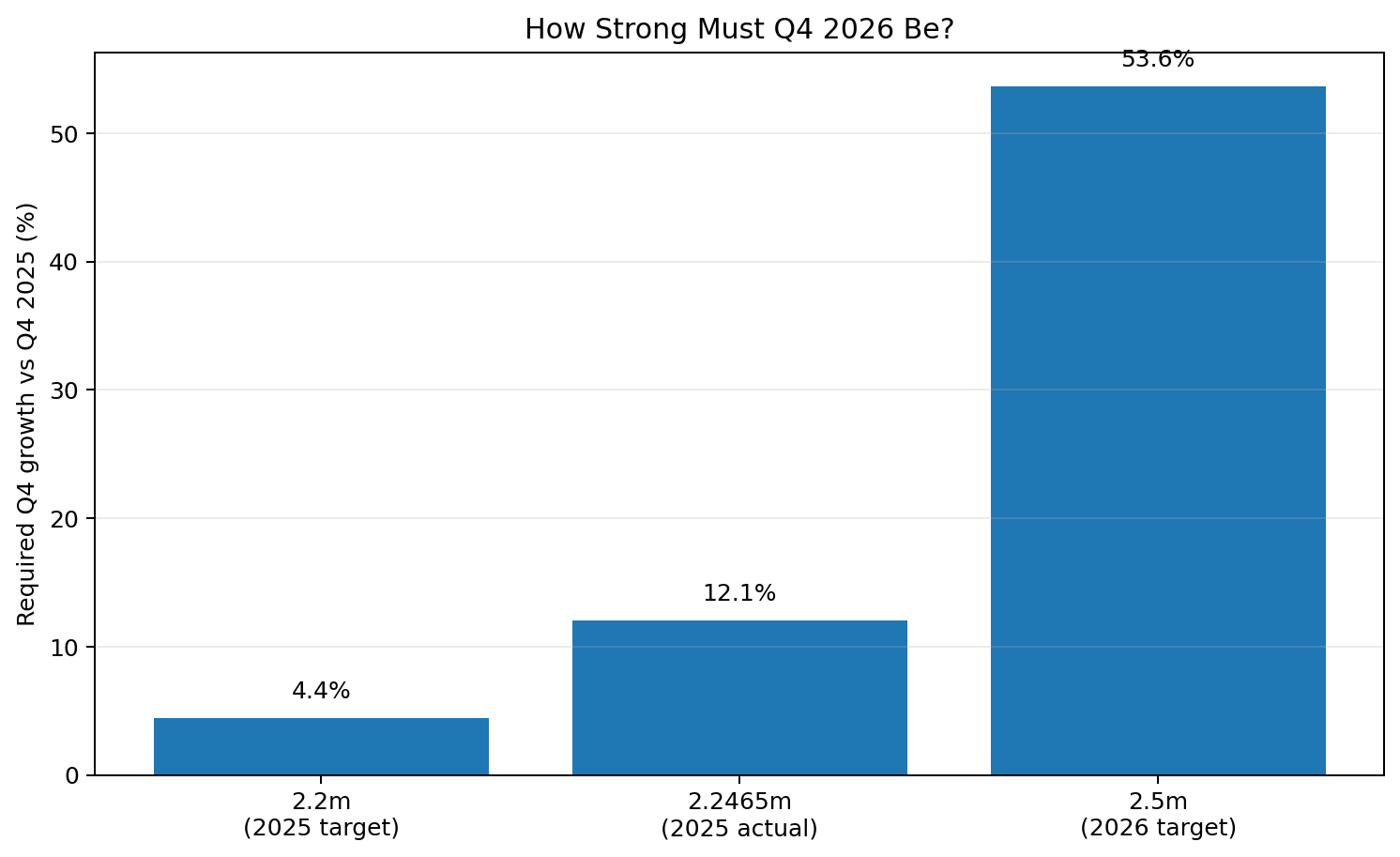
History helps put those numbers into perspective. Across the comparable non-pandemic Q4 periods of 2016–2019 and 2022–2025, year-on-year growth ranged from approximately 3% to 15%, averaging around 9%.
On that simple historical-frequency basis, clearing 2.2 million appears highly probable—above 90% under normal Q4 conditions.
Matching 2025's actual result is much less certain but remains realistic. The required 7.3% Q4 growth was exceeded in five of those eight comparable years. I would therefore treat this as roughly a 50–65% planning probability, rather than a prediction.
The 2.5 million target is different. It requires a Q4 acceleration far outside this recent historical range. Under the same framework, its probability is very low.
As I discussed in Tourism Industry Insight: The Confidence Band, a forecast becomes more useful when it describes uncertainty rather than pretending that one number represents the future.
Arrivals are never the real finish line
Even reaching 2.2 or 2.25 million tourists would not automatically mean a strong year for every operator.
July recorded 59.7% utilisation, with 1.263 million bed nights sold but another 854,000 bed nights remaining unused. The August MTO planning estimate suggests improvement—around 1.30 million sold bed nights and 783,000 of shadow inventory—but substantial spare capacity remains.
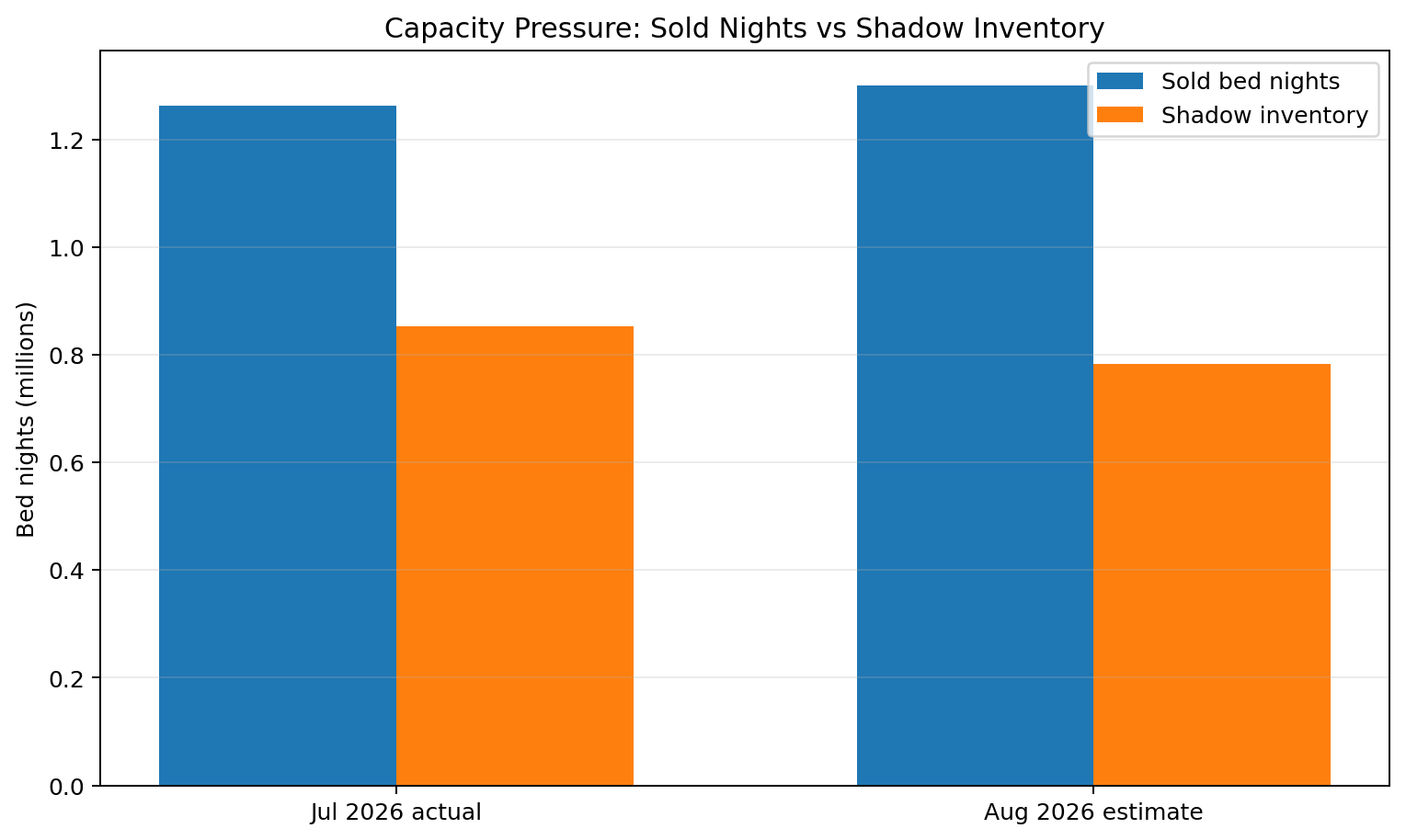
This is the problem explored in The Million Unsold Nights: What Shadow Inventory Reveals. A tourist arrival only creates value when it becomes occupied nights, meals, transfers, excursions and revenue.
And, as the Maldives’ Seven-Night Tourism Reset showed, length of stay matters almost as much as the number crossing the border.
There is also concentration risk. China and Russia currently account for roughly one-third of arrivals, while 97.8% enter through Velana International Airport. The longer story behind that exposure is discussed in What 20 Years of Maldives Arrivals Reveal.
What I would watch now
My reading today is therefore fairly simple.
2.2 million looks increasingly achievable. Matching the 2025 record remains genuinely in play. The 2.5 million target would require an exceptional final quarter.
But the industry's more important question is not whether the national counter finishes at 2.20 or 2.25 million.
It is whether those visitors convert into enough profitable occupied nights.
September tells us where the valley is.