September’s Strange Valley: Why Maldives Tourism Demand Falls Between Summer and Winter
09 Sep 2026, 18:23 · by IzuCT · 5 min read · Tourism · EN

September’s Maldives tourism dip is a persistent calendar-driven valley, not simply a weather problem. Early 2026 data reinforce the pattern, highlighting opportunities in market timing, value-added packages, longer stays, and September-specific experiences for resilient demand.
Free tourism insights
Get Free Tourism Insights
Receive selected MTO insights, tourism data alerts, and new resource updates by email.
Get Free Tourism InsightsImagine looking at fifteen years of Maldives tourism on a graph.
The line rises and falls with crises, recoveries, new airlines, changing source markets and millions of individual travel decisions. Yet, almost every year, something curious happens.
Between August and October, the line bends downward.
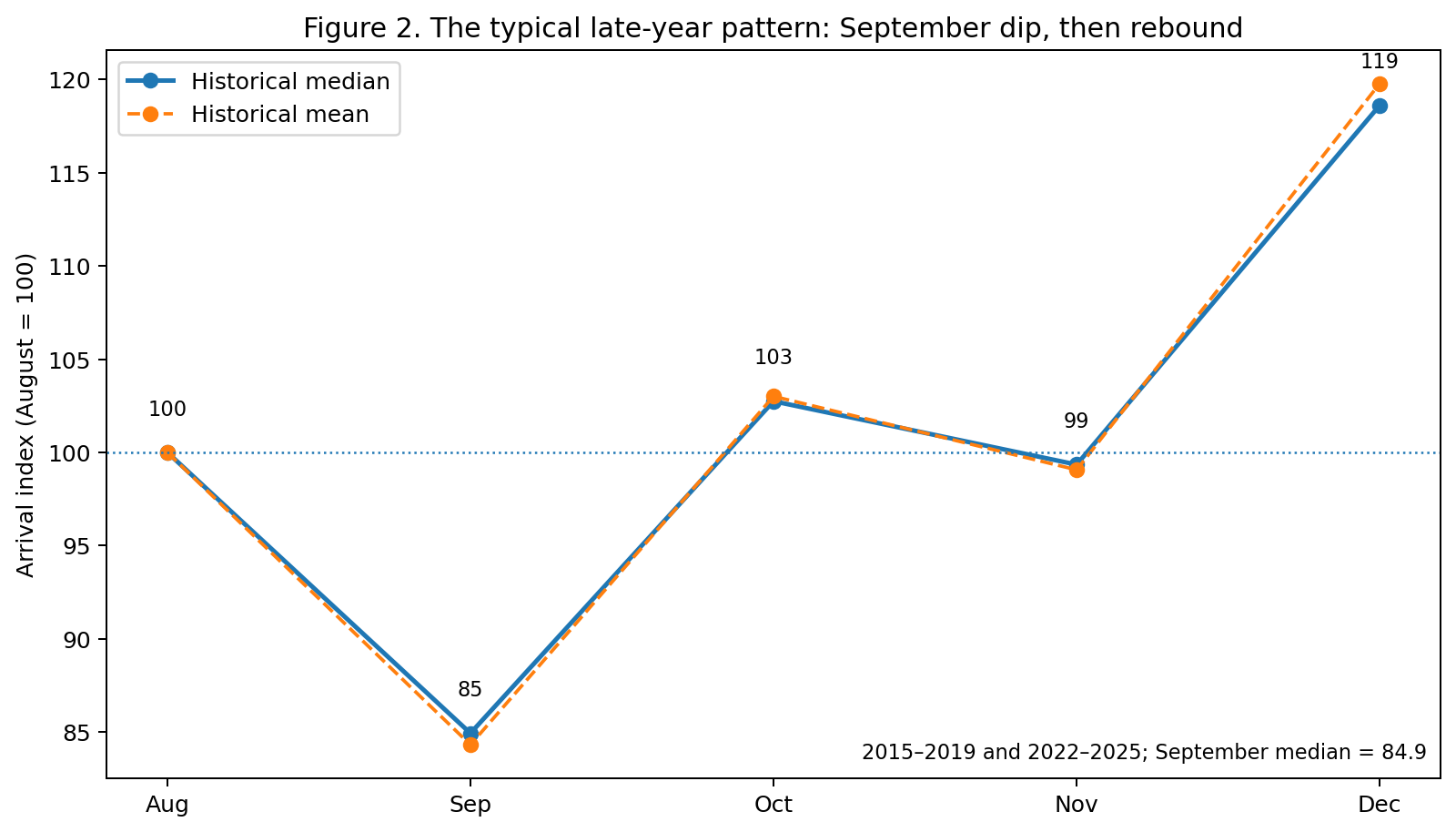
September becomes a valley.
The first eight days of September 2026 suggest that the valley has appeared again. The Maldives received 36,960 tourists from 1–8 September, averaging 4,620 arrivals a day — 4.3% below the same period in 2025. The seven-day average, 4,613, tells much the same story.
Eight days cannot tell us how the month will finish. But they can ask a useful question:
Why does September keep doing this?
A valley hidden inside a growing industry
The Maldives tourism story is overwhelmingly one of growth. More islands, more beds, more airlines and a much broader international market have transformed the destination.
Yet growth has not erased seasonality.
Across comparable non-pandemic years, September repeatedly falls below both August and October. It is not always the absolute weakest month — May and June can perform worse — but September is unusually consistent as a dip between two stronger periods.
The contrast was particularly visible in 2025. September recorded 149,563 tourists, around 22% fewer than August. Tourist bed-nights fell to roughly 921,000.
Occupancy reveals the commercial consequence even more clearly. In 2024, resort occupancy fell from 78.5% in August to 53.1% in September.
Think of the Maldives tourism system as an aircraft flying with thousands of seats. The aircraft is still moving, but suddenly many more seats are empty.
For resorts, those empty rooms become what I have described elsewhere as “shadow inventory” — tourism capacity that exists but earns nothing when it goes unsold.
And September creates a lot of it.
The obvious suspect is the weather
September sits within the southwest monsoon.
Clouds gather. Rainfall becomes less predictable. Travellers searching Instagram or weather apps may see thunderstorms stretching across an entire week and quietly move the Maldives further down their shortlist.
This matters because the Maldives sells something unusually vulnerable to weather perception: the promise of blue sky, turquoise water and outdoor freedom.
But here is the puzzle.
October is not magically dry.
It also sits within the broader wet-season transition, yet historically tourism demand often rebounds sharply.
If rainfall alone created the September trough, October should remain deep inside it.
It does not.
Weather therefore appears to be an amplifier rather than the fundamental cause.
The real force may be invisible: the calendar
Tourism demand is governed by clocks that are difficult to see from inside a resort.
School calendars. Public holidays. Salary cycles. Family routines. Winter temperatures thousands of kilometres away.
September sits at an awkward intersection of those clocks.
Across Europe, the great summer migration is ending. Children return to school. Families that travelled in July or August return to work and routine. Some households have already spent a large part of their annual holiday budget.
Meanwhile, the winter escape has not yet begun.
China has not reached its major October holiday period. European autumn school breaks are still ahead. Christmas and New Year remain distant enough for many travellers to wait.
September therefore becomes a kind of temporal no-man's-land: after one powerful reason to travel and before the next.
That is why different source-market calendars can make Maldives tourism more resilient.
True diversification is not merely having visitors from China, Russia, Britain, Germany, India and Italy.
It is having customers who want to travel at different times.
The Maldives has already evolved towards a rotating portfolio of international source markets. September exposes the next frontier: diversifying the tourism calendar itself.
The early September 2026 figures are interesting in this respect. China and Russia still account for around 33.4% of year-to-date demand, while the market mix has remained relatively stable.
That suggests the early weakness is not simply one large market disappearing.
The gravitational pull may be broader.
Then the industry begins responding to the valley
Once businesses expect September to be weak, the system can reinforce the expectation.
Airlines reduce frequencies. Resorts become more promotional. Marketing teams concentrate expenditure on stronger periods. Some properties schedule maintenance. Travellers learn that September is when Maldives discounts appear.
A seasonal pattern can gradually become a behavioural pattern.
Connectivity is particularly important. Almost 97.8% of tourist arrivals currently pass through Velana International Airport, making airline capacity and scheduling central to demand.
But discounting the villa is not always the smartest response.
For many Maldives holidays, the psychological obstacle may be the total trip cost — particularly transfers. As explored in The First Price the Guest Feels, removing transfer friction can sometimes create greater perceived value than another room-rate reduction.
The objective should be to make September more desirable, not merely cheaper.
What if September became a season of its own?
That changes the strategy.
Instead of asking, “How do we fill discounted rooms?”, ask:
Who has a reason to travel specifically in September?
Couples without school-age children. Honeymooners. Divers. Surfers. Wellness travellers. Remote workers. Photographers. Flexible older travellers. Visitors attracted by manta encounters, marine life and the dramatic character of the southwest monsoon.
For these travellers, September does not need to imitate January.
It can offer something January cannot.
Airlines and resorts could build joint September packages around transfers, experiences, spa credits, diving or flexible weather guarantees rather than blunt room discounts.
Resorts could also turn spare capacity into longer stays. The logic behind the Extra-Night Dividend becomes particularly powerful in a soft month: once the guest has already been acquired and transferred to the island, another night can generate accommodation, food, beverage and activity revenue at relatively low incremental acquisition cost.
And campaigns should begin months earlier — not when September has already arrived.
The real September lesson
The first eight days of September 2026 do not prove how the month will end.
But history gives those eight days meaning.
September appears to be less a weather problem than a calendar problem — amplified by weather perception, airline capacity and industry behaviour.
That distinction matters.
Weather cannot be negotiated.
Calendars can.
The Maldives may never eliminate September seasonality completely. But it can stop treating the month as an inferior version of peak season.
The opportunity is to give September its own audience, its own experiences and its own reason to exist.