Research Notes Series: Maldivian Resorts Coral Ecosystems as Productive Capital
11 Sep 2026, 01:49 · by IzuCT · 11 min read · Updates · EN
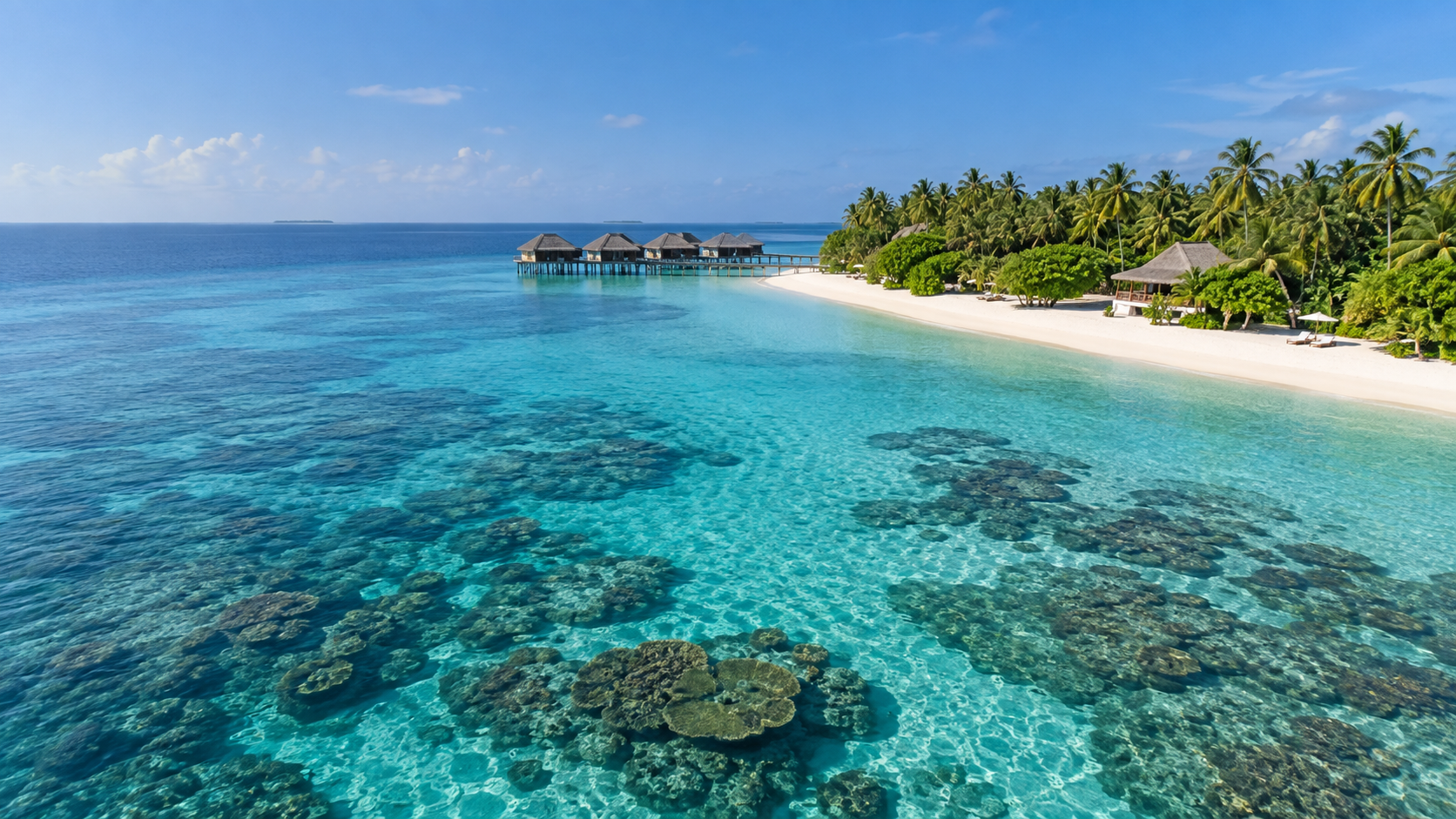
This article conceptualises Maldivian resort reefs as productive natural capital and examines their economic relevance through ecosystem-service valuation, tourism pricing and investment analysis. It argues that reef conservation can generate commercially relevant benefits through visitor experience, coastal protection and competitiveness, while requiring careful treatment of ecological uncertainty and value capture.
A resort balance sheet is very good at recognising buildings. It can record the value of villas, restaurants, boats, generators, furniture and equipment. It can depreciate a desalination plant and calculate the return on refurbishing a room. But one of the assets most closely connected to the value of a Maldivian resort will usually appear nowhere on that balance sheet: the coral reef surrounding the island.
This is more than an accounting curiosity.
For many Maldivian resorts, the reef helps produce the tourism product itself. Guests snorkel over it, dive on it, photograph it and describe it in reviews. Reef structure contributes to the formation and persistence of beaches, while coral ecosystems support marine biodiversity and provide physical protection from waves. This relationship between environmental assets and commercial value is also visible in the economics of protecting the beach as productive resort capital.
In economic terms, the reef is not simply scenery. It is productive natural capital.
That distinction matters because it changes the question facing resort owners and managers. Instead of asking only how much a business should spend on conservation, we can ask a more demanding question:
Under what conditions could investment in reef conservation or restoration generate an economically defensible return?
From environmental amenity to productive capital
The concept of natural capital is well established in ecological economics. Natural ecosystems constitute stocks of assets capable of producing flows of services that contribute to human welfare and economic activity (Costanza et al., 1997).
Coral reefs provide an unusually clear illustration.
Globally, reef ecosystems support recreation, tourism, fisheries, biodiversity and coastal protection. Spalding et al. (2017) estimated the global tourism value associated with coral reefs at approximately US$36 billion annually, distinguishing between direct “on-reef” activities, such as diving and snorkelling, and broader “reef-adjacent” tourism benefits.
Their contribution is especially relevant to the Maldives because tourists do not necessarily have to enter the water for a reef to contribute to tourism value. Sheltered lagoons, beaches, views, biodiversity and the wider image of the tropical island product can all depend, directly or indirectly, on functioning reef systems.
There is also a physical-capital dimension. A global meta-analysis by Ferrario et al. (2014) found that coral reefs can dissipate a very large proportion of incoming wave energy. The exact protective benefit at an individual island depends on reef morphology, depth, exposure and other local conditions, but the broader economic point remains: degradation of natural infrastructure can eventually create costs for built infrastructure.
For an island resort, therefore, ecological quality and commercial performance should not automatically be analysed as separate systems.
They are partially connected production systems.
The economic value of environmental quality is not merely theoretical
Environmental economists have long faced a problem: ecosystems frequently create real economic benefits without having observable market prices.
A reef does not send the resort an invoice for wave attenuation. A healthier marine environment does not automatically appear as a separate line in the room rate.
Its value has to be inferred.
One approach is hedonic pricing. The underlying idea is that the observed price of a differentiated product—such as hotel accommodation—reflects the bundle of attributes embedded within it.
Research on Maldivian accommodation has examined precisely this relationship between internal hotel characteristics, environmental amenities and prices. My earlier research on tourism and hotel-room pricing in the Maldives found evidence that environmental characteristics form part of the economic environment within which accommodation prices are determined (Zuhuree, 2017).
This mechanism is explored more practically in my earlier article on what happens when better environmental quality becomes expected and is absorbed into price. An environmental improvement need not produce dramatically higher review scores to possess economic value. Some of that value may instead be capitalised into the price visitors are prepared to pay.
A second approach asks tourists directly about their willingness to pay.
Mohamed's (2007) study of Dhigali Haa Marine Protected Area in Baa Atoll found substantial support among surveyed international tourists for financing improved reef management. The estimated mean willingness to pay for a one-off conservation fee was approximately US$35, while the estimated willingness to pay for a diver user fee was approximately US$15.
Importantly, these are stated-preference values, not evidence that a resort can simply add US$35 to its room rate. But they establish something economically significant: visitors may attach measurable monetary value to reef conservation.
Bhat, Bhatta and Shumais (2011), using a different economic framework, estimated that a contribution of approximately US$41 per tourist would have been sufficient at the time of their study to finance the prevailing level of domestic and donor-supported environmental protection expenditure.
Again, that US$41 is not a room-rate premium and should not be interpreted as one. It demonstrates the wider scale of recreational surplus associated with the Maldives' marine environment.
The analytical challenge for a resort is therefore narrower:
How much of the value generated by a healthier reef can the individual resort actually capture?
A simple investment test
Consider an illustrative 100-villa luxury resort.
Assume average occupancy of 70%. That produces approximately 25,550 occupied villa nights per year.
Now suppose the resort considers a substantial reef-restoration programme requiring:
US$500,000 in initial capital expenditure;
a five-year investment horizon;
a 10% hurdle rate; and
US$120,000 annually for monitoring, maintenance and marine-biologist support.
Annualising the US$500,000 initial investment over five years at 10% produces an annual capital requirement of approximately US$131,900.
Adding annual operating and monitoring expenditure produces a total annual economic requirement of approximately:
US$251,900.
Now assume that 90% of any incremental accommodation revenue generated by the ecological improvement reaches contribution.
The required value per occupied villa night is then:
US$251,900 ÷ (25,550 × 0.90) ≈ US$10.95.
Call it US$11 per occupied villa night.
This is the more interesting way to view the US$500,000 restoration programme.
The investment does not need to create US$500 of value for each guest.
Under these assumptions, it needs to produce approximately US$11 of sustainable, capturable economic value for each occupied villa night.
That is an entirely different scale of question.
The US$11 should not be mistaken for an ADR increase
This is where financial discipline becomes essential.
The model does not demonstrate that restoring a reef will allow management to increase the published room rate by US$11.
The value may appear through several mechanisms.
A stronger reef experience might improve booking conversion while prices remain unchanged. It might support a stronger competitive position relative to substitute resorts. It might increase diving or guided-snorkelling expenditure. It might contribute to repeat visitation, reputation or direct bookings. In some locations, improved reef condition could potentially contribute to avoided erosion or coastal-protection costs.
These channels are economically different.
They should be estimated independently rather than added together casually.
Otherwise, the resort risks double counting the same underlying environmental improvement.
This distinction between ecosystem value and financially capturable value is crucial. Ecological-economic valuation literature consistently shows that reefs possess substantial value, but valuation estimates vary widely according to methodology, location and the services included (Brander et al., 2007).
A resort investment committee therefore needs evidence of marginal value: what additional commercial benefit is likely to result from this particular intervention, at this particular island, relative to what would otherwise have happened?
The same marginal-value logic is important elsewhere in resort investment. As discussed in The Density Frontier, adding physical capacity does not automatically create economic value once infrastructure costs and effects on the existing tourism product are recognised. Reef investment requires the same discipline: expenditure should be evaluated against the additional value it is expected to preserve or create.
Why the Maldives has an unusual economic advantage
Environmental investment frequently suffers from a classic incentive problem.
A business may pay to protect an ecosystem while much of the resulting benefit flows to other firms or the general public. Economists describe this in terms of positive externalities and incomplete appropriation of benefits.
The Maldives' one-island–one-resort model changes that problem in an interesting way.
A resort that improves the environmental quality immediately surrounding its island may capture part of the resulting value through accommodation, recreation, excursions, reputation and the overall guest experience.
The reef remains ecologically connected to a larger marine system, so the benefits cannot be completely internalised. Fish move. Larvae disperse. Currents cross administrative boundaries.
But spatially, the commercial product and the environmental asset are unusually closely aligned.
This can reduce—although certainly not eliminate—the free-rider problem.
Indeed, the one-island–one-resort system can be understood partly as a property-rights structure. The operator controls a bounded tourism environment while simultaneously bearing much of the economic consequence when that environment deteriorates. Beach quality, lagoon conditions, reef health, landscaping, waste management and perceptions of privacy become interconnected components of the product being sold.
That makes Maldivian resort islands unusually interesting laboratories for studying whether private tourism investment can help finance natural-capital preservation.
There is also a warning in the evidence
Treating reefs as productive capital should not be interpreted as permission to commercialise them without restraint.
The opposite conclusion follows.
If the reef is an asset, activities that degrade it should be treated as forms of capital depletion.
Research examining Maldivian resort reefs has identified pressures associated with construction, sediment, pollution and other tourism-related activity. Cowburn et al. (2018), studying reefs surrounding seven resort islands, found evidence of environmental impacts associated particularly with resort construction and localised resort activities, while also noting substantial variation between habitats and atolls.
Jaleel (2013) similarly identifies thermal stress, coastal development, dredging, waste and institutional constraints among the pressures affecting Maldivian reef systems. More recent synthesis work stresses both the economic importance of the reefs and the substantial uncertainty surrounding the cost and effectiveness of restoration interventions (Hilmi et al., 2023).
This creates an important hierarchy for resort policy.
Avoiding ecological damage should generally precede attempting to restore what has already been damaged.
Restoration should not become an accounting device that allows degradation in one part of the system to be justified by planting coral somewhere else.
There is a parallel here with the broader economics of finite island space. As the analysis of whether a resort can run out of island before it runs out of demand argues, apparently unused environmental space can itself possess economic value. Development decisions should therefore recognise not only the revenue created by new physical capital but also the natural and experiential capital potentially displaced by it.
From CSR expenditure to capital allocation
The practical implication is not that every resort should immediately launch a reef-restoration project.
It is that reef expenditure deserves a more sophisticated analytical framework.
A proposed project should specify the ecological outcome being sought, establish a credible baseline, identify the commercial pathways through which value could arise, estimate costs over the complete project life, test alternative scenarios, account for ecological and financial uncertainty, and measure outcomes after investment.
In other words, reef conservation can be subjected to many of the same questions asked of conventional capital expenditure.
What is the investment?
What future stream of benefits might it generate?
What is the counterfactual without intervention?
What risks could prevent those benefits from materialising?
And what evidence would convince management that the project worked?
This does not reduce the reef to dollars.
Some ecological values cannot be adequately captured by market prices, and some should not need to be.
But ignoring financial value altogether creates a different problem. It allows an economically productive ecosystem to remain invisible in the very decisions that determine how much money is allocated to maintaining it.
Perhaps the most useful change, therefore, is simply conceptual.
The reef surrounding a Maldivian resort is not located outside the tourism economy.
It helps create the tourism economy.
And once we recognise that, reef conservation is no longer only a discussion about environmental responsibility.
It also becomes a discussion about asset quality, resilience, risk and investment.
For a country whose tourism product is built quite literally on coral foundations, that may be an important shift in how we think about capital.
--..........................................................
References
Bhat, M. G., Bhatta, R. C., & Shumais, M. (2011). User-based financing of marine protection in the Maldives. SANDEE Working Paper No. 57-11, South Asian Network for Development and Environmental Economics.
Brander, L. M., Van Beukering, P., & Cesar, H. S. J. (2007). The recreational value of coral reefs: A meta-analysis. Ecological Economics, 63(1), 209–218. https://doi.org/10.1016/j.ecolecon.2006.11.002
Costanza, R., d'Arge, R., de Groot, R., Farber, S., Grasso, M., Hannon, B., et al. (1997). The value of the world's ecosystem services and natural capital. Nature, 387, 253–260. https://doi.org/10.1038/387253a0
Cowburn, B., Moritz, C., Birrell, C., Grimsditch, G., & Abdulla, A. (2018). Can luxury and environmental sustainability co-exist? Assessing the environmental impact of resort tourism on coral reefs in the Maldives. Ocean & Coastal Management, 158, 120–127. https://doi.org/10.1016/j.ocecoaman.2018.03.025
Ferrario, F., Beck, M. W., Storlazzi, C. D., Micheli, F., Shepard, C. C., & Airoldi, L. (2014). The effectiveness of coral reefs for coastal hazard risk reduction and adaptation. Nature Communications, 5, 3794. https://doi.org/10.1038/ncomms4794
Hilmi, N., Basu, R., Crisóstomo, M., Lebleu, L., Claudet, J., & Seveso, D. (2023). The pressures and opportunities for coral reef preservation and restoration in the Maldives. Frontiers in Environmental Economics, 2, 1110214. https://doi.org/10.3389/frevc.2023.1110214
Jaleel, A. (2013). The status of the coral reefs and the management approaches: The case of the Maldives. Ocean & Coastal Management, 82, 104–118. https://doi.org/10.1016/j.ocecoaman.2013.05.009
Mohamed, M. (2007). Economic valuation of coral reefs: A case study of the costs and benefits of improved management of Dhigali Haa, a marine protected area in Baa Atoll, Maldives [Master's thesis, University of Canterbury].
Spalding, M., Burke, L., Wood, S. A., Ashpole, J., Hutchison, J., & zu Ermgassen, P. (2017). Mapping the global value and distribution of coral reef tourism. Marine Policy, 82, 104–113. https://doi.org/10.1016/j.marpol.2017.05.014
Zuhuree, I. (2017). An empirical analysis on international tourist flow and hotel room prices: The case of Maldives [Doctoral dissertation, National Graduate Institute for Policy Studies].