Tourism Industry Insight: Making Island Holidays Accessible from Arrival
30 Oct 2026, 08:00 · by IzuCT · 4 min read · Tourism · EN
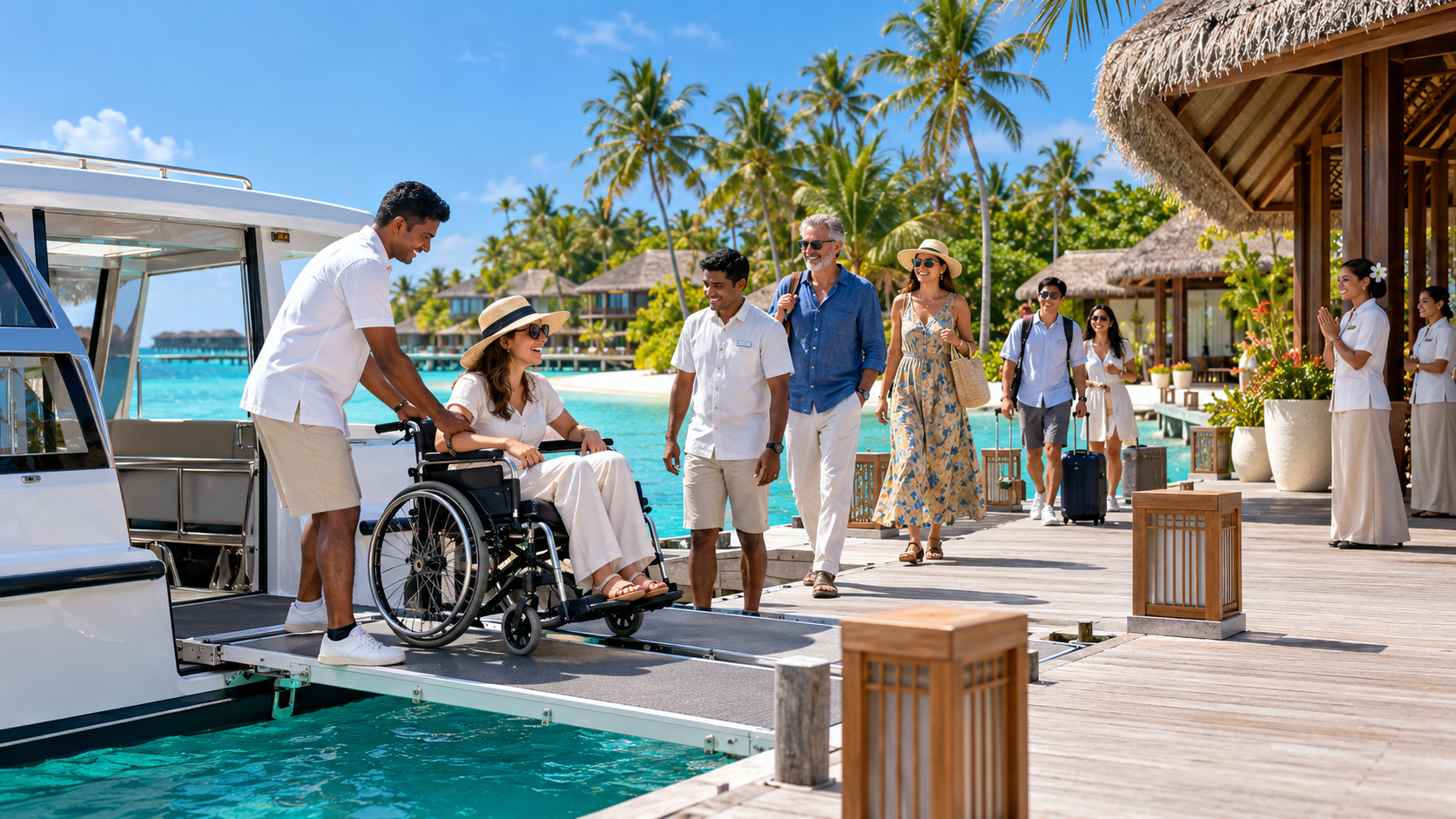
An accessible hotel room cannot secure a booking when the journey to it remains uncertain. The overlooked opportunity may be at the jetty.
Free tourism insights
Get Free Tourism Insights
Receive selected MTO insights, tourism data alerts, and new resource updates by email.
Get Free Tourism InsightsImagine a traveller comparing two Maldivian resorts for a family holiday. Both advertise spacious, step-free rooms. One has an attractive pool, accessible dining areas and a beautiful beach. But when the traveller asks how a wheelchair user boards the airport speedboat, the answer is uncertain: staff usually help passengers over several steps. The family postpones booking. The resort has invested in accessible accommodation, yet the holiday may be lost before anyone reaches reception. How can one short section of a journey outweigh improvements across an entire property?
The journey is a chain, not an average
A hotel can perform well on accessibility in most departments and still offer an unusable journey for a particular guest. This is a problem of complementarity: some services deliver value only when the other services needed to reach them also work. An accessible bathroom cannot compensate for an unsafe boat transfer.
Suppose four of five essential stages are usable: airport reception, onward transport, resort pathways and accommodation. If the fifth stage—boarding the vessel—is impossible for that traveller, the completed journey remains impossible. Calling the property “80% accessible” conceals the decisive constraint. Different travellers face different barriers, making a single accessibility score inadequate.
The World Health Organization estimates that 1.3 billion people, approximately 16% of the global population, experience significant disability. More specifically, Tourism Research Australia recorded 70.5 million trips involving travellers with accessibility needs or their companions in 2024, representing 22% of Australian trips. Neither figure forecasts demand for Maldivian resorts, but both establish accessibility's wider relevance.
A jetty is part of the room being sold
The Maldives Fifth Tourism Master Plan 2023–2027 identifies accessible tourism as Goal 15, explicitly addressing marine, air and land transport. International guidance from UN Tourism likewise treats accessible transport as fundamental to a dignified journey. These are policy priorities and recommendations, not evidence that particular transfers meet individual requirements.
The earlier examination of why the cheapest transfer can cost a resort more considered holiday time lost through waiting. Accessibility reveals a different cost: an unsuitable transfer can eliminate the booking altogether. The problem is not simply inconvenience; it is whether the advertised holiday can be purchased and experienced.
Consider two vessels. One requires passengers to negotiate steep steps and a moving gap. Another offers an assessed boarding arrangement compatible with a particular traveller's mobility equipment. The second may make a previously unavailable holiday feasible. However, sea conditions, tidal variation, equipment limitations, crew training and emergency procedures must be verified. Improvised manual lifting is not a substitute for safe, appropriate access.
Measure the barrier before investing
Begin with a complete journey audit involving disabled travellers and qualified accessibility specialists. Follow the actual route from airport reception through boarding, island arrival, accommodation, dining and activities. Document gradients, surfaces, equipment specifications, boarding methods and alternatives. Test realistic operating conditions rather than relying exclusively on calm-weather demonstrations.
Information is equally important. The analysis of clearer hotel information in AI travel search explains why vague descriptions create uncertainty. The discussion of accurate hotel photographs reinforces the need for representative evidence. Publish verified access details rather than broad claims such as “fully accessible.”
Managers should track access-related enquiries, the proportion receiving verified feasible itineraries, declined bookings by identified barrier, boarding incidents and assistance requirements. As with maintaining a consistent commercial promise, descriptions must agree across booking channels. Prioritise improvements according to safety, exclusion severity, operational feasibility and cost, while meeting applicable obligations regardless of expected revenue.
Accessibility must also extend beyond arrival. The analysis of how nearby experiences influence tourism choices demonstrates that attractions have less practical value when reaching them is difficult. An accessible room is a limited achievement if the restaurant, beach or advertised activities remain inaccessible.
Return to the family considering that beautiful resort. The decisive improvement may not be another room renovation. It may be an appropriate boarding system, a dependable alternative transfer or precise information allowing the family to assess suitability before paying. Each requires verification against individual needs.
The larger insight concerns where investment creates usable value. Accessibility is not the sum of isolated facilities. It is the ability to complete a journey with safety, dignity and meaningful choice.
Removing one genuine barrier can make existing rooms, restaurants and experiences available to travellers who previously could not use them. That is where inclusion and tourism competitiveness can reinforce each other.