The Invisible Shelf: How AI Travel Agents Will Decide Which Maldives Islands Get Seen
06 Jul 2026, 18:35 · by IzuCT · 9 min read · Tourism · EN
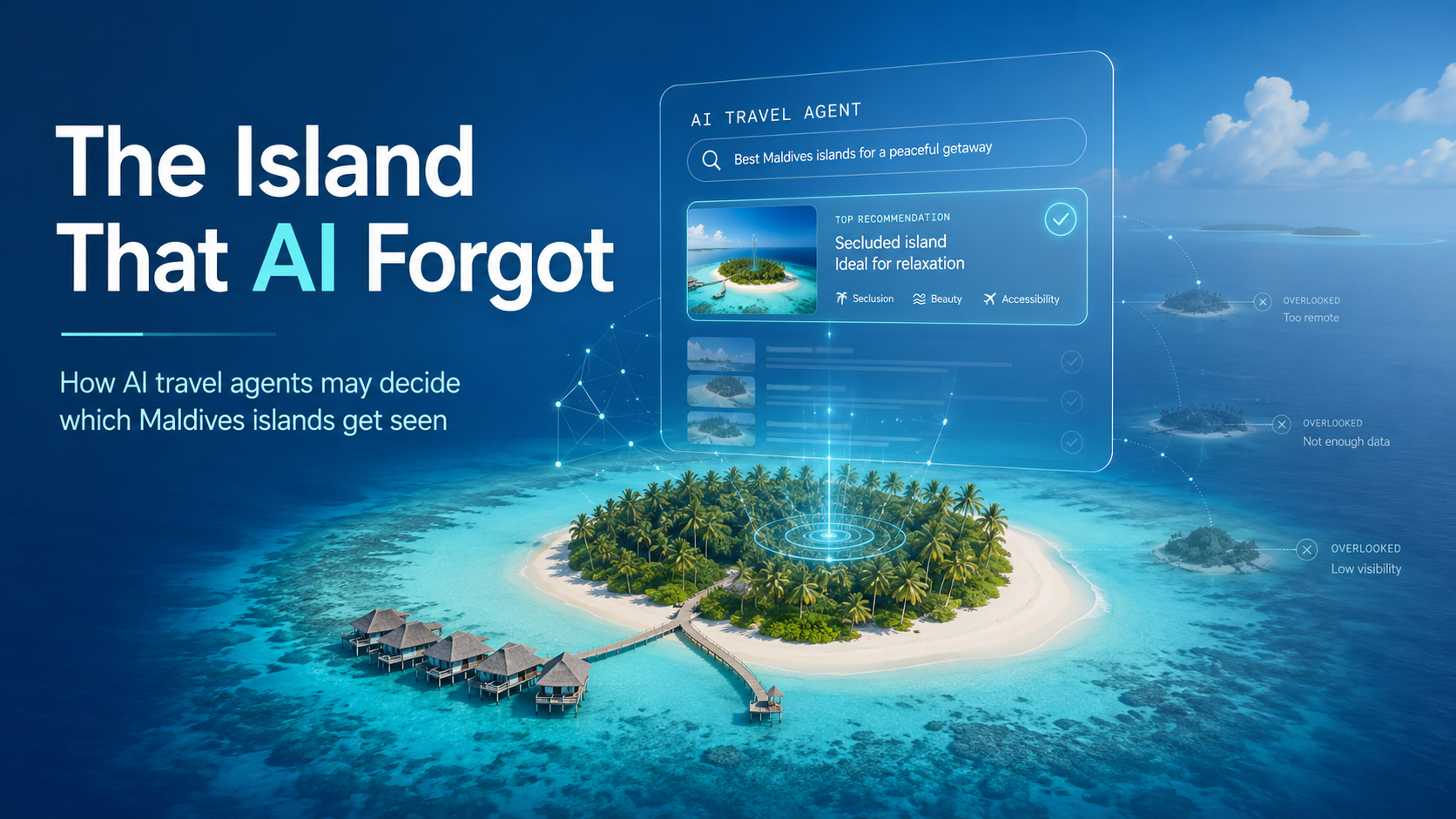
AI travel agents are becoming a new gateway to tourism. Operators must measure whether AI understands, recommends and describes them accurately, using visibility scorecards to identify hidden competitors, weak signals and missed booking opportunities.
Free tourism insights
Get Free Tourism Insights
Receive selected MTO insights, tourism data alerts, and new resource updates by email.
Get Free Tourism InsightsIn an earlier article, The Visibility Problem I argued that many tourism businesses no longer lose only because their product is weak. They lose inside the digital systems that decide what travellers see.
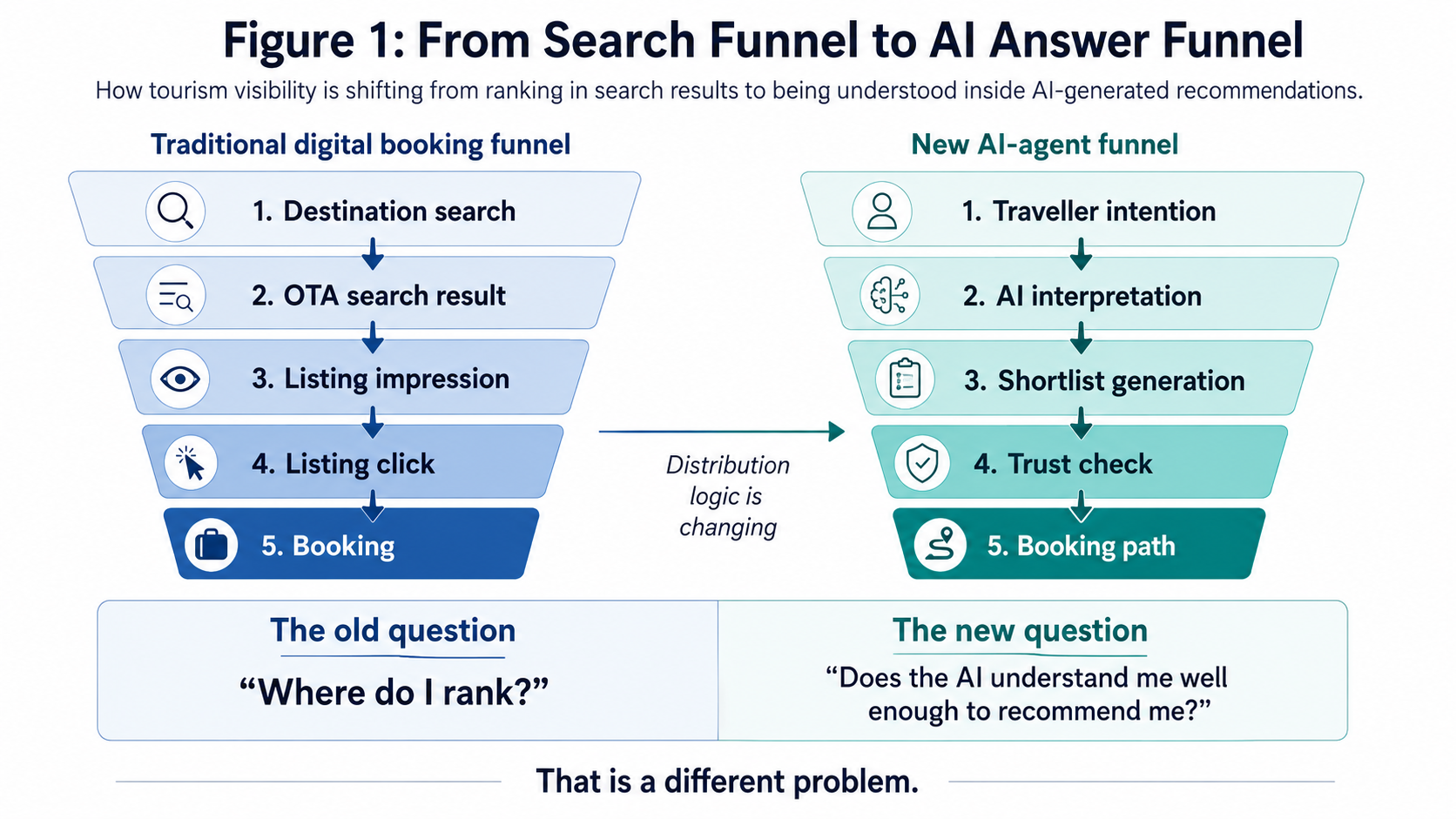
This article is the continuation. Because the visibility problem is changing again. The current battle may be inside the answer. A traveller may soon stop searching in the old way. She may not compare twenty OTA listings, open ten tabs, and manually read reviews.
She may ask an AI agent: “Plan a five-night Maldives holiday in February. I want a quiet island, good reef, easy transfer, local character, comfortable rooms, and a reasonable budget.”
The AI agent will answer. It may recommend three islands. It may choose five properties. It may exclude hundreds of others without the traveller ever knowing they existed. That answer becomes the new shelf.
In physical retail, products compete for shelf space. In online travel, hotels compete for search position. In AI-mediated travel, destinations will compete for inclusion inside machine-generated recommendations.
For Maldives tourism, this is not a small change. It is a new layer of distribution.
Why this matters
Global travel technology is moving quickly toward AI-assisted discovery. Phocuswright’s 2026 travel technology preview reports that 39% of U.S. travellers are actively using AI to plan trips, up from 28% a year earlier. It also reports that general search engines fell as the most-used travel research resource from 51% in mid-2024 to 36% in late 2025.
Google has also been expanding AI travel planning through AI Mode, including itinerary building, flight-deal discovery, hotel suggestions, map-based planning and follow-up questions. Its Flight Deals feature has expanded to more than 200 countries and territories and supports more than 60 languages.
Booking.com, working with OpenAI, describes its AI work as a way to personalise travel at scale, improve intent-driven search, simplify travel with smart filters, property Q&A and review summaries, and help travellers move from vague intent to relevant accommodation choices.
Expedia Group’s 2026 AI Trust Gap report adds an important caution. Travellers are increasingly open to AI suggestions, but many still prefer trusted travel brands when it comes to the final booking. In other words, AI may not replace OTAs immediately. But it may increasingly shape what enters the traveller’s consideration set before booking happens.
That is why the Operators should pay attention. Because many islands and properties do not lose at the payment page. They lose before the traveller knows their name.
The old equation still matters
In the earlier visibility article, I used a simple booking equation:
Bookings = Searches × Visibility Rate × Click-through Rate × Conversion Rate
Or:
B = S × V × C × R
Where:
B = confirmed bookings
S = destination searches
V = visibility rate
C = click-through rate
R = conversion rate
This equation remains useful. It reminds operators that demand alone is not enough. A traveller may want the Maldives, have the budget, and be ready to book. But if a property is not visible in the search journey, that demand never becomes a booking.
But AI agents add a new layer before visibility. Before a property appears, the AI must first interpret the traveller’s intention, search or retrieve relevant options, compare them, and decide what to recommend.
So the new equation begins one step earlier.
Bookings = Traveller Prompts × AI Inclusion Rate × Trust Rate × Booking Conversion Rate
Or in short:
B = P × I × T × R
Where:
B = confirmed bookings
P = relevant traveller prompts
I = AI inclusion rate
T = trust rate
R = booking conversion rate
This is the new visibility problem. The operator no longer asks only: “How many people searched for Maldives hotels?” The operator asks: “When travellers describe the kind of trip we are good at, does the AI include us in the answer?”
A practical new metric: AI Inclusion Rate
Let us make this measurable.
AI Inclusion Rate = Number of relevant prompts where the property appears ÷ Total relevant prompts tested
Example:
If a guesthouse island is tested against 40 traveller prompts, and it appears in 8 AI-generated answers:
AI Inclusion Rate = 8 ÷ 40
AI Inclusion Rate = 20%
That is not a marketing slogan. It is a measurable digital-distribution indicator. The prompts should not begin with the property name. They should begin with traveller intent: “quiet Maldives guesthouse island with good reef”, “affordable Maldives honeymoon without a resort budget”, “Maldives island with local culture and comfortable rooms”, “best Maldives island for diving and guesthouses”, “family-friendly Maldives guesthouse with easy transfer”, “eco-conscious Maldives stay with reef access”, “remote Maldives island with fewer crowds”
These are not random questions. They are demand signals. A property that appears for its own name is already known. The more important question is whether it appears for the traveller’s problem.
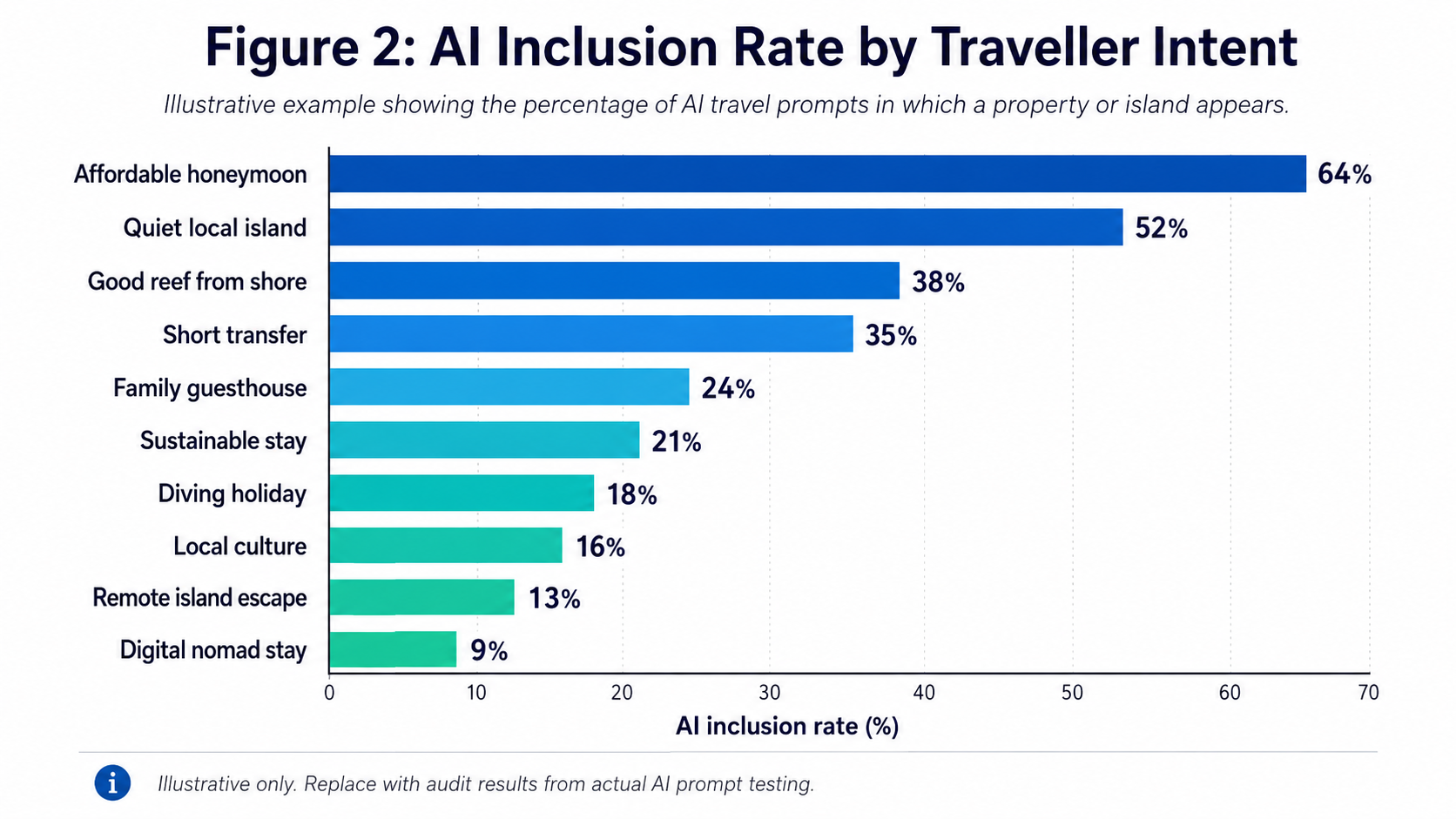
This chart tells an operator where they are visible and where they are absent. A guesthouse may be visible for “budget Maldives” but invisible for “reef holiday.” A resort may be visible for “honeymoon” but invisible for “wellness,” “sustainability,” or “family privacy.” An island may be known locally but invisible to machines because its online evidence is scattered, outdated or poorly structured.
Visibility is not enough. Accuracy matters
There is another risk. AI may mention a property but describe it badly. It may give the wrong transfer time. It may confuse one island with another. It may exaggerate sustainability claims. It may miss alcohol restrictions on local islands. It may recommend a “quiet” island that is actually congested in peak season. It may describe a beach, reef or activity using outdated information.
This creates a second metric.
AI Accuracy Score = Correct AI mentions ÷ Total AI mentions
Example:
If an island appears in 10 AI answers, but 3 answers contain wrong or misleading information:
AI Accuracy Score = 7 ÷ 10
AI Accuracy Score = 70%
This matters because bad visibility may be worse than invisibility. A traveller who arrives with wrong expectations is not a neutral guest. She is a disappointed reviewer waiting to happen.
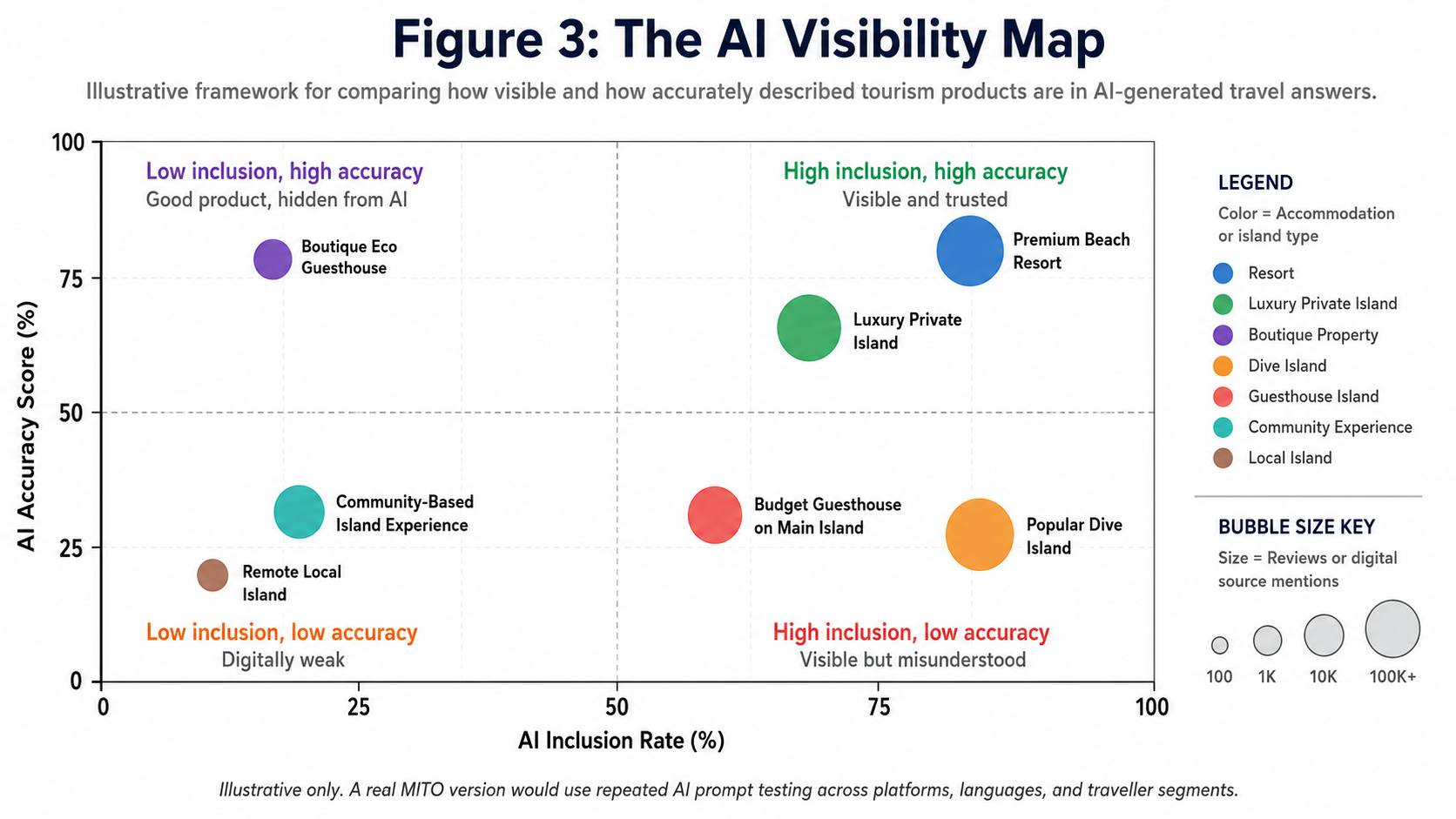
This will become one of the new datasets of the Maldives Tourism Observatory. Not arrivals. Not only prices. Not only beds. But AI visibility. Because if AI agents become a major travel-planning interface, visibility will become a measurable competitive asset.
The invisible inequality
AI may help small operators. It may allow a traveller to discover a small island that would never appear in a conventional search. It may translate vague wishes into better matching. It may surface local experiences, specialist dive products, family guesthouses, food stories and cultural itineraries.
But it may also deepen existing inequalities.
Famous resorts have more reviews, more media coverage, more structured listings, more high-quality photography, more third-party mentions, and stronger brand signals. Established guesthouse islands have more digital traces. Emerging islands may have real product strength but weak machine-readable evidence.
The result is a new kind of inequality: not only unequal access to airports, capital or marketing budgets,
but unequal access to machine understanding. An island may exist physically. It may have rooms, boats, reefs, cafés, guides, families, stories and ambition.
But if the AI cannot read it, classify it, verify it and recommend it, the island may remain commercially invisible.
That is the island that AI forgot.
What operators should measure
Every guesthouse, resort, dive centre, island council and destination marketer can start with a simple AI visibility audit. One of the most useful measures is competitor overlap. In AI travel discovery, your real competitors are not all properties in the Maldives. They are the properties that appear beside you in the same AI-generated answer. That is the new competitive set.
AI Visibility Scorecard on hub.izuct.com can make this audit easy. Operators can enter simple prompt-test results: whether their property or island appears, where it ranks, whether the information is accurate, whether the booking path is clear, and which competitors appear alongside it. The tool can then generate a scorecard showing Mention Rate, Top-3 Rate, Accuracy Score, Booking Path Clarity, Competitor Overlap and an overall AI Visibility Score.
This helps operators see whether AI understands, trusts and recommends their property for the right traveller.
What this means for Maldives tourism
For guesthouses, AI visibility may become a survival issue. Many guesthouses depend heavily on digital platforms because they do not have the brand equity, tour-operator networks or marketing budgets of large resorts. If AI agents become a gateway to discovery, guesthouses need better structured information, clearer product positioning, stronger reviews, updated websites, and accurate third-party descriptions.
For resorts, the issue is not only appearing for “luxury Maldives.” That is too broad. The real question is whether the resort appears for high-intent segments: wellness, diving, family privacy, sustainability, gastronomy, overwater villas, short transfer, ultra-luxury, long-stay winter escape, or marine conservation.
For island councils, the lesson is also practical. Local island tourism is not only built through beds. It is built through public information: transfer schedules, beach rules, waste systems, activity maps, safety guidance, cultural notes, business directories and environmental credibility. These are not administrative details. They are digital infrastructure. For policymakers, the larger question is whether national destination marketing should support machine-readable tourism knowledge. The Maldives has many products, but the global digital system may keep recommending only the most famous ones unless smaller islands become easier to understand and verify.
New Research
For MTO, this opens a new research agenda: the AI Visibility Dataset for Maldives Tourism. The old tourism question was: “How do we attract more tourists?” The newer question was: “How do we rank better on digital platforms?”
The next question may be: “How do we become the right answer?” This does not mean operators should write for machines instead of people. That would be a mistake. Hospitality is still human. Service is still human. Memory is still human.
Machines are increasingly becoming the bridge between human intention and human experience. A traveller has a dream. The AI translates the dream into options. The platform translates the option into a booking. The operator translates the booking into a memory.
If the operator is missing from the answer, the chain breaks before hospitality begins. That is why AI visibility should become part of tourism intelligence. Not because algorithms are more important than guests. But because guests may increasingly meet the algorithm first.
At hub.izuct.com and through the Maldives Tourism Observatory, this is the kind of practical tourism intelligence we want to build: tools that help operators, islands and policymakers see the invisible systems shaping tourism decisions.
Try a simple experiment today.
Ask three AI tools to recommend a Maldives island or property for the exact traveller segment you serve.
Do you appear? Are you described correctly? Who appears beside you? The future of tourism discovery may already be answering.
The question is whether it knows your island. Your guesthouse, Your business!